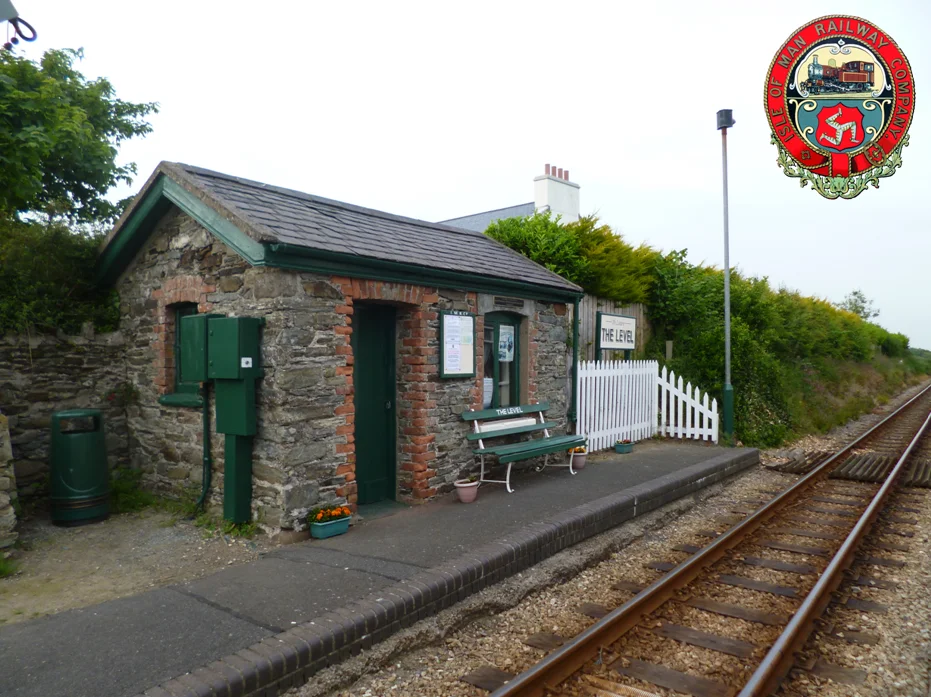

The Level Railway Station
The Level is named after a hole in the ground that nobody can find anymore. Somewhere in the hills above this quiet request stop on the Isle of Man Railway, in country between Colby and Port St Mary, ran the adit of one of the Ballacorkish mine workings - the horizontal entry tunnel that miners called a level, the word that gave its name to the road, the road that gave its name to the railway crossing, and the crossing that gave its name to the seasonally-operated halt where a one-carriage-length platform meets a small lodge painted in uniform maroon. The mine is long gone. The level remains.
Where the Adit Was
Mining was once the dominant industry across this part of the Rushen sheading, the southern administrative division of the Isle of Man. Lead and zinc came out of these hills in the 19th century, hauled to the coast by the same line that now carries summer tourists in Victorian carriages. The Ballacorkish mine near Colby was the main operation, its underground workings reaching out from a series of adits driven horizontally into the slopes. Miners called these horizontal tunnels levels, distinct from the vertical shafts that dropped down to the deeper workings. The local stretch of main road, the A7, ran flat - level - between two such mine entrances, and the name Level transferred from the geological feature to the road to the level crossing where the railway met the road in 1874. The mine workings closed long ago, but the mine ruins are still discernible in the hills directly above the station, faint scars of the industry that named the place.
1874: The Crossing Becomes a Halt
The Isle of Man Railway opened its Douglas-to-Port Erin line on 1 August 1874. At The Level the new line crossed a small road between the main Colby-to-Port Erin road and the coast road past Kentraugh House. Officially this was just a crossing - not a station - but locals immediately began using it as an unofficial stopping place to flag trains down. By 1877 plans were in place for a substantial keeper's hut, followed later by a small lodge house. A gatekeeper lived adjacent to the crossing, often as part of a job specification that combined gate-keeping with another role somewhere else on the line. The lodge had an open coal fire fueled by coal delivered straight from passing trains. Not until 1928 did The Level appear officially in the railway's timetable as a request stop. By then the surrounding hamlets of Croit-E-Caley, Kentraugh, Ballagawne and Ballakillowey had grown around the crossing, and the halt had become an established part of village life.
Names It Was Called
Almost no station on the Isle of Man Railway has been called more different things. Colby Level - in reference to the nearby village, and persistently misleading because The Level is actually in the parish of Rushen, not Colby. Level, on its own. Level (Rushen), to distinguish it from Level Rushen, a separate locality of similar name in the same sheading. Colby Level - Crossing, as a metal nameboard installed in 1973 stubbornly insisted for forty years. The historical research that accompanied the 2013 restoration of the lodge finally settled the question: contemporary documentation supported The Level as the most-used historical title, with the Manx Gaelic Yn Laare added in 2008 when the railway introduced bilingual nameboards across the entire line. All references to Colby have now been removed from official timetabling, partly to honour the historical name and partly because Colby Station itself - a mandatory stop further west - was being confused with The Level often enough to inconvenience passengers.
Manual to Automatic
The 2001 all-island sewerage works, which forced a complete relay of the railway permanent way, brought The Level into the modern era of crossings. Automatic lifting barriers replaced the manually operated gates in 2002 - matching changes happening across the line, with only a couple of crossings retaining their old gates - and the gatekeeper's hut became unstaffed, used only for off-season storage. A single-carriage-length raised platform was installed at the request of a regular passenger, a small dignity unimaginable on a 21st-century mainline railway. The keeper's house adjacent to the crossing had already been sold off in 1972 to private buyers, and now carries the name Station Cottage. The Level Garage, which had operated near the crossing and received motor parts by rail from Douglas as recently as the 1990s, closed in 2000 and has since become housing.
Listed and Repainted
In February 2013 volunteers from the Isle of Man Steam Railway Supporters' Association - the principal volunteer body supporting the line - took on the restoration of the crossing lodge and its environs. They cleaned, repaired, refitted period signage, and used the project to standardise the naming. Later that year the lodge was added to the island's register of protected buildings, recognised as one of the few surviving structures of its kind. The Association came back in July 2020, after pandemic restrictions eased, and gave the lodge a uniform maroon paint scheme, replaced rotting woodwork with the help of the Department of Infrastructure, added traditional concrete plant pots along the platform, and put up a new running-in board to replace the time-expired original. Local residents tend the floral displays in summer. The Level is now a building so small that protecting it costs less than ignoring it would have done, and the railway is wealthier for the care.
From the Air
The Level Railway Station sits at 54.091N, 4.721W in the rural parish of Rushen on the south of the Isle of Man, between Colby station to the east and Port St Mary station to the west. From the air, look for the small road crossing about a kilometre west of Colby village, with the maroon-painted lodge and the single-carriage-length platform alongside the narrow-gauge line. Cruising altitude 2,000-3,000 ft gives a good view of the rural southern parish and the surrounding hill country where the Ballacorkish mine workings once operated. Nearest airport: Isle of Man Airport (Ronaldsway, EGNS) approximately 4 nm northeast.
Nearby Stories
- RAF Jurby Head 14 km away
- German submarine U-246 16 km away
- German submarine U-1051 17 km away
- Kilclief Castle 18 km away
- Ardglass 31 km away
- St Bees Lighthouse 44 km away
- Trwyn Du Lighthouse 54 km away
- Seascale Lifeboat Station 61 km away