.jpg)
The Mumbles Lifeboat Station
There is a wall at the end of Mumbles Pier where the names are remembered. Four men in 1883. Six men in 1903. Eight men in 1947. Eighteen men in total, every one of them a volunteer, every one of them dead because he answered a call. The Mumbles Lifeboat Station has launched into Swansea Bay since 1835, and in 2022 it logged 126 calls, more than any other RNLI station in Wales. The work has not become safer. It has become better equipped, and the crews who pull on their kit when their pagers go off in the middle of the night know exactly what coast they are putting to sea on.
Why a Lifeboat Was Needed
In February 1832 the cutter Ilfracombe Packet ran aground while trying to enter Swansea harbour. A young man named Silvanus Padley, son of the harbour clerk, asked to borrow the Customs Officers' boat to help. He was refused. He broke the lock, took the boat anyway, and rowed out with five pilots to assist the wreck. That incident, and dozens like it, prompted years of petitioning before the Royal National Institution for the Preservation of Life from Shipwreck finally agreed in 1835 to provide a lifeboat for the Mumbles. A 28-foot non-self-righting boat built by Taylor of Blackwall in London arrived that year. It cost £120. There are no service records for it, and by 1851 the Swansea Harbour Trust reported it unserviceable, observing that it had never been regarded as a good boat. Half a century of trial and error followed before reliable equipment and reliable funding came together. The Royal National Lifeboat Institution took over in 1863.
27 January 1883
The first disaster came in the bitter winter of 1883. Wolverhampton, the station's lifeboat, was launched in heavy seas and capsized. John Jenkins, the second coxswain, and crew members William Jenkins, William Henry Macnamara (aged forty), and William Rogers were lost. Macnamara left behind a family. The men were neighbours in a small fishing village; this was not an accident among strangers. The boathouse was demolished and rebuilt at a cost of £350, completed in 1884, and a new slipway followed in 1888. In 1897 the Mumbles Railway and Pier Company built another slipway at no cost to the RNLI when they extended the railway across the headland to reach the new pier under construction. The station kept going. There was no question of stopping.
1 February 1903
Twenty years later, on 1 February 1903, the Mumbles lifeboat James Stevens No. 12 launched to the steamship Christina out of Waterford. The lifeboat capsized in service. Six men were lost. Thomas Arthur Rogers, the coxswain, was thirty-nine. Daniel Claypitt, the second coxswain, was forty-two. George Michael was fifty-one. James Gammon was fifty. Robert Smith was forty. And David John Morgan, forty-nine, had survived the 1883 capsize twenty years earlier. He had been on the boat both times. The 1903 sea took him along with the others. The men of Mumbles village buried half a dozen of their own, again, in a generation that thought it was past the worst of the work.
23 April 1947
The worst was still to come. On 23 April 1947, the American Liberty ship SS Samtampa drove ashore in a gale at Sker Point near Porthcawl. The Mumbles lifeboat Edward, Prince of Wales launched into a force-ten storm to reach her. She capsized and was wrecked. All eight crew aboard her died. William John Gammon, the coxswain, was forty-seven; he had been awarded the RNLI Gold Medal a few years earlier for an extraordinary rescue. William Noel, second coxswain, was forty-two. Gilbert Davies was the mechanic. Ernest Griffin, assistant mechanic, was fifty-two. William R. S. Thomas, the bowman, was fifty. The crew were William L. Howell (thirty-five), William Ronald Thomas (twenty-one), and Richard H. Smith (thirty-five). The Samtampa's thirty-nine crew also all perished that night, including her own master and officers. The Mumbles lost eight of its men and the Bristol Channel lost forty-seven in total. Memorials in Mumbles still mark the date.
Now
The current Mumbles boat is the 16-27 Roy Barker IV, a Tamar-class all-weather lifeboat that entered service in 2014. The station's inshore boat, Hugh, Maureen and Heather Pope, arrived in 2024. In 2015 and 2016 Mumbles was the busiest lifeboat station in Wales, with 83 launches each year. In 2022 it was the busiest station with 126 launches, more than two a week on average. In January 2023, safety concerns about access along Mumbles Pier forced the station building to close; the current pier owners cannot fund essential repairs, and the lifeboat is kept afloat on a mooring for now while the question of what comes next is worked out. Whatever the answer, the boat will keep launching. The work has been going on since 1835, and the names on the memorial wall are the price of doing it.
From the Air
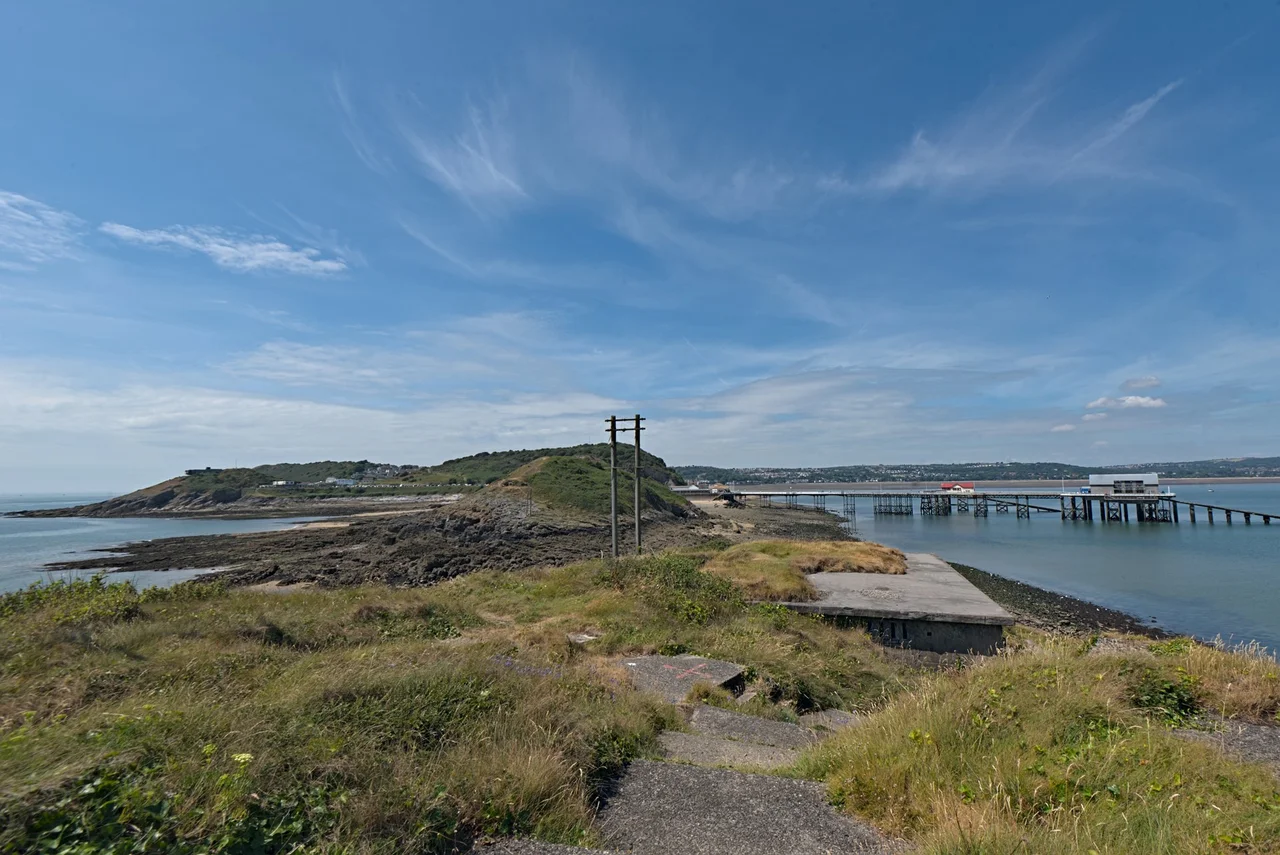
The Mumbles Lifeboat Station is at the seaward end of Mumbles Pier, at 51.5698 N, 3.9741 W in the south-western corner of Swansea Bay. The station sits at the tip of the long Victorian pier, with Mumbles Head and its lighthouse just to the south. Approaching from the east along the Bristol Channel you'll see Port Talbot's industrial works first, then the sweep of Swansea Bay opening westward, then the village of Mumbles tucked at the western corner of the bay with the pier reaching out into the water. Swansea Airport (EGFH) is 4 nautical miles west-northwest on Fairwood Common. Cardiff (EGFF) is 27 nautical miles east. Sker Point, where the SS Samtampa wrecked in 1947, lies 18 nautical miles east-southeast across the bay. Recommended viewing altitude is 1,500 to 3,000 feet.
Nearby Stories
- Dinefwr Castle 2.9 km away
- Cymmer Colliery Explosion 7.7 km away
- Brecon Beacons National Park 8.5 km away
- Caldey Abbey 9.4 km away
- Preseli Transmitting Station 12 km away
- Minehead Lifeboat Station 13 km away
- Ilfracombe Lifeboat Station 14 km away
- Lundy 19 km away