.jpg)
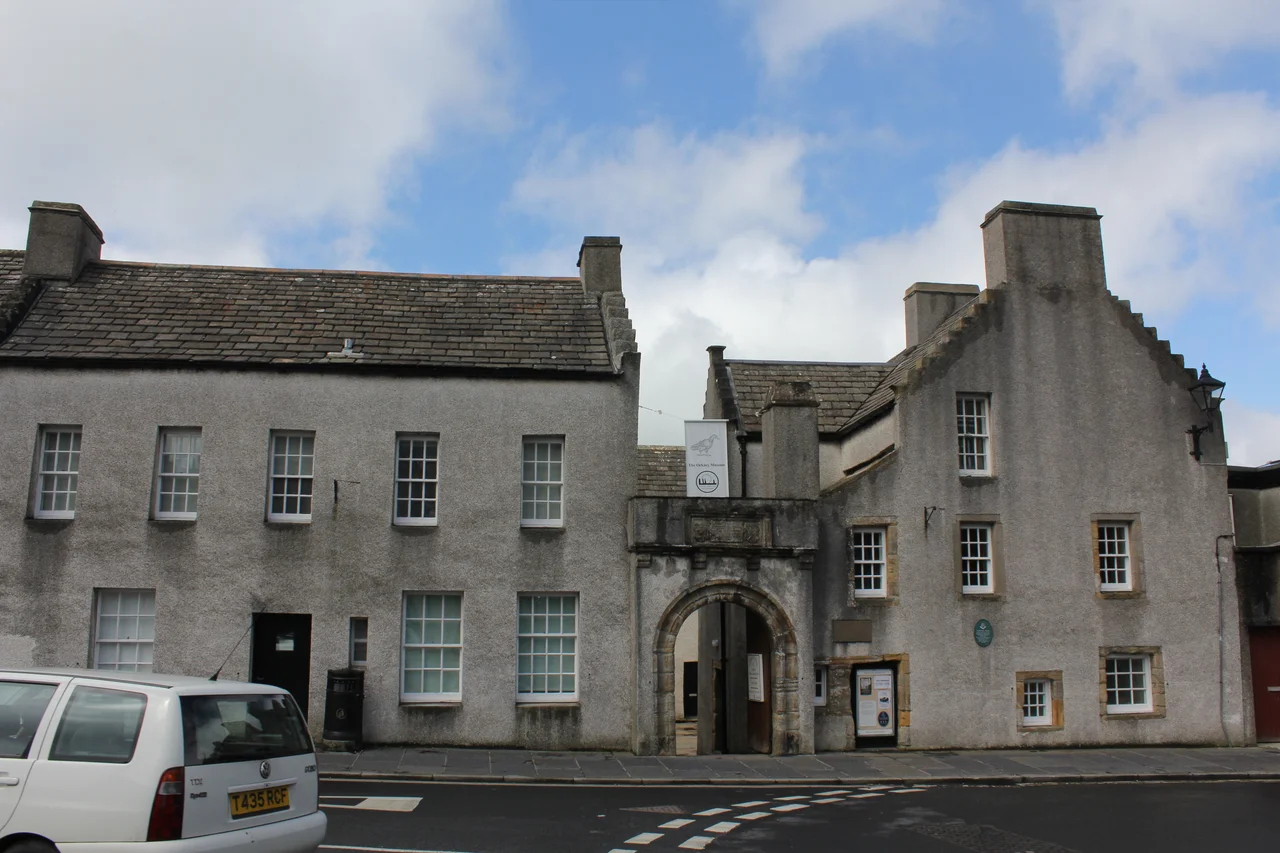
The Orkney Museum
On a bench in the courtyard of Tankerness House, the beggars of Kirkwall used to wait. The archdeacon Gilbert Foulzie had built it for them in 1574, the year he added the east wing to two former cathedral manses and made the place his own. He called it the dole's seat, and the alms he distributed there were part charity, part performance: the rich man's bench, the poor man's queue. The bench is gone now, but the courtyard still curves around the same paving stones, and the building has become the keeper of every story Orkney has to tell.
Layers in Stone
Tankerness House is itself an archaeological site. The north and south wings went up in the 1530s as separate manses for the priests of St Magnus Cathedral across the street. After the Scottish Reformation upended the church, Foulzie purchased the houses from his diminished employer and added the east wing and the Latin-inscribed gateway with his coat of arms. In 1642 his descendants sold the complex to John Baikie of Tankerness, whose family added the west wing in 1680 and the south-west gable in 1722. For three centuries the Baikies lived here, accumulating a library and a drawing room that still survive on display. In 1951 they sold to the local council. In 1968 the building opened as a museum, and in 1999 it shed the Baikie family name for the broader title it carries now.
The Wooden Box
Among the museum's most quietly extraordinary objects is a plain wooden box. It is the box in which the bones of Saint Magnus Erlendsson were once kept. Magnus was the Earl of Orkney murdered in 1117 on the island of Egilsay during a power struggle with his cousin Haakon. His relics were enshrined in St Magnus Cathedral when it was consecrated, and the box held them until 1919, when restoration workmen discovered the bones hidden inside a cathedral column, where they had been concealed for centuries during the Reformation's iconoclasm. The box outlasted the cause it served. It sits now in the museum like a chrysalis whose moth has flown.
Vikings, Picts, and a Plaque
From the Scar boat burial on Sanday came a carved whalebone plaque bearing two dragon heads facing each other: the Scar Plaque, one of the most striking pieces of Viking-era art found in Britain. It dates to the 9th or 10th century and was buried with three people, including a woman dressed in finery whose grave is now the most studied female Viking burial in Scotland. The museum's Pictish collection includes a symbol stone from the Knowe of Burrian, the kind of cryptic incised marker that has provoked over a century of scholarly argument about a culture whose language we cannot read. The Peedie Pict, a small ox-bone figure carved by a Pictish artist on the Burray sands, has the slightly cartoonish features of every prehistoric portrait that survives by accident.
Five Thousand Years
The collection covers Orkney's whole human story, from Stone Age tools made before the pyramids to letters from the wartime sailors of Scapa Flow. Skara Brae artefacts share rooms with crofting tools and printer's type from 19th-century Kirkwall. The trick of the place is its scale: a townhouse small enough to walk through in an afternoon, holding objects that span the rise and fall of civilizations. Outside the door, St Magnus Cathedral fills the view across Broad Street. The Baikie library still has its books. The dole's seat is gone, but you can stand in the courtyard where it once was, and feel for a moment the awkward democracy of a place where the lowest and the highest of Orkney's society used to meet on stone.
From the Air
Located at 58.98 N, 2.96 W, on Broad Street in central Kirkwall, directly opposite St Magnus Cathedral. The nearest airport is Kirkwall (EGPA), about two miles southeast. Best identified from the air by its position relative to the cathedral's polychrome bulk and copper spire; the museum occupies the courtyarded townhouse complex to the cathedral's southwest. View at 2,000-3,000 feet AGL on EGPA approaches.
Nearby Stories
- Pentland Skerries 5.4 km away
- Thurso 13 km away
- HMS Daring (H16) 42 km away
- Wolfburn Distillery 42 km away
- Orcadian Basin 55 km away
- Fair Isle 57 km away
- Jarlshof 119 km away
- The Laki Eruption: The Volcano That Changed World History 941 km away