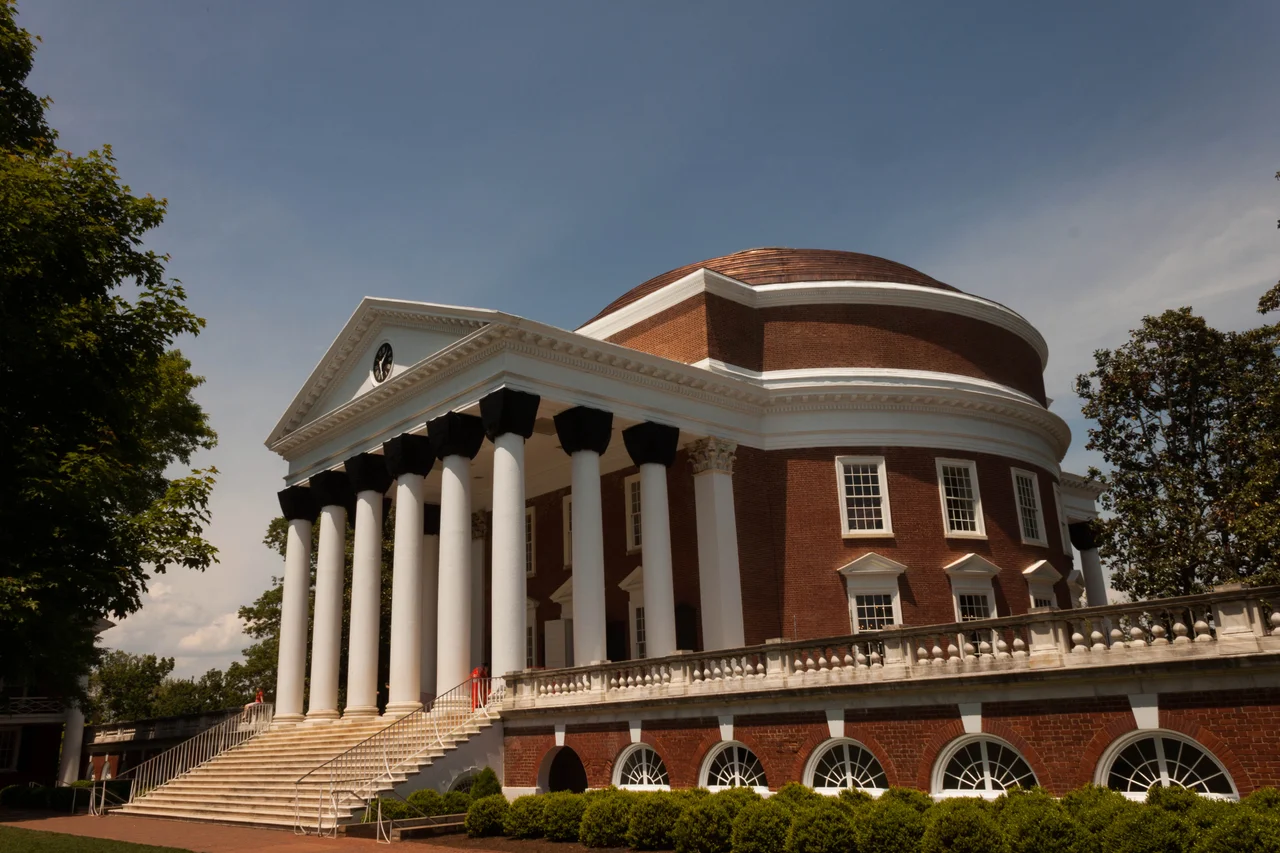

The Rotunda (University of Virginia)
Jefferson built his university around a library instead of a chapel. That choice made the Rotunda what it is: not a place of worship but a building dedicated to what he called the authority of nature and power of reason - knowledge made visible in brick and column at the head of the Lawn. He scaled it precisely. Half the height, half the diameter of the Pantheon in Rome, which meant one-quarter the floor area and one-eighth the volume. Seventy-seven feet across, seventy-seven feet tall. Construction began in 1822, when Jefferson was seventy-nine. He died on July 4, 1826, before it was finished.
A Library for a New Country
When Jefferson founded the University of Virginia, almost every other university in the English-speaking world centered on a chapel. The Rotunda's principal function was to hold the books, and that decision was the building's argument. The columns, the dome, the Corinthian capitals copied from Andrea Palladio's 1721 translation of the Pantheon - all of it dressed up a library and gave it the proportions and gravity normally reserved for a place of worship. The original construction cost $57,773 - roughly a million in 2006 dollars. The cornerstone was laid in 1822. The dome and outer shell were largely complete by 1826. Enslaved laborers cut the bricks, hauled the stone, and raised the building. Jefferson did the drawings. Benjamin Henry Latrobe had proposed the idea in a letter dated July 17, 1817 - a domed central building at the head of the Lawn - and Latrobe's hand can still be read in the design alongside Jefferson's.
Lafayette and the Toast
The Rotunda's first formal banquet took place in the unfinished Dome Room in November 1824. Jefferson was eighty-one. The Marquis de Lafayette, on his grand tour of the United States, sat beside him; former President James Madison sat across. Lafayette raised his glass and toasted Jefferson as the Father of the University of Virginia. The phrase moved Jefferson so much that he asked that it be inscribed on his gravestone. The graveyard at Monticello, four miles to the southeast, still carries the inscription: Father of the University of Virginia, alongside Author of the Declaration of Independence and Author of the Virginia Statute for Religious Freedom. The Rotunda is the only one of the three accomplishments that took the shape of a building.
The Fire and the Argument Over Rebuilding
On October 27, 1895, an electrical fire broke out in the Rotunda Annex, a multi-story addition built in 1853 to handle classroom overflow. The fire spread quickly to the Rotunda itself. A professor named William Reddy Echols hurled a hundred pounds of dynamite into the flames in a desperate attempt to blast the Annex away from the Rotunda. It failed. Students rushed inside and saved Alexander Galt's marble statue of Jefferson, much of the library's books, and the scientific instruments. The wooden dome and most of the interior were lost. The architect Stanford White was hired to rebuild. He simplified Jefferson's three floors into two, enlarged the Dome Room, and replaced the burned wooden dome with a fireproof Guastavino tile shell. For eighty years that was the Rotunda anyone alive had ever known. In 1976, during the United States Bicentennial, the university tore out White's interior and rebuilt to Jefferson's original three-story plan at a cost of $2.4 million. The American Institute of Architects' Bicentennial issue called the result, together with the Lawn and Monticello, the proudest achievement of American architecture in the past 200 years.
The Building That Never Happened
Jefferson had wanted more from the Dome Room than just a reading hall. The university was the first in the country to offer specialization in astronomy, and he sketched plans to paint the inside of the dome as the night sky and then build a mechanism that would let students float through the air on a movable platform - studying the celestial bodies from different vantage points and even controlling their position. It would have been the first planetarium in the United States. The astronomical machinery was never built. The dome stayed plain. But on December 6, 1882, the Transit of Venus was observed from the steps of the Rotunda in coordination with the university's McCormick Observatory. The instinct survived even if the device did not. When the Rotunda was renovated again in 2012, workers discovered a forgotten nineteenth-century chemistry laboratory walled up inside, complete with a chemical hearth and a network of brick ventilation tunnels. It had been sealed during a previous renovation and lost to memory.
What You See From the Air
From the air the Rotunda anchors the north end of the Lawn like a small white drum, the green Lawn running south away from it, the ten Pavilions stepping down its sides. Jefferson placed it deliberately. He left the south end open so that the line of sight ran out across the cultivated countryside toward the Blue Ridge. Stanford White's south buildings closed off that view after the fire, and they still close it; the open prospect Jefferson designed exists now only in his drawings. The Rotunda has stood for two centuries as a model. Duke, Johns Hopkins, MIT, Rice, Vanderbilt, Tsinghua in Beijing, the original University of Alabama - all built their own central domed buildings inspired by what Jefferson placed at the head of his Lawn. The original campus at Alabama was burned in 1865 during Wilson's Raid. The Charlottesville Rotunda has burned twice now and been rebuilt both times. It is still here.
From the Air
The Rotunda stands at 38.0356 N, 78.5036 W, at the north end of the Lawn on the central Grounds of the University of Virginia in Charlottesville. The building is 77 feet (23.5 meters) in height and exterior dome diameter, with a tile dome painted to look like sheet metal. Recommended viewing altitude is 2,500 to 4,000 feet AGL for the best look at the white drum, the rectangular Lawn running south, and the relationship to Monticello on its ridge about 5 nautical miles southeast. The nearest airport is Charlottesville-Albemarle (KCHO), about 4 nm north. Shenandoah Valley Regional (KSHD) is roughly 25 nm west across the Blue Ridge. Mid-morning sun catches the copper details on the lantern; late afternoon throws a long shadow down the Lawn. Mountain wave from the Blue Ridge can produce afternoon turbulence on summer days.
Nearby Stories
- Augusta County Training School 10 km away
- A. P. Hill Boyhood Home 18 km away
- Reddish Knob 20 km away
- Amherst County, Virginia 21 km away
- Appalachian Trail 21 km away
- Fork Union Military Academy 28 km away
- Huguenot Memorial Chapel and Monument 39 km away