
Tianhou Temple (Anping)
Long before Taiwan was Taiwan, when Anping was a Dutch trading post called Fort Zeelandia, a sea goddess arrived. She came, according to temple tradition, in 1661 — carried across the strait by Koxinga himself (also known as Cheng Cheng-kung, his Chinese name), depending on which account you trust. Her name was Mazu, patron of sailors and fishermen, and the temple built to house her statue became the first Mazu shrine on the island. Today the Tianhou Temple, also known as the Kaitai Tianhou, stands in Anping District as one of Tainan's most ancient and active places of worship — open every day from 4:30 in the morning until 10 at night.
A Goddess Older Than the Temple Itself
The primary statue at the heart of the Kaitai Tianhou is said to be more than a thousand years old. It predates the temple, predates Koxinga, predates the entire recorded history of Taiwan as a settled place. Whether she truly crossed the Taiwan Strait in Koxinga's fleet in 1661 — during his campaign to expel the Dutch and reclaim Taiwan for the Southern Ming resistance — or arrived by some earlier route, the statue carries the weight of centuries. Mazu, whose real name was Lin Moniang, was a 10th-century woman from Fujian province believed to have died young but to have continued protecting mariners from beyond death. Fishermen returning from treacherous straits credited her with saving their vessels. Koxinga's soldiers, sailing from the mainland to take Fort Zeelandia, were exactly the kind of people who would have prayed to her and then built her a home when they succeeded.
Miracles at the Water's Edge
Temple traditions collect around old statues like barnacles on a hull, and the Kaitai Tianhou is no exception. Mazu is credited here with multiple recorded interventions: she reportedly appeared in luminous form to guide Anping's earliest Chinese settlers through unfamiliar terrain. During World War II, when Allied bombers struck the Tainan area, the temple survived while nearby structures did not — a fact attributed, by the faithful, to Mazu's protective presence. The statue has been observed producing what devotees describe as miraculous sweat. And in 1990, when fire broke out in the temple, the primary statue emerged unharmed. Each of these accounts has grown into part of the temple's living identity, stories retold by worshippers who pack the incense-thick interior in the early morning hours when the doors open at 4:30 am.
What the Interior Holds
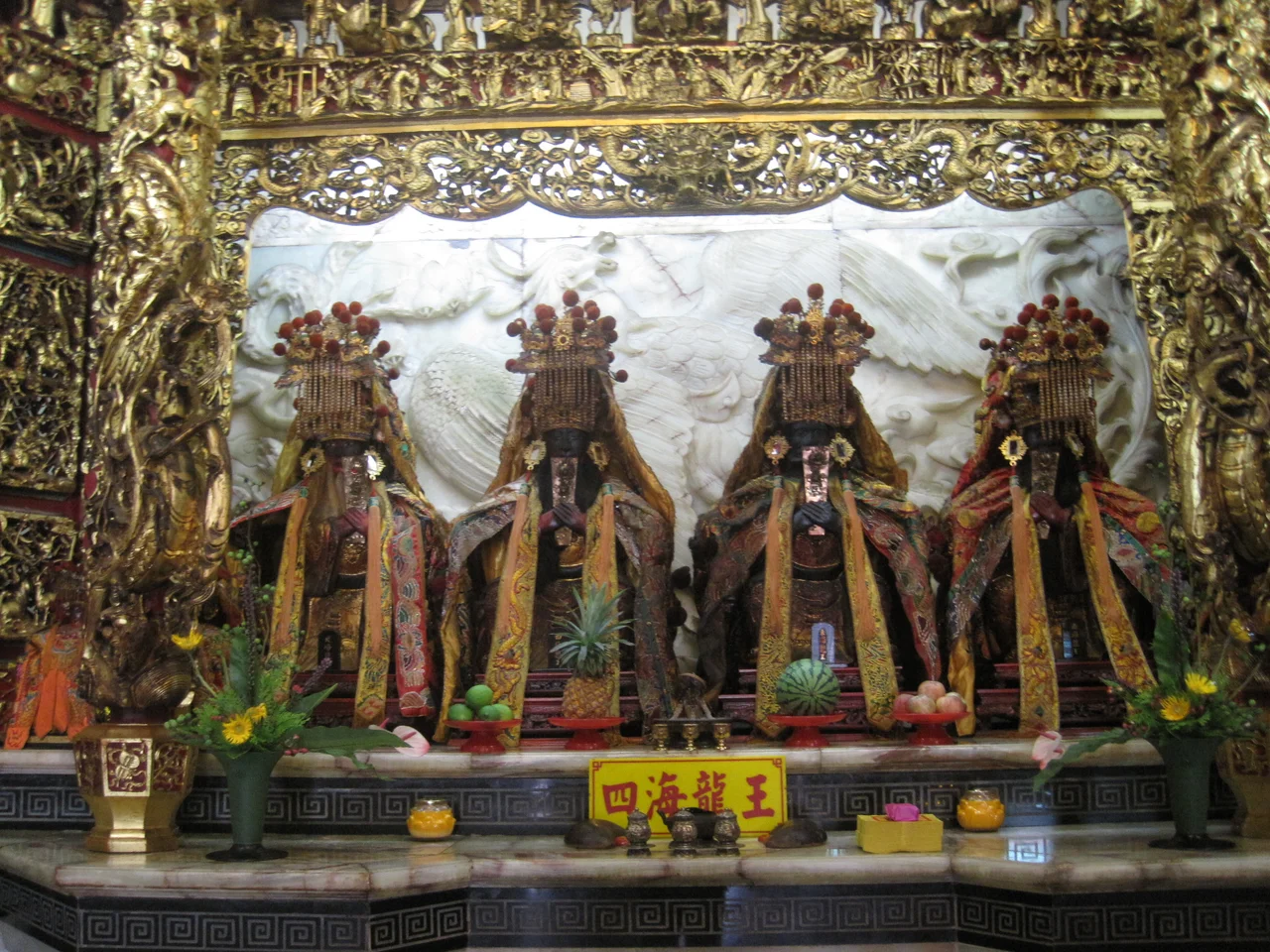
Beyond the main altar where Mazu presides, the temple houses a remarkable cast of divine figures. The Stone Generals flank the entrance — stern protectors rendered in weathered stone. Inside, the Dragon Kings of the Four Seas represent the elemental forces of the ocean that Mazu has always governed. The Five Kings of the Water Immortals add another layer to the temple's theological complexity, a reminder that Taiwanese folk religion synthesizes Taoist, Buddhist, and local traditions into something altogether its own. The architecture itself reflects Anping's long history as a port and trading district: the ornate roof ridges, the curved eaves, the layered detail of tile work all speak to craftsmen who inherited traditions from Fujian and then adapted them across several centuries of practice on Taiwanese soil.
Anping, Gateway and Palimpsest
The temple does not stand alone. Anping is one of Tainan's oldest neighborhoods, built over the ruins of Dutch Fort Zeelandia and shaped by every wave of settlement since. Walk a few blocks in any direction and you pass historical markers for the Dutch colonial period, Koxinga's siege works, and the Japanese-era streets that reorganized the whole district again after 1895. The Kaitai Tianhou is the neighborhood's spiritual anchor through all of it. Generations of fishing families, merchants, and now tourists have oriented themselves by the temple's red lanterns and the smell of incense. The daily schedule — 4:30 am to 10 pm, seven days a week — is not ceremonial convenience but practical necessity for a congregation whose working lives have always been tied to water, weather, and the goodwill of a goddess who has been watching over this coast for more than three hundred years.
Arriving by Air
From the air, Anping District appears as a dense urban grid pressed against the southwestern coast of Taiwan, directly facing the Taiwan Strait. The temple sits at approximately 23.001°N, 120.161°E, nestled within the low-rise fabric of the old port neighborhood. Kaohsiung International Airport (RCKH) lies about 25 kilometers to the south-southwest; Tainan Airport (RCNN) is closer, roughly 6 kilometers to the east. Descending toward either airport, the flat coastal plain of southwestern Taiwan spreads wide below — the reclaimed mudflats, the fish ponds, and the winding estuary channels that make this coast feel barely tamed. Tainan's urban center rises in the middle distance, and Anping juts toward the sea on its western edge, the red roof of the Kaitai Tianhou distinguishable from low altitude on a clear day.
From the Air
Located at 23.001°N, 120.161°E in Anping District, Tainan, on the southwestern coast of Taiwan. Nearest major airport: Kaohsiung International (RCKH), approximately 25 km south-southwest. Tainan Airport (RCNN) is closer at roughly 6 km east. Best viewed from 2,000–3,000 feet on approach to RCNN. The coastal plain here is exceptionally flat, with fish ponds and estuary channels visible from low altitude. The Anping neighborhood's dense red-roofed buildings stand out against the surrounding wetlands.
Nearby Stories
- Chung Li-ho Museum 0.7 km away
- Jingzaijiao Tile-paved Salt Fields 8 km away
- Wanchin Basilica of the Immaculate Conception 9.3 km away
- Namasia District 16 km away
- Battle of Penghu 21 km away
- Shoushan (Kaohsiung) 21 km away
- Penghu Air Raids 62 km away
- Daya Bay 512 km away