.jpg)
Timoleague
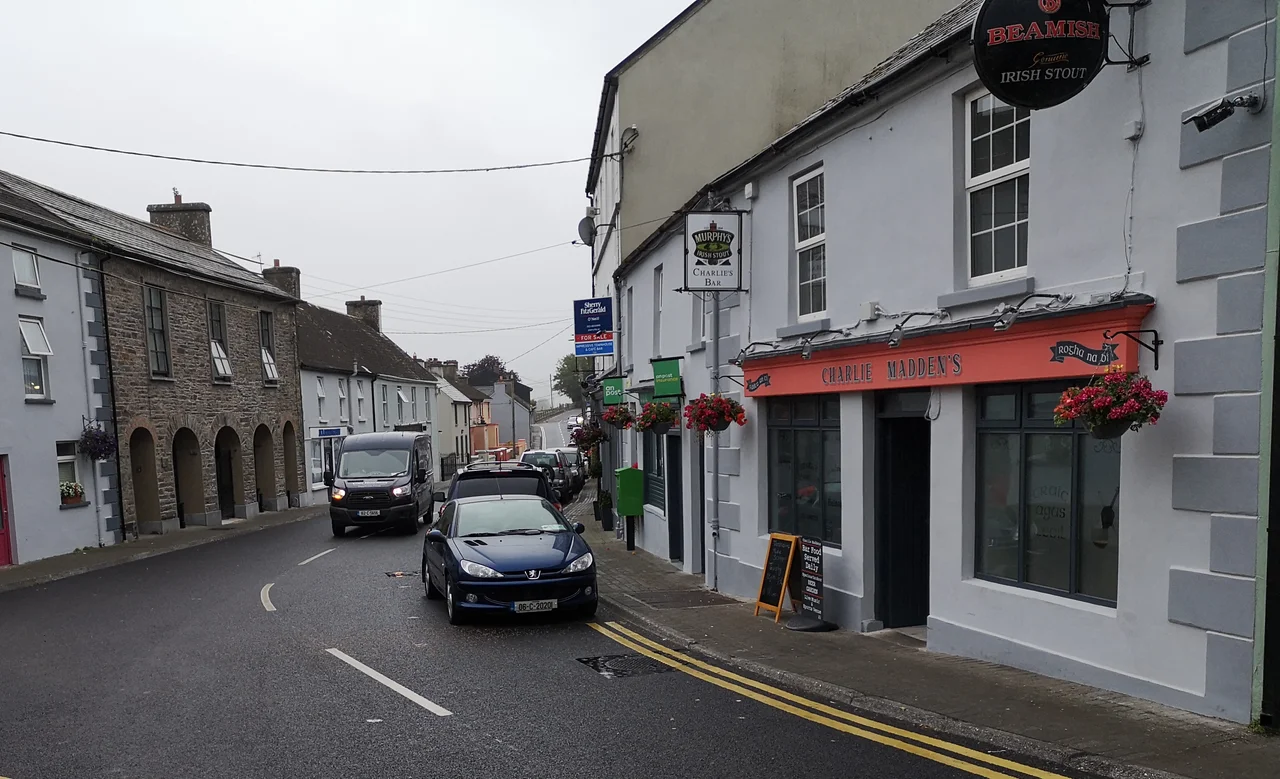
On the road from Kinsale to Clonakilty the bay opens suddenly to the right, the Argideen River widening into a long mirror of estuary mud and sky, and a roofless medieval tower stands directly at the water's edge. That is Timoleague - or rather, that is what most people see first. The village itself is small, a single core gathered on the R600 along the estuary's southern bank. The friary is its public face, but Timoleague's surprises are smaller and stranger than the abbey: a sixth-century beekeeping saint, a parish priest beaten to death over tithes, a Polish 21st-century majority, and a blood pudding that holds protected status under European law.
House of the Bee Saint
The Irish name is Tigh Molaga - 'Molaga's House' - and Saint Molaga is reputed to have brought beekeeping to Ireland. Honey is still produced in the area today. He chose this estuary site in the 6th or 7th century, founding the monastic settlement that the Franciscans built over six centuries later. The village name has been spelled many ways across the records - Tagumlag, Tymulagy, Tymoleague - all of them a slow drift toward the modern form. Before the Normans, the land belonged to the O'Cowigs. With the Norman invasion came the Hodnetts, an English family from Shropshire who settled here, and the Barrys. In the reign of Henry III the two families fought a battle at Timoleague: Lord Phillip Hodnett against Lord Barrymore. The Hodnetts were routed, their leader killed. The Barrymores took possession and held it through their descendants until the 1800s, when the Travers family bought the estate.
Murder over Tithes
In 1832 the parish priest of Timoleague, the Reverend Charles Ferguson, was murdered when he tried to collect tithes by force. He was beaten to death in a field near Bandon, his skull so badly broken that he was 'almost unrecognisable'. Ireland's Tithe War - a slow-burning resistance to the Church of Ireland tax imposed on a mostly Catholic countryside - had reached its violent peak in those years. Ferguson was buried, no one was definitively convicted, and the church he served (the Church of the Ascension, just up the road from the friary) carried on. The murder is one of the only entries in Timoleague's official history that is told with no romance and no candle on a sheaf of corn - just a priest, a tithe, and a rock.
Two Abbeys, One Maharaja
Timoleague has not one but two medieval ecclesiastical ruins. The Franciscan friary, founded around 1240 by the MacCarthy Reagh family and later patronised by Donal Glas McCarthy and others, is the larger and the more famous. The friars were dispersed by the Reformation, returned in 1604, were sacked in 1612 when English soldiers smashed every stained-glass window, and were finally burned out for good by Lord Forbes in 1642. Two miles east, on the road to Courtmacsherry, are the ruins of Abbeymahon - a Cistercian abbey founded in 1172 by Dermot MacCormac MacCarthy, King of Desmond. And in the village itself, the small Church of the Ascension (built 1811) holds intricate mosaic decoration, much of it paid for by the Travers family - and one wall completed in 1925 by the then-Maharaja of Gwalior, Madho Rao Scindia, in memory of his Cork-born doctor Aymler Crofts, who came from Timoleague. Three faiths and three eras of patronage - Cistercian, Franciscan, Church of Ireland - within a few miles of estuary.
Brown Pudding and a Polish Quarter
Modern Timoleague does small things stubbornly. Timoleague Brown Pudding - a type of blood sausage made by Staunton's Foods in the village - has been granted Protected Geographical Status under European Union law, meaning it can only legitimately be made here. The Argideen Rangers GAA club won the Cork Intermediate Hurling Championship in 2005 and has lifted multiple Junior titles. The Timoleague Harvest Festival fills the village each August. Tim Severin, the British explorer who recreated St Brendan's voyage by skin-boat across the Atlantic in 1976-77, lived locally until his death in December 2020. Fachtna Murphy, born in Timoleague in 1947, served as Garda Commissioner from 2007 to 2010. And then there is the demographic detail that surprises most outsiders: in the 2011 census, Timoleague had the highest proportion of Polish residents of any settlement in Ireland, at 25 percent of the population. A medieval Franciscan friary, a Mughal-funded mosaic, a Cistercian ruin, an Antarctic-era explorer's last home, and a Polish neighbourhood - all in a village you can walk across in fifteen minutes.
From the Air
Located at 51.65 N, 8.77 W in West Cork, between Kinsale and Clonakilty along the R600 coastal road, on the southern bank of the Argideen River estuary. The friary's bell tower is the dominant feature visible from low altitude (1,000-2,500 ft). About 48 km from Cork city; nearest airport is Cork (EICK), 26 nm to the northeast. The whole village, friary, and Church of the Ascension can be seen in a single frame at 3,000 ft.
Nearby Stories
- Ballymaloe House 1.3 km away
- Ballincollig Castle 2.8 km away
- Skibbereen 9.8 km away
- Ballyvourney 10 km away
- Ballycotton 27 km away
- HMHS Llandovery Castle 53 km away
- Wolfpack Prien 74 km away
- SM U-27 85 km away