
Tomb of Khải Định
Most emperors leave behind tombs that look like the kingdoms they ruled. Khải Định left behind a tomb that looks like the kingdom that ruled him. Rising in tiers from Châu Chữ mountain, 8 kilometers south of Huế, the Ứng Mausoleum blends Baroque balustrades with dragon-scale rooflines, concrete battlements with lacquerwork altars, French Romanesque arches with Vietnamese guardian statues. The result is unlike any other imperial tomb in Vietnam — not quite Eastern, not quite Western, but unmistakably the work of a man who spent his reign navigating the narrow space between two worlds.
The Emperor Between Two Worlds
In 1916, Khải Định ascended to the throne of the Nguyễn dynasty under circumstances that stripped the title of much of its meaning. His predecessor, the emperor Duy Tân, had been exiled to Réunion Island by the French colonial government after participating in a resistance movement. Khải Định, by contrast, worked closely with France — so closely that by the end of his reign, critics described him as little more than a salaried employee of the colonial administration. He was the last Nguyễn emperor to commission a dynastic tomb, and the decision said something about his character: even under French dominance, he wanted a monument that would outlast him. Before his death he visited France, and the European architectural influences he encountered there became visible in every tier of the structure he designed. Historians note that taxes rose substantially during his reign, and debate continues over how much of the increase was directed toward funding the tomb's construction — estimated to have taken eleven years, from 1920 to 1931.
Mosaic, Porcelain, and Glass
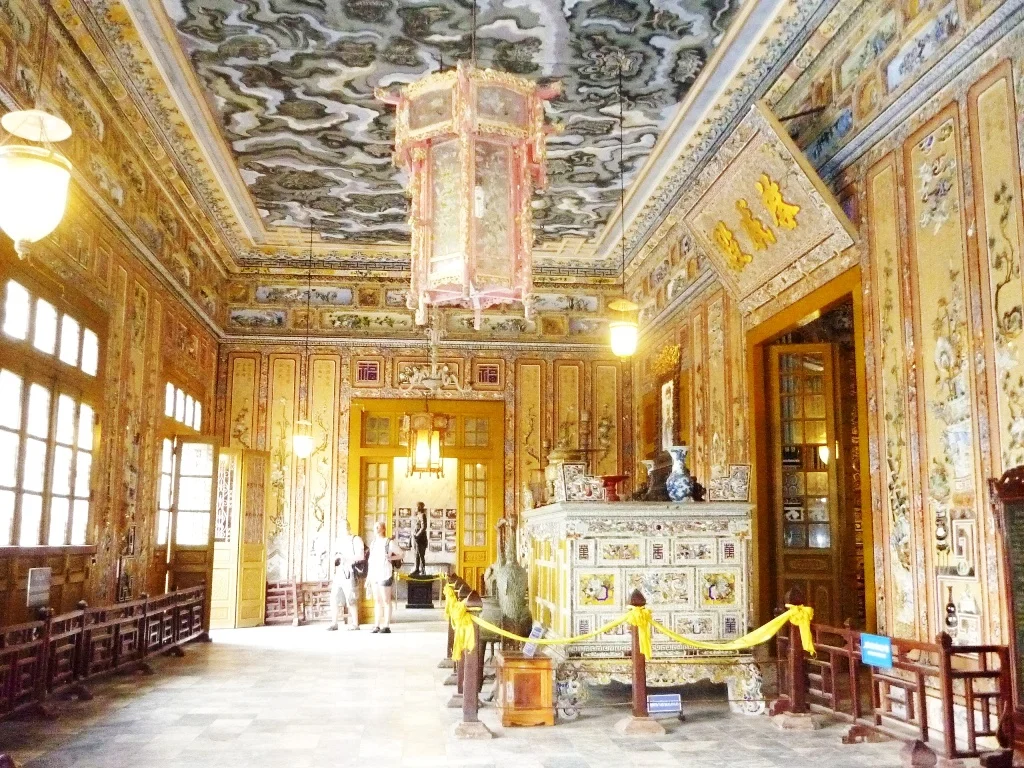
What sets Khải Định's tomb apart from those of his predecessors is the surface of it. Where earlier Nguyễn tombs favored subdued elegance — garden pavilions, pine forests, lotus ponds — the Ứng Mausoleum covers nearly every inch of its interior walls with intricate mosaics of broken glass and porcelain. Artisans embedded fragments of Chinese ceramics, French china, and colored glass into the concrete walls to create patterns of dragons, phoenixes, and clouds. The effect is dense and shimmering, more encrusted than serene. In the left hall, a collection of Khải Định's personal memorabilia survives: photographs, gifts from the French government including silver dinner sets and bejeweled ornaments, and a life-size bronze statue of the emperor himself — 160 centimeters tall, cast in full imperial regalia, carrying a sword. The statue is so realistic in bearing that it has the quality of a man frozen mid-ceremony, neither fully present nor fully gone.
The Last of the Dynasty
Khải Định died in 1925, six years before his tomb was completed. His son, Bảo Đại, oversaw its finishing — and would himself become the last emperor of Vietnam, abdicating in 1945 when Hồ Chí Minh declared independence. The Ứng Mausoleum thus marks not just the end of one life but the final monument of a dynasty that had ruled Vietnam since 1802. Designated a UNESCO World Heritage Site in 1993 as part of the Complex of Huế Monuments, the tomb now draws visitors who come partly to admire its technical audacity and partly to puzzle over what it reveals: a man who accepted the diminishment of his role with enough equanimity to spend eleven years building a legacy in stone, glass, and borrowed styles.
Form and Contradiction
Standing at the top of the staircase — 127 steps, flanked by stone mandarins, horses, and elephants in the traditional guardian arrangement — you feel the contradiction most acutely. The courtyard layout follows the classical Vietnamese formula for imperial mausoleums. But look up at the main hall and the skyline is interrupted by Baroque towers, crennelated parapets, and decorative elements that could have come from a provincial French château. Scholars call this blend "Indochine" style, a collision that was happening across colonial Vietnam in public buildings, train stations, and villas. Here, though, it appears on an emperor's tomb — which means it will endure. The mists that sometimes settle over Châu Chữ mountain soften the visual argument somewhat. In that light, the mosaic surfaces catch and scatter the gray sky, and the whole structure seems less like a statement about cultural compromise and more like something genuinely strange and genuinely beautiful.
From the Air
The Tomb of Khải Định sits at approximately 16.3986°N, 107.5880°E, on Châu Chữ mountain about 8 km south of central Huế. Approaching from the north along the Perfume River corridor at 3,000–5,000 feet, the terraced structure is visible against the hillside. The nearest major airport is Phú Bài International Airport (VVPB), approximately 8 km to the southeast. The city of Huế's grid and the Citadel walls are visible to the north; the Perfume River provides a clear navigational reference running northeast toward the coast.
Nearby Stories
- Battle of Fire Support Base Ripcord 4 km away
- Sơn Trà Mountain 5.8 km away
- Quảng Trị Citadel 7.3 km away
- Battle of Nam Dong 10 km away
- Hội An wreck 56 km away
- Battle of Cua Viet 65 km away
- Saravan 100 km away
- Hainan Island Incident 342 km away