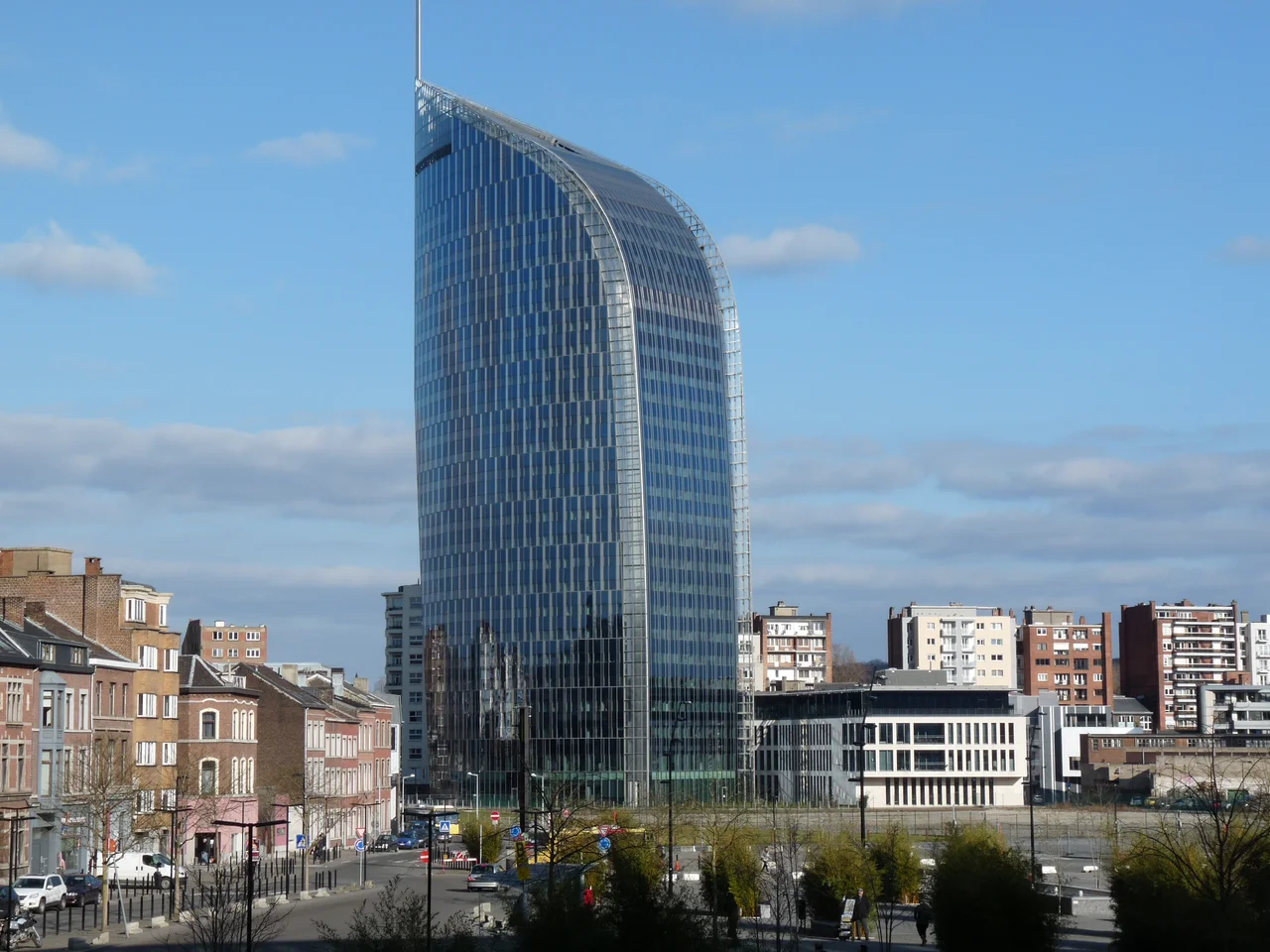

Tour Paradis
From the platform of Liège-Guillemins railway station - itself a Calatrava-designed vault of glass and white steel - the eye is pulled across the esplanade to a single curving slab of concrete and photovoltaic glass that looks like an iron stood on end. This is Tour Paradis, 136 meters tall including its 18-meter spire, the tallest building in Belgium outside Brussels and the only skyscraper in Wallonia. Inside, on a typical mid-2020s weekday, more than a thousand desks for Belgian Federal Pensions Service employees sit largely empty - the tower opened in 2015, and within five years a pandemic had taught the civil service that home offices worked too. The locals, who had lodged 87 formal objections against the building before it was approved, now had a different argument: who exactly was paying the lease on all that vacant floor space.
Why Liège builds up
Wallonia's other cities - Namur, Charleroi, Mons - spread sideways. They have room. Liège does not. The old industrial city sits in a tight bend of the Meuse, hemmed in by steep terrain and short on flat land, but with an urban area of more than 600,000 people, the third largest in Belgium after Brussels and Antwerp. Since the late 1930s, the city's answer to depopulation and to its partial destruction in two world wars has been to build vertically. The Belvedere went up in 1963, the Atlas in 1978, the Simenon in 1963, all clustered along the quays and the Avroy-Sauveniere axis. None of them, however, dominate the skyline the way the Tour Paradis does, because none of them sit in the deliberately staged urban axis that runs from the new Guillemins station through Place Pierre Clerdent and out across the La Belle Liegeoise footbridge to La Boverie Park.
The argument behind the curve
The federal Buildings Agency wanted to consolidate the Finance Department's Liege offices out of an asbestos-ridden building on the spot where Calatrava's esplanade was going. The first competition in 2007 was canceled on a procedural mistake - no European-level call for tenders had been published. The 2008 rerun left only two viable bids: the developer Fedimmo with a tower at the end of the esplanade, and the Belgian national railway, SNCB, with a more modest block of flats on the Rue du Plan Incline. SNCB's planning certificate arrived with a list of conditions so impossible that the company withdrew. Fedimmo won. Then 87 residents objected, mostly about the tower's bulk. The Walloon Region required redesigns: the tip had to be reoriented away from neighboring buildings, and the train-facing facade had to grow more pronounced curves. A new permit issued in 2012 finally let construction begin, after which SNCB and the residents both appealed to the Council of State, halting work for four months.
Engineering the half-oval
What got built between March 2012 and December 2014 looks, depending on the angle, like a half-oval, an iron, or a boat tipping back toward the sky. The structure is reinforced concrete, with prefabricated floors, beams, and columns made of C80/95 high-performance concrete - so strong that engineers had to recalculate deformations after every pour, because the columns and central core shrank at slightly different rates. The 95-million-euro building rises from a shale bedrock twelve meters down, with pumps in the basements working against the seepage of a water table fed by the nearby Meuse. Two cranes, 151 and 131 meters tall, were anchored to the building as it rose. The dynamic wind study calculates that the top of the tower can sway up to 10.25 centimeters in heavy gusts - one one-thousandth of its above-ground height - producing a peak acceleration the occupants would barely register.
An empire of empty desks
On 12 December 2014, the Federal Buildings Agency took possession of a 52,946 square-meter tower on a 27.5-year lease. Floor 1 became classrooms; floors 2 through 17 and 20 through 25 became offices; 18 and 19 stayed undefined. Some 1,124 civil servants were to work there, generating roughly 5.9 million euros in annual rent. Then COVID-19 arrived. By 2022, Belgian media were reporting that the tower stood between 60 and 80 percent empty on a typical day, as Federal Pensions Service employees took up the federal government's encouragement to work from home. The lease ran on regardless. Across the Meuse, Nicolas Schoffer's cybernetic tower from 1961 - a 52-meter open frame of moving panels and lights - watches the newer giant from a quieter park. The Guillemins tram line, opened in April 2025, now glides past Tour Paradis where the buses used to.
What the tower replaced
Building the Guillemins district cost some heritage. In 2017 the Rigo House, listed as Walloon heritage, was demolished directly across from the Finance Tower because it sat in the way of the development plan and, increasingly, in the way of the future tram line. The decision drew the kind of slow Liegeois anger that turns up in editorials for years afterward. The building of a single skyscraper - the project, the appeals, the lost neighbors, the half-empty floors - has become a fair summary of what Liege does when it tries to remake itself: it argues at length, builds something genuinely ambitious, and then watches the world change underneath it. The Cite ardente, the fiery city, keeps adjusting.
From the Air
Located at 50.63°N, 5.57°E in the Guillemins district on the right bank of the Meuse in Liege, southern Belgium. At 136 meters including spire, the half-oval tower is the unmistakable silhouette of central Liege from any direction. Nearest airports: Liege Airport (EBLG), 8 km west; Maastricht Aachen (EHBK), 30 km north. Approach can be hazy along the Meuse valley in autumn.
Nearby Stories
- Limburg (Belgium) 4.7 km away
- Herbesthal railway station 5.9 km away
- Castle of Westerlo 12 km away
- Heinsberg-Lindern Railway 14 km away
- Ad's Path 20 km away
- Marcinelle Mining Disaster 35 km away
- Fort Jeanne d'Arc 148 km away
- Basilica of Saint-Pierre-aux-Nonnains 157 km away