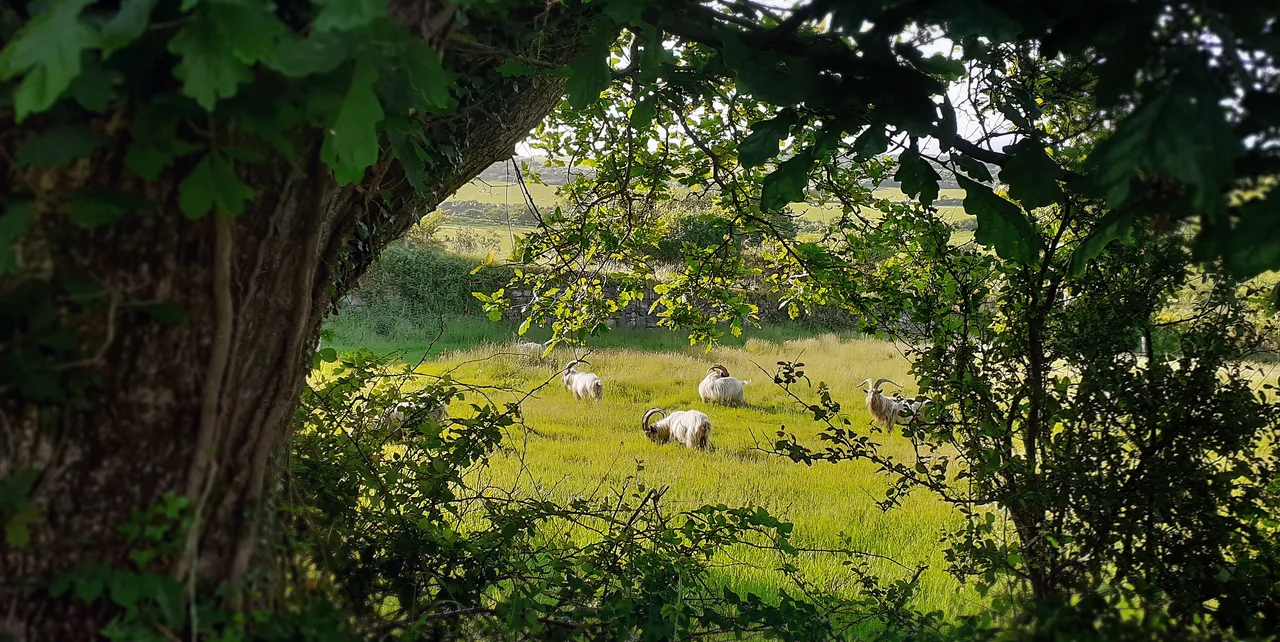

Trefor, Gwynedd
The granite under Trefor's hillside is one of two stones in the world that the World Curling Federation will let you slide across competition ice. The other comes from Ailsa Craig in Scotland. Everything else -- ordinary granite, ordinary stone -- behaves wrongly under the strange physics of a curling sweep. The quarry above Trefor that produced this Olympic-grade rock opened in 1850 and closed in 1960, and most of the village beneath it grew up to support the work. Today fewer than 1,100 people live here, in a village wedged between Caernarfon Bay and the steep north face of Yr Eifl.
Y Gwaith Mawr
The locals called it Y Gwaith Mawr -- the Large Works. Trefor Granite Quarry, sometimes called Yr Eifl Quarry, opened in 1850 on the seaward flank of Garn For, the lowest of the three peaks of Yr Eifl. By 1865 a narrow-gauge railway ran from the quarry down to a pier on the shore, where conveyor belts loaded crushed granite onto ships bound for harbours along the British coast. The work shaped the village. Houses, chapels, a school, a shop, a football team -- everything that defines a small Welsh coastal village -- arose because men needed somewhere to live near the quarry. When industrial extraction ended in 1960, the buildings came down, the rubble was buried or pushed into hedges, and most of the rails were pulled up and re-purposed as fence posts. Walk through Trefor now and look at the posts: many of them are old quarry track, hammered into the ground a lifetime ago.
The Olympic Stone
The granite at Trefor has a specific microstructure -- coarse-grained, low-porosity, dense -- that means it does not absorb the very thin film of water that forms between a curling stone and the prepared ice in a competition rink. A normal granite stone would slowly soak up water, change weight, and behave unpredictably. Trefor granite glides instead. So does the granite from Ailsa Craig, the tiny volcanic plug in the Firth of Clyde that has been the world's primary source for centuries. When Ailsa Craig stocks ran low and conservation rules tightened around the bird sanctuary on the rock, curling stone makers turned to Trefor as the only other reliable source. Some of the stones used at the curling event at the 2006 Winter Olympics in Turin came from this quarry. The Welsh village beneath Yr Eifl is one of two places where Olympic curling ice is allowed to begin.
Three Peaks at the Door
Yr Eifl rises sheer behind Trefor. Three peaks, often called the Rivals in English -- a corruption of Yr Eifl, which actually means The Fork. Garn For is closest to the sea at 444 metres, scarred where the quarry bit into it. Garn Ganol is the highest at 561 metres, the central peak, crowned with an ancient cairn and the highest point on the whole Llyn Peninsula. And Tre'r Ceiri, 485 metres, holds the Iron Age hill town that gives it its name -- Town of the Giants. From a clear summit you can see Ireland, the Isle of Man, the Lake District, the whole sweep of Cardigan Bay. From the village below you mostly see the steepness of the climb. Wild mountain goats graze the slopes between the peaks. The boulder clay deposited along the shore by the last ice age is still slowly being eroded by Caernarfon Bay; at low tide the exposed grey clay can be dangerous to walk on.
Welsh in the Schoolhouse
Ysgol yr Eifl, the village primary school, had 58 pupils on its rolls in 2023. Nearly nine out of ten of them came from Welsh-speaking homes -- a figure that puts Trefor in the small minority of Welsh communities where the language is still genuinely the first tongue of childhood. The village shop opens twelve hours a day on weekdays, less at weekends. Two local bus operators serve the route; both contract with Gwynedd Council to keep the public services and the school routes running. Writers and musicians have come from the place over the years: Geraint Jones, one of the founders of Cymdeithas yr Iaith Gymraeg -- the Welsh Language Society that fought for legal recognition of the language in the 1960s. The novelist Alun Jones. The poet Guto Dafydd. For a quarry village of a thousand souls, Trefor has carried more than its share of Welsh literary life.
From the Air
Located at 52.99N, 4.42W on the north coast of the Llyn Peninsula, 9 miles north of Pwllheli and 13 miles south of Caernarfon. The three peaks of Yr Eifl rise immediately behind the village -- highest at 561 metres. Nearest airport: Caernarfon (EGCK) about 9 nm northeast. The granite scar of the old Trefor Quarry is visible on the seaward face of Garn For. Best viewed at 2,000-3,500 ft AGL flying along the coast. The small harbour and pier on the bay are landmarks; the A499 traces the coast inland of the village.
Nearby Stories
- GeoMôn 1.9 km away
- Battle of the Conwy 3.2 km away
- Irish Sea Bridge 5.2 km away
- Ysbyty Ifan 10 km away
- Machynlleth 16 km away
- Barmouth Lifeboat Station 23 km away
- Irish Sea 27 km away
- HMS Tyler 32 km away