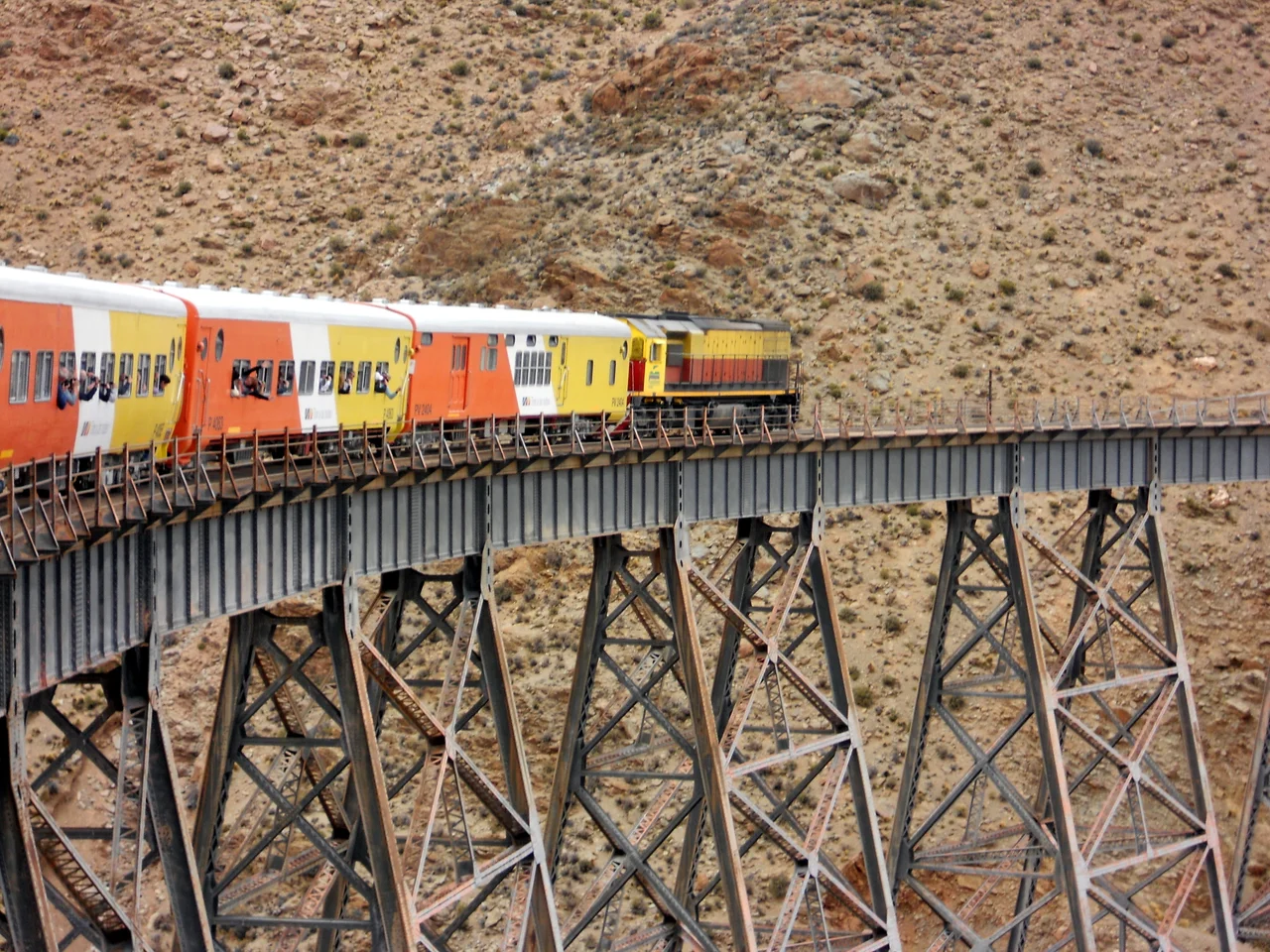

Tren a las Nubes
The name came from a movie. In the early 1960s, students filmed a journey along the Salta-Antofagasta railway, and their footage kept catching the same eerie sight: plumes of white vapor from the steam locomotive billowing up into the frigid mountain air, until the whole train seemed to be swimming through cloud. A documentary built from that film took the name Tren a las Nubes, the Train to the Clouds, and it stuck so well that the railway company eventually adopted it. The image is no exaggeration. This line climbs to 4,220 meters above sea level, high enough that the clouds are often below you, not above.
The Engineer Who Refused the Easy Way
An American engineer named Richard Maury designed this railway, and he made one decision that shaped everything. He refused to use a rack-and-pinion system, the toothed track that lets trains haul themselves up steep mountain grades by brute mechanical grip. Without it, the line could only climb gently, which meant the mountains had to be coaxed, not conquered. Maury's answer was a route of astonishing ingenuity: 29 bridges, 21 tunnels, 13 viaducts, two great spirals, and two zigzags where the train reverses direction to gain height, climbing the mountainside in a slow staircase of switchbacks. Construction dragged through delays and a two-year stoppage. The full railway was finally inaugurated on February 20, 1948. Maury made Argentina his home, and he died in Córdoba in 1950.
Crossing La Polvorilla
The journey's climax is a structure that seems to defy the thin air around it. The La Polvorilla viaduct, completed on November 7, 1932, curves 224 meters across a high desert ravine, its deck suspended some 64 meters above the canyon floor. As the train inches onto it, passengers feel the ground simply fall away on both sides, replaced by open sky and the rust-and-ochre folds of the puna stretching to the horizon. This is the highest point of the line and the reason most travelers come. Pause here long enough and the altitude announces itself: the light is harsh and clear, the breath comes short, and the silence between gusts of wind is total.
From Valley Floor to Roof of the World
The ascent is a study in transformation. Leaving Salta, the route enters the fertile Valle de Lerma, green and cultivated. Then it threads the Quebrada del Toro, a dramatic gorge where the walls close in and the vegetation thins. Finally the land opens into the puna, the bleak and beautiful high-altitude desert of the Andes. Along the way the train pauses at small stops where families from the altiplano lay out artisan crafts and regional food, llama-wool weavings and warm empanadas sold in the cold. The line was never built for tourists. Maury laid it for trade and to connect remote mountain communities, and locals still ride it at reduced fares as ordinary transport.
A Railway That Endures
The Train to the Clouds has survived its own troubles. In July 2014, a train derailed near Abra Muñano before reaching San Antonio de los Cobres, and roughly 400 passengers had to be evacuated. The provincial government, citing safety failures, cancelled its contract with the private operator and brought the service back under state control. The line went dark for eight months while crews restored track and rolling stock, reopening on April 4, 2015. The operation has since contracted. As of late 2025, the train itself runs only the 44-kilometer stretch between San Antonio de los Cobres and the La Polvorilla viaduct, with passengers bused up from Salta and back to reach it.
From the Air
The high point of the line, the La Polvorilla viaduct, sits near 24.20°S, 66.16°W at roughly 4,220 meters (13,850 ft), west of Salta near San Antonio de los Cobres. From the air the railway traces a thin thread through the Quebrada del Toro gorge before emerging onto the pale, treeless puna; the curved viaduct and the zigzag switchbacks are visible against the bare rock. Salta's Martín Miguel de Güemes International Airport (ICAO SASA, IATA SLA) is the regional gateway, roughly 100 km east at the valley floor. Expect strong winds and thin air at altitude; the dry season (April to November) offers the clearest views, with sharp light and deep shadow over the mountains.
Nearby Stories
- Cachi 19 km away
- San Antonio de los Cobres 33 km away
- 1844 Salta Earthquake 36 km away
- San Salvador de Jujuy 39 km away
- Los Cardones National Park 48 km away
- 1692 Salta Earthquake 54 km away
- Ledesma S.A.A.I. 72 km away
- Quebrada de Las Flechas 100 km away