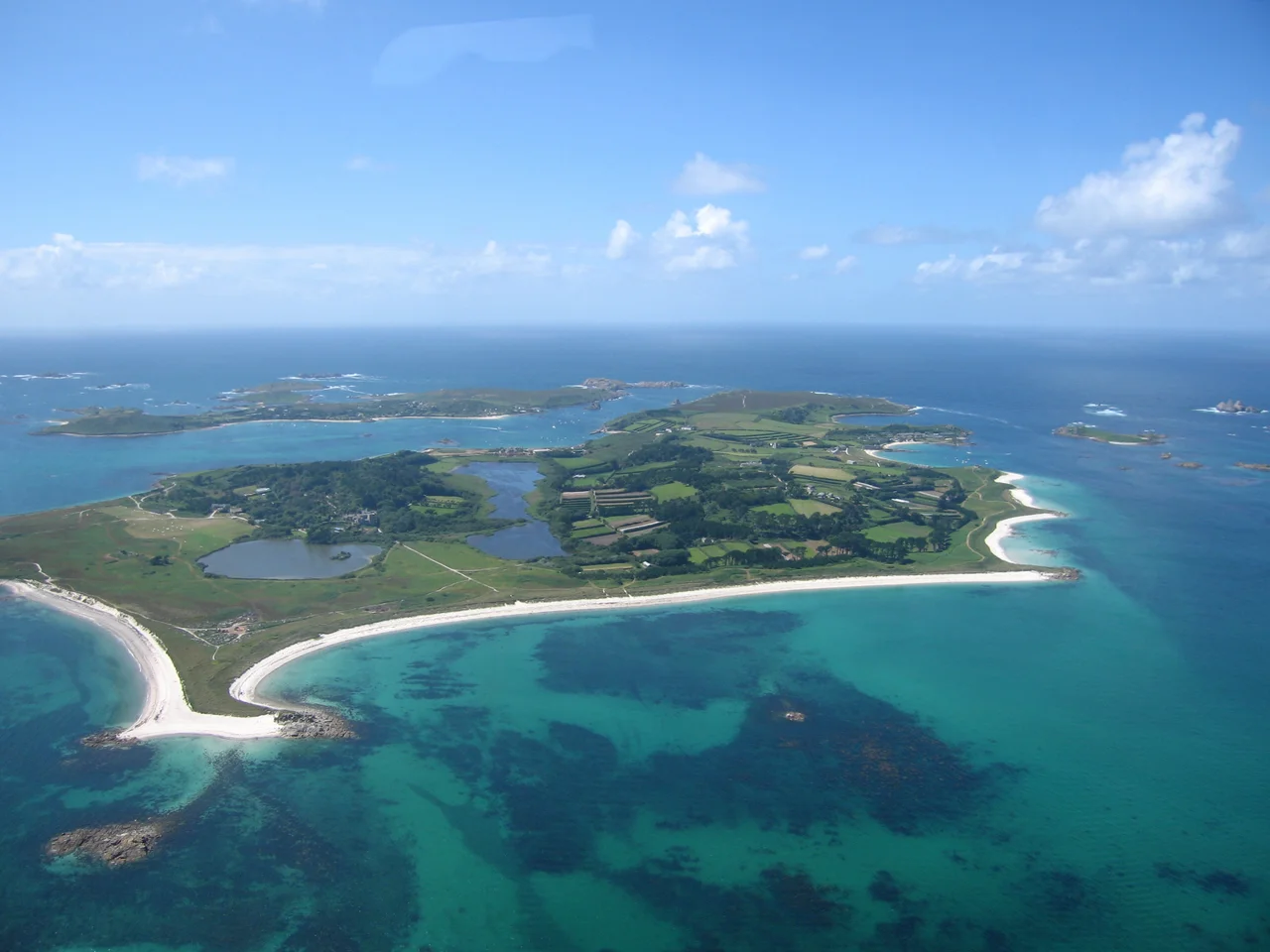

Tresco, Isles of Scilly
There are no cars on Tresco. Electric carts ferry visitors from the heliport and the quays, and the rest of the island runs on bicycles, boots, and the considered slowness of a place where there is nowhere to hurry. Tresco is the second-largest of the Isles of Scilly, leased entire from the Duchy of Cornwall by the Dorrien-Smith family and operated as something between a private estate and a public destination. King Henry I gave the island to Tavistock Abbey nine centuries ago. The current leaseholder is Robert Dorrien-Smith. The continuities here are unusually long.
From Promontory of Sand-Dunes to Iniscaw
The names change as the languages do. In Cornish the island was called something meaning promontory of sand-dunes, including what is now Bryher to the north-west. By 1193, when the island was granted to the Abbot of Tavistock by Pope Celestine III, it was St Nicholas's Island. In 1305 it became Trescau, the farm of elder-trees. By 1540 that had softened to Iniscaw, island of elder-trees. The current spelling appears in an 1814 publication. Each name marks a transition: Celtic to Latin to Cornish to English, hermits to monks to landlords. The island absorbs them all and keeps growing elder.
Tudor Castles, Civil War Ruins
Tresco is studded with fortifications because whoever held it controlled the approaches to the English Channel. The Old Blockhouse, guarding Old Grimsby harbour, dates from between 1548 and 1552 and was fought over hard during the Civil War. King Charles's Castle was built 1550-54, occupied by Royalists, then partially demolished by Parliament to provide the building materials for the lower coastal tower they called Cromwell's Castle, completed in 1652. Oliver's Battery, at the southern tip near Carn Near quay, was thrown up in fifteen days by Admiral Robert Blake in 1651 to bombard St Mary's into surrender. The ruins are still there. They sit in the gorse like punctuation marks left by everyone who thought they had finished the sentence.
The Last Piece of England
Tresco's geography is a small, almost theatrical anthology of Atlantic landscapes. The north of the island is wind-blasted maritime heath on granite outcrops, an SSSI for its lichens and its breeding common terns. The south is sheltered dune and shell beach, where the subtropical Abbey Gardens hold 2,280 species behind their nineteenth-century walls. In between sit New Grimsby and Old Grimsby, the only settlements, each smaller than a village, sharing a single convenience store, an art gallery, two cafes, and a pub, all owned by the Tresco Estate. From 1915 to 1919 the island hosted RNAS Tresco, a Royal Naval Air Service seaplane base; the airfield site was redeveloped in 2007 into Abbey Farm. Helicopters from Penzance now land at Tresco Heliport, year-round.
Vagrants and Vegetations
Because Tresco sticks out into the Atlantic at the western edge of Europe, exhausted migrating birds blow in here and are sometimes the first of their species ever recorded in Britain. The list reads like a roll-call of trans-Atlantic confusion: Common Nighthawk in 1927, Black-billed Cuckoo in 1932, Northern Parula in 1966, Western Sandpiper in 1969, Yellow-bellied Sapsucker in 1975. A Great Blue Heron stayed for 23 days in 2015, visiting Bryher and St Mary's as well. The red squirrels are a deliberate addition: five were flown in by helicopter in 2012, twenty more in 2013, and they have been breeding in the Abbey Woods since 2014. The island is fox-free, grey-squirrel-free, and squirrel-pox-free, which makes it one of the rare safe havens for the species in Britain.
A Place That Performs Itself
Tresco has been on screen and on the page for as long as people have made stories about islands. The 1989 BBC adaptation of The Voyage of the Dawn Treader filmed its Lone Islands scenes here. Joanna Hogg's 2010 film Archipelago, starring Tom Hiddleston, was set on Tresco. Blondie shot the video for Island of Lost Souls on the island in the early 1980s. The novelist Sam Llewellyn, a direct descendant of Augustus Smith, has written several books set in fictionalised versions of his ancestor's island, and Michael Morpurgo's Why the Whales Came draws on the same coast. The 2001-2009 Tresco Marathon ran 7.5 laps around the island for the Cystic Fibrosis Trust. Tresco is small enough to be circled by a runner in a morning, large enough to hold every story it has ever been told.
From the Air
Located at 49.95N, 6.33W, the second-largest island of the Isles of Scilly. Best viewed at 2,000-3,000 ft AGL to capture the contrast between the rocky north and the sheltered, garden-rich south. Tresco Heliport (no public ICAO) is at the south end. Nearest airport is St Mary's (EGHE) 2 nm south-east; Land's End (EGHC) is 28 nm east. The island runs roughly north-south for about 3 km. Cromwell's Castle is the prominent low tower on the west coast facing Bryher; the Abbey Gardens lie at the southern tip.
Nearby Stories
- SS Vigrid 6.2 km away
- SS Georgia (1890) 32 km away
- SS Irma (1905) 35 km away
- 1979 Fastnet Race 45 km away
- Great Wheal Charlotte 53 km away
- SM U-27 55 km away
- Wolfpack Prien 151 km away
- Tower of Hercules 715 km away