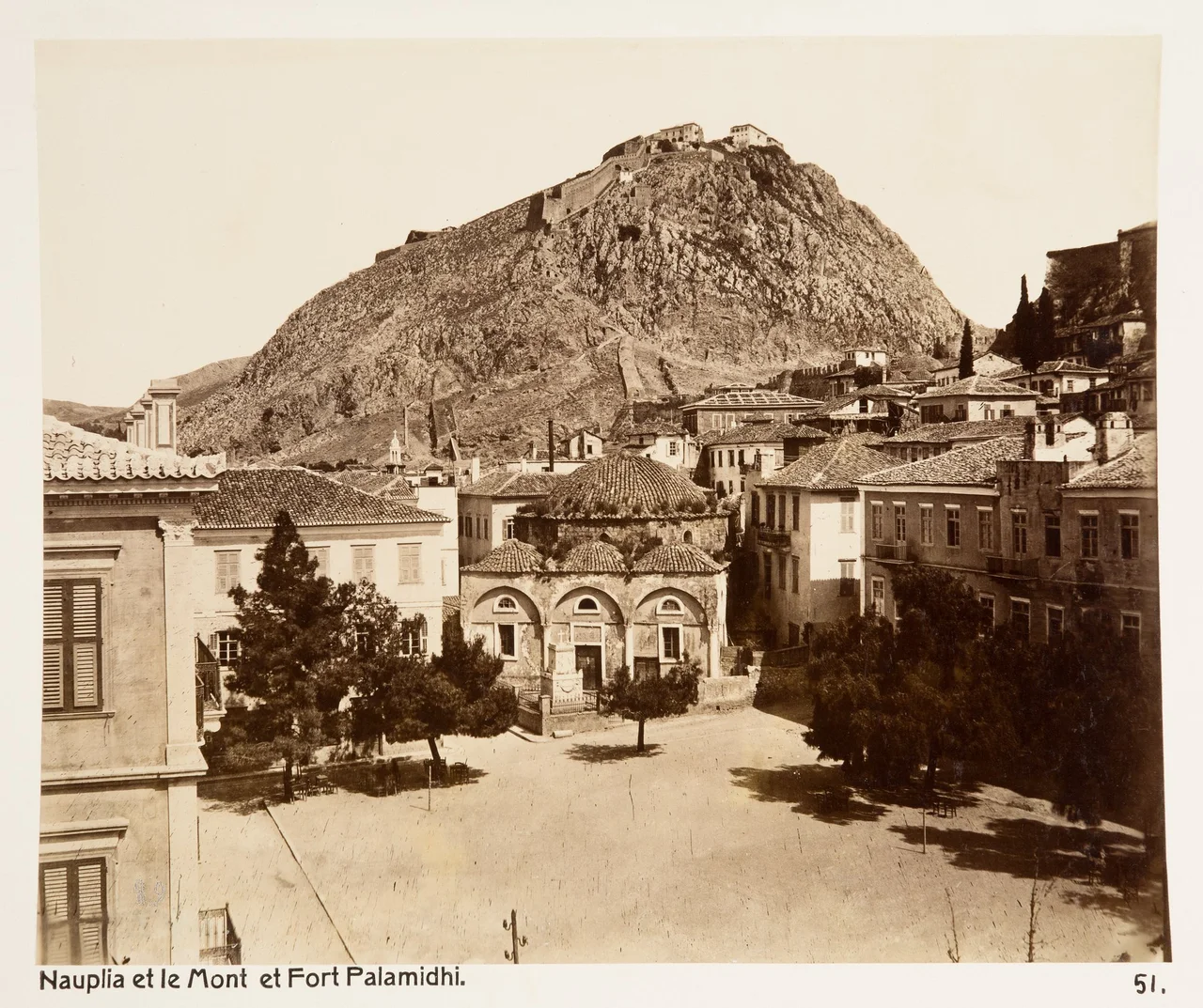

Trianon Mosque
Every empire that passed through Nafplio left its mark on a single modest building at the edge of Syntagma Square. The Trianon Mosque — also called the Old Mosque — was built sometime before the late sixteenth century, when the Ottomans controlled the Peloponnese and this corner of the market quarter belonged to the Grand Vizier. It is the oldest surviving example of Ottoman architecture in Nafplio, and its walls have absorbed the prayers of Muslims, the hymns of Catholics, the lessons of orphaned children, and eventually the flicker of a cinema projector. No other building in the city has changed hands — and purposes — quite so many times.
Built in the Shadow of Empires
The mosque was constructed during the first Ottoman era in the Peloponnese, most likely toward the end of the sixteenth century, possibly shortly before 1666–1667. It stood at the center of the town's market, in the quarter associated with the Grand Vizier and Sultan Ahmed — the commercial and administrative heart of Ottoman Nafplio. The Ottoman traveler Evliya Çelebi, who visited the city, recorded three mosques here, describing them as stone structures with brick domes and stone minarets. The Trianon was one of two that stood on the market square, approximately 100 meters from what is now called the Agha Pasha Mosque across Syntagma Square.
The building's orientation tells its own story: it is aligned with the Qibla at 132 degrees and 44 minutes, pointing toward Mecca in the precise way that Islamic tradition requires. That alignment is among the few original features that survives unaltered. When the Venetians took the Peloponnese in 1687 during the Morean War, the mosque became a church dedicated to Saint Anthony of Padua. Ottoman forces retook Nafplio in 1715, and the building reverted to a mosque. Faiths followed armies.
A New Nation Finds Its Footing Here
The Greek War of Independence changed everything. In the early years of the struggle, the building was repurposed again — this time as the seat of the Charitable Society of Nafplio, an organization that tended to the poor, the sick, and the children who had been orphaned by the fighting. Nafplio was, at that moment, the first capital of the emerging Greek state, and the city's mosques became the unlikely infrastructure of a new nation scrambling to find buildings for its institutions.
After Greece's independence in 1830, the former mosque became a mutual-teaching school for poor families — a system in which older students taught younger ones, spreading basic literacy as widely and cheaply as possible. Ioannis Kapodistrias, the first governor of Greece, personally funded the institution. The man who was trying to build a modern state from the ruins of Ottoman rule was investing his own resources in a converted Ottoman mosque turned schoolroom. The irony was probably not lost on him.
Layers Buried, Layers Covered
The building's architecture reflects its complicated history. The original structure was simple by design: a rectangular plan topped by an octagonal dome, with an arched colonnaded porch sheltered by three smaller domes at the entrance. To the west there was once a small courtyard, now gone. The minaret — no longer standing — was described by Evliya Çelebi as built from stone.
Over the centuries, each new use required modifications that gradually obscured the original form. In 1915, false ceilings were installed, hiding the domes and adding internal staircases and a reinforced concrete mezzanine. The soil level around the building rose over time, burying the lower portion of the walls. The narthex — the columned entrance porch — was eventually enclosed with a wall, further masking the mosque's original appearance. The result is a building that holds its history invisibly, layer by layer, each era's practical needs sealing off the one before.
From Prayers to the Silver Screen
The building's final reinvention was as a cinema — a role it played for decades under the name Trianon, the French word for a small pleasure palace, which became the name by which Nafpliots still know it today. The cinema is gone, and the building now serves cultural purposes, but the name stuck in the way that popular names do: outlasting the function that generated them.
Walking past the former Trianon Mosque today, there is little about its exterior that announces its antiquity. The original Ottoman architectural elements are largely invisible, hidden beneath successive renovations. But the building stands on the same ground where the market of Ottoman Nafplio once bustled, where a church briefly operated during Venetian rule, and where Greece's first orphaned schoolchildren learned to read. Its silence is not emptiness. It is accumulation.
From the Air
The Trianon Mosque sits at coordinates 37.5658°N, 22.7974°E in the center of Nafplio, on the Argolid Peninsula of the Peloponnese. Approaching from the north over the Argolic Gulf, Nafplio appears as a compact town on a narrow peninsula beneath the massive fortress of Palamidi. The nearest major airport is Athens International (LGAV), approximately 120 km to the northeast. Recommended viewing altitude for the Nafplio town center is 3,000–5,000 feet for orientation; the building itself is best appreciated on foot in Syntagma Square. Visibility is typically excellent from late spring through early autumn.
Nearby Stories
- Kastanitsa 2.3 km away
- Heroon at Nemea 3.4 km away
- Psari, Trikolonoi, Arcadia 4.2 km away
- Siege of Gardiki-Arcadia 8 km away
- Cleitor 12 km away
- Troezen 15 km away
- Cave of Euripides 24 km away
- SS Heraklion 94 km away