.jpg)
Trường Tiền Bridge
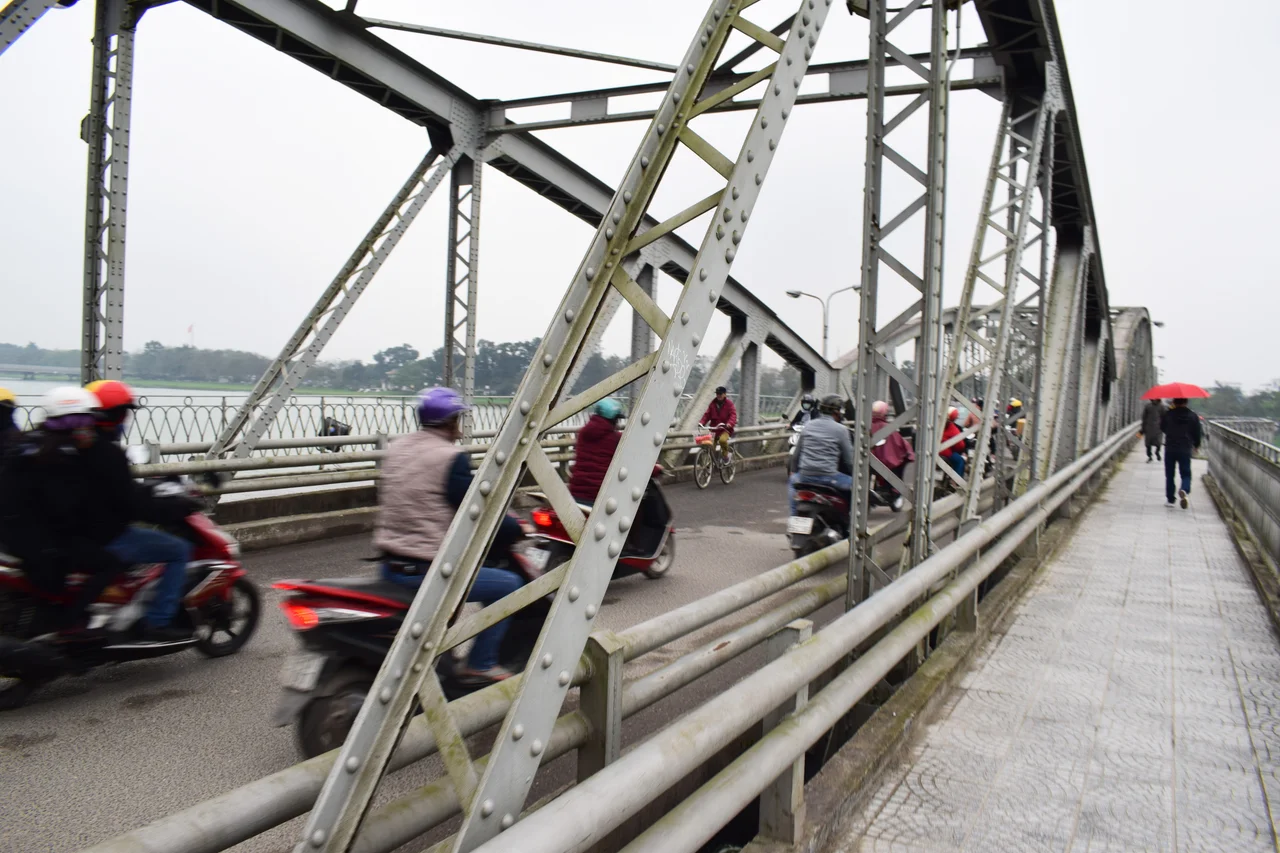
The bridge has been destroyed and rebuilt so many times that Huế residents joke it has had more lives than a pagoda cat. Six Gothic arches of comb-shaped steel girders span 403 meters across the Perfume River, connecting the Dong Ba ward on the north bank to Phu Hoi ward on the south. When the evening lights come on — colorful LEDs installed permanently in 2002 — the arches reflect in the water below and the river becomes a mirror of curves. But behind that quiet beauty is a structure that has been flooded, bombed, collapsed, renamed, and rebuilt across more than a century, each repair leaving another layer in the story of Huế itself.
Steel from France, Silver on the River
In 1897, the French Resident Superior in Central Vietnam commissioned the engineering firm Schneider, Cie, and Letellier to design a permanent crossing over the Perfume River. The groundbreaking took place in May 1899, and the bridge was inaugurated on December 18, 1900, at a cost of 732,456 francs. Its Gothic silhouette — six arches of comb-shaped steel, originally painted silver — made it immediately distinctive in a city of Imperial citadels and Buddhist temples. Huế had its landmark. Within four years, the 1904 Year of the Dragon flood (Trận lụt năm Thìn) caused significant damage, forcing closure and repair; it reopened in 1906 with a concrete road deck replacing the original wooden planks. The bridge was learning, from the beginning, how to survive.
A Name Taken, Then Reclaimed
In 1907, the French colonial government exiled Emperor Thành Thái to Réunion Island — a blunt act of political removal — and marked the occasion by renaming the bridge "Clémenceau Bridge," after Georges Clemenceau, then a rising figure in French politics. The renaming was a small colonial gesture, the kind that placed French names over Vietnamese reality across Indochina. Vietnamese residents continued using their own name for the bridge. When independence came, so did the return of Trường Tiền. The bridge's original name had simply outlasted the decree.
In the 1930s, as rust and traffic loads began to compromise the structure, the Eiffel company — at that point operating as Anciens Etablissements Eiffel — was contracted for a major expansion. Engineer Martin André led the work, which began June 20, 1937, and concluded in November 1939. The upgrade cost 435,000 francs and included reinforced concrete decking, widened pedestrian sidewalks of 1.95 meters, and anti-rust treatment throughout.
The Tet Offensive and the Weight of History
The most devastating chapter came in 1968. During the Tet Offensive, intense fighting swept through Huế over weeks of close urban combat. The bridge, connecting the two halves of the city, became a focal point. It was severely damaged — photographs from the period show it partially collapsed, old and young residents crossing the wreckage or wading through the shallows of the Perfume River to reach the south bank. The people in those images were not soldiers but civilians: families carrying what they could, caught in a war whose scale no single photograph could contain. The bridge that had been a daily crossing became a symbol of the city's devastation. Repairs came in stages, but a long-term rebuilding effort lasting from 1991 to 1995 finally addressed the structural damage comprehensively. In those renovations, the pedestrian balcony pathways were removed, the roadway was narrowed to allow bracing pipes on both sides, and the paint color shifted from the original silver to gray.
Crossing at Dusk
Today the bridge is 6 meters wide — narrow enough that motorbikes stream across in close formation, giving it the slightly chaotic energy of a Huế street translated onto water. Pedestrians take the sidewalks, looking down at the Perfume River flowing green and slow below. At dusk, when the city softens into shades of orange and the first lights come on along the bank, the bridge's colored LEDs begin their nightly display. The arches glow in reflection. School groups photograph it. Couples walk across it slowly. Food stalls set up near the northern bridgehead. Nothing about this evening ritual suggests the collapses and floods and conflicts that preceded it — which is perhaps what a bridge, repaired enough times, eventually becomes: ordinary, necessary, loved.
From the Air
Trường Tiền Bridge crosses the Perfume River at approximately 16.4689°N, 107.5886°E in central Huế. At low altitude — 1,500 to 2,500 feet — the six arches are clearly visible as a distinctive Gothic silhouette against the river. The Citadel of Huế lies immediately to the northwest, providing an unmistakable reference point. Phú Bài International Airport (VVPB) is approximately 14 km to the south-southeast. The Perfume River runs northeast to southwest through the city and is visible from considerable altitude on clear days.
Nearby Stories
- Battle of Fire Support Base Ripcord 4 km away
- Sơn Trà Mountain 5.8 km away
- Quảng Trị Citadel 7.3 km away
- Battle of Nam Dong 10 km away
- Hội An wreck 56 km away
- Battle of Cua Viet 65 km away
- Saravan 100 km away
- Hainan Island Incident 342 km away