
Tryfan
There are two rocks at the top of Tryfan, side by side, each about three metres tall, with a gap of one and a quarter metres between them. The Welsh call them Sion a Sian. The English call them Adam and Eve. To claim the Freedom of Tryfan you have to leap from one to the other. The drop on either side is not survivable. Mountain writer Frank Showell Styles, who knew exactly what he was talking about, called it not too hard a step in calm dry weather, while noting that the penalties of failure are unpleasant in the extreme. Most people who reach the summit choose to look at the rocks and leave them alone.
The Shape of a Mountain
Tryfan is not the highest mountain in Wales. It comes in fifteenth at nine hundred and seventeen and a half metres, three thousand and ten feet, having been resurveyed in 2010 and found to be eight feet taller than the maps had said since the mid-1980s. It is, by general agreement, the most recognisable. The mountain rises in a single near-symmetrical wedge from the southern shore of Llyn Ogwen, a triangular silhouette with a serrated ridgeline running from the lake to the summit. From the A5 road you can pick out every feature, the Milestone Buttress at its foot, the Cannon Stone halfway up pointing at the sky at forty-five degrees, the twin pillars known as Cain and Abel on the south ridge, and finally Adam and Eve on top. Trail magazine asked its readers to name Britain's favourite mountain and Tryfan won. Anyone who has stood at Ogwen Cottage and looked south will understand why.
The Name and the Legend
Tryfan comes from try, an intensifying particle, and ban, a peak or summit. The very high peak. The name describes itself. Arthurian legend names it as the burial place of Sir Bedivere, the knight who threw Excalibur into the lake, the last of the Round Table to leave the dying king's side. There is no body and no grave to find, but the story has clung to the mountain for long enough that it now belongs to it. Welsh hillsides hold more legends than they hold paths, and Tryfan holds its share.
The North Ridge
The classic route up Tryfan is the north ridge, starting from a layby on the A5 about a mile east of the Idwal Cottage youth hostel. You go straight up. There is no path in the conventional sense, just a Grade 1 scramble that becomes harder if you follow the most direct line and easier if you traverse around the steeper sections. The Cannon Stone marks roughly the one-third point, and yes, you can stand on it for the photograph that every Tryfan veteran has somewhere. The upper ridge demands hands as well as feet. In wet weather the rock turns greasy and the holds disappear. Mountain rescue gets called out here often. The view from the summit, when the cloud lifts, takes in the whole Glyderau ridge to the south, the long roll of the Carneddau across the valley, and on a clear day the sea at Conwy Bay.
Climbing Country
Milestone Buttress, the great slab at the mountain's foot, made Tryfan a destination for rock climbers from early in the sport's British history. The Direct Route, seventy-five metres of Very Difficult climbing, was first put up by G. Barlow and H. Priestly-Smith in 1910. It remains so popular that you sometimes have to queue at the base. Tryfan Bach on the other side offers gentler slabs that have introduced generations of beginners to mountain rock. The south ridge crosses Bristly Ridge to Glyder Fach, a magnificent traverse for scramblers who want a long day with their hands on the stone.
The Goats
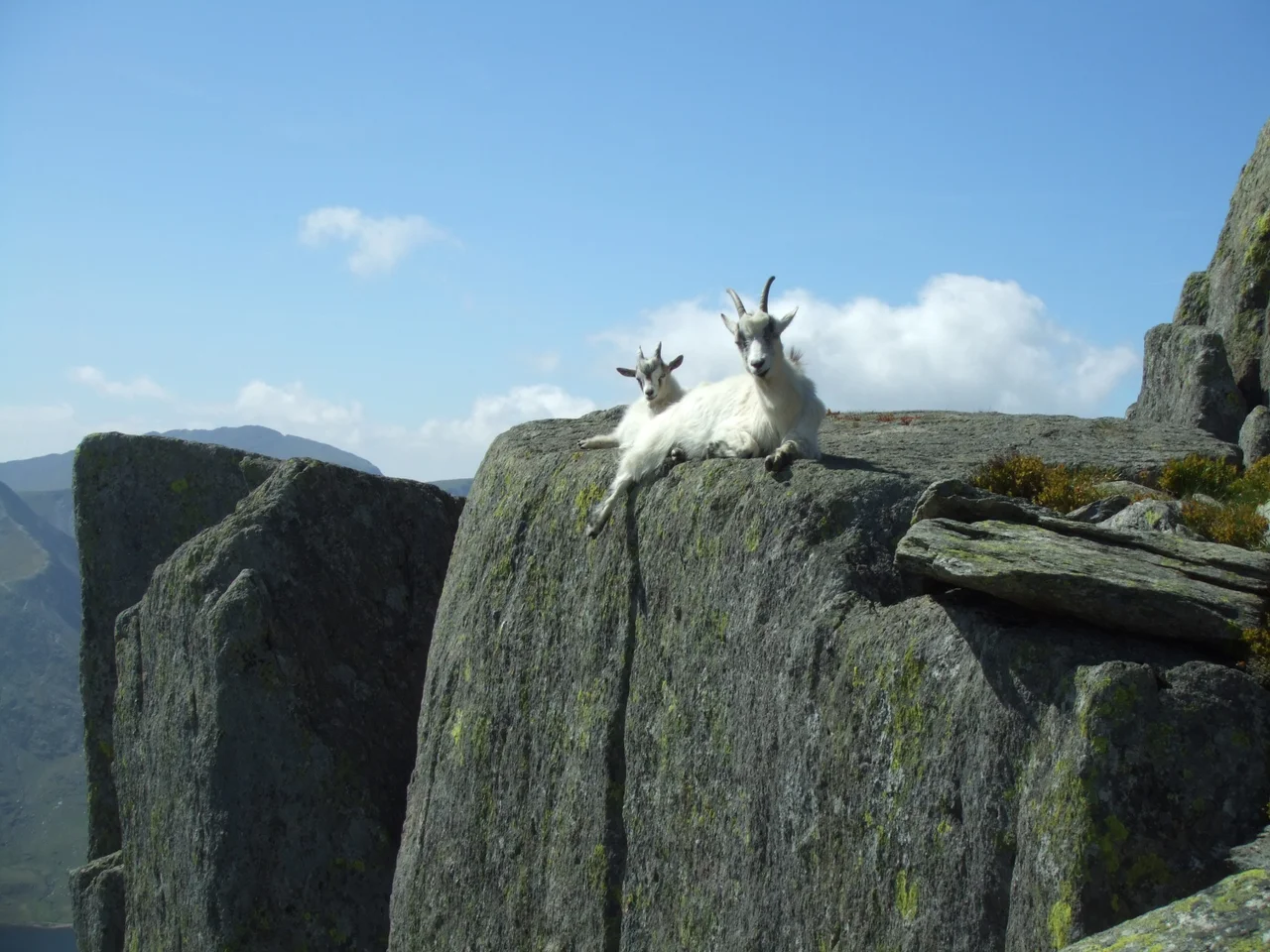
Look for the goats. Feral goats, descendants of domesticated animals that escaped or were turned out centuries ago, live on Tryfan and across the Glyderau. They have long shaggy coats and curving horns and they perch on ledges that no human could reach. They watch climbers thoughtfully and occasionally appear in places that seem geometrically impossible. They have outlasted the slate industry, the railway, two world wars, and every change to the surrounding farms. They will probably outlast the rest of us too. Tryfan is their mountain. We are the visitors.
From the Air
Tryfan rises at 53.11 north, 4.00 west, on the south side of Llyn Ogwen at the head of the Ogwen valley. The summit reaches 917.5 metres, 3,010 feet. The pointed triangular silhouette is the most distinctive single mountain in Eryri (Snowdonia) and reads clearly from any direction. Recommended viewing altitude 5,000 to 7,000 feet to see the mountain against the surrounding Glyderau ridge. Adam and Eve, the twin monoliths on the summit, are visible from the Ogwen valley floor in good light. Mountain weather can deteriorate rapidly. Nearest airports EGCK Caernarfon to the southwest and EGOV Valley on Anglesey to the northwest.
Nearby Stories
- Tudweiliog 3.6 km away
- Denbigh Castle and Town Walls 6.4 km away
- Rhoscolyn Lifeboat Station 7.6 km away
- Butlin's Pwllheli 20 km away
- East–West Interconnector 20 km away
- New Brighton Lifeboat Station 31 km away
- Battle of Oswestry 31 km away
- Celtic Array 44 km away