_-_img_06.jpg)
Từ Đàm Temple
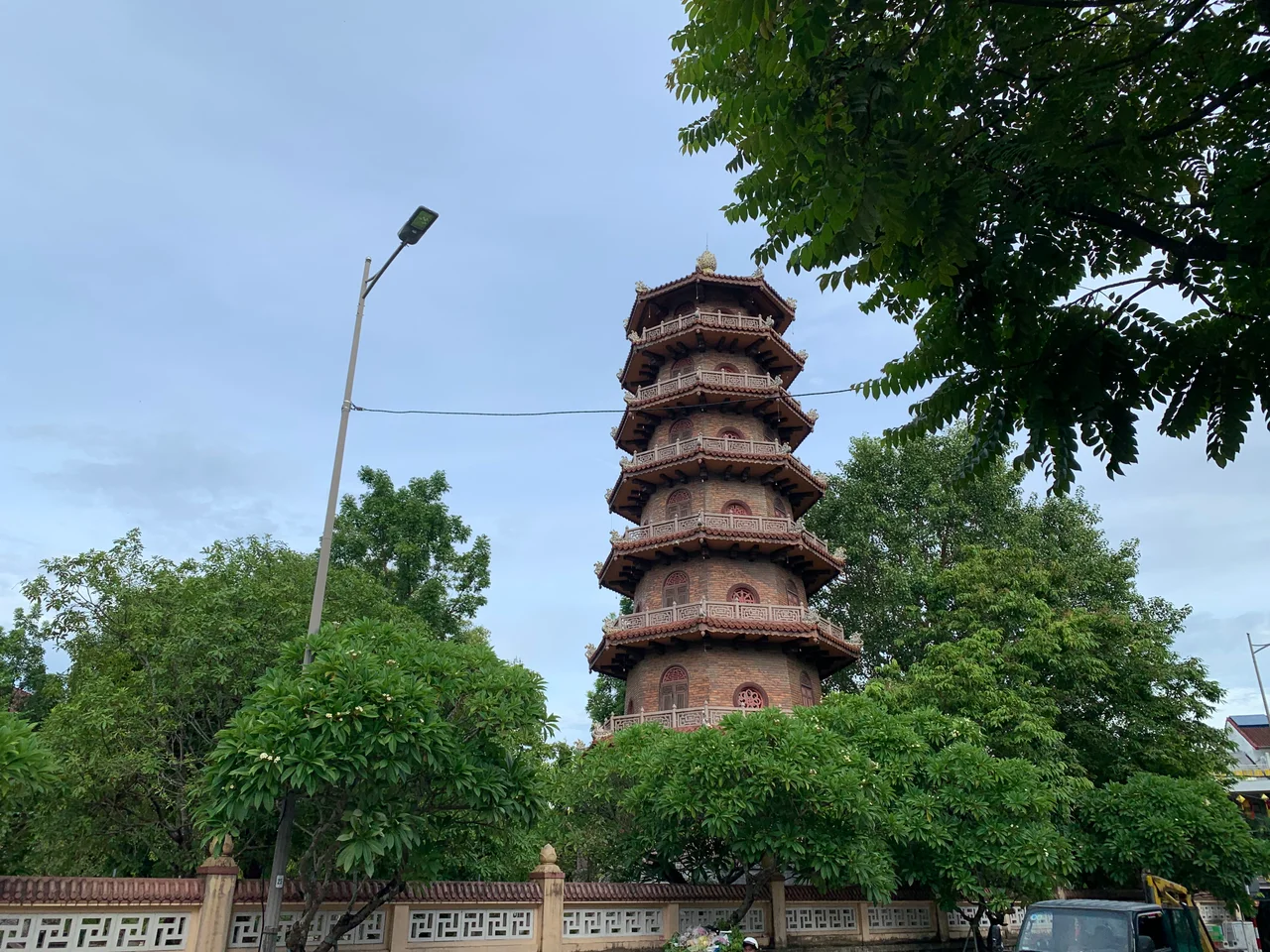
The smoke from the incense at Từ Đàm Temple has been rising for more than three centuries. On Long Sơn hill in the Trường An District of Huế, monks have chanted, administrators have gathered, and pilgrims have come to pray through the reigns of Nguyễn lords, French colonial governors, South Vietnamese presidents, and the unified governments that followed. The temple is still inhabited by monks today and serves as the provincial headquarters of the Buddhist Association — a continuity that is remarkable, given what happened here in 1963.
Three Centuries on Long Sơn Hill
Từ Đàm Temple was built and opened under the direction of Thiền master Thích Minh Hoằng, the 34th in the lineage of the Lâm Tế Zen tradition. Construction took place in the late 17th century under the nominal rule of Emperor Lê Hy Tông, though the region was effectively governed by the Nguyễn lords under Nguyễn Phúc Chu, who ran their domain as an independent state while paying formal allegiance to the Lê dynasty. The temple thus entered the world in a landscape of competing sovereignties — a condition that would recur throughout its history. For centuries it served as a center of Buddhist study and practice in central Vietnam, its position in Huế giving it significance in a city that was both the imperial capital and the spiritual heartland of Vietnamese Buddhism.
A Center of Resistance
By the early 1960s, Từ Đàm had become the most politically charged Buddhist site in South Vietnam. The abbot, Thích Trí Quang, was the leading figure of the Buddhist movement and head of the General Association of Buddhists in central Vietnam. In 1961, the temple administration and the Association for Buddhist Studies organized a major expansion of the temple's facilities, adding buildings to support the growing range of activities the movement hosted. This was not merely spiritual growth — it reflected the temple's role as a gathering place for people who felt the government of President Ngô Đình Diệm was systematically discriminating against Vietnamese Buddhists.
In 1963 those tensions reached a breaking point. Self-immolation had emerged as an extreme form of protest, and on August 16 of that year, an elderly nun set herself alight at Từ Đàm. It was one of several such acts that shook the country and drew international attention to the crisis.
The Night the Pagoda Was Stormed
The political turning point came shortly after midnight on August 21, 1963, when Ngô Đình Nhu — the president's brother and the director of the secret police — sent special forces to raid Buddhist temples across South Vietnam simultaneously. At Từ Đàm, troops set off an explosion that leveled much of the pagoda. Many of the Buddhist monks and laypeople inside were shot or clubbed to death. Thousands of monks across the country were rounded up and detained. The coordinated raids were a deliberate attempt to destroy the institutional infrastructure of the Buddhist movement and silence those who led it. They failed: international outrage intensified, the military turned against the government, and Ngô Đình Diệm was overthrown and killed in a coup less than three months later. The monks who survived at Từ Đàm did not forget what had been done there, or why.
Damage, Memory, and Continuity
The 1963 raids were not the temple's only ordeal. In 1968, during the Tet Offensive, Từ Đàm was heavily damaged again in the fighting that engulfed Huế — damage that, according to accounts from after the war, some portions of the temple still bore unrepaired. In 1966, a bronze statue of Gautama Buddha was cast to replace the one destroyed during the 1963 attacks; the new statue stood as both a restoration and a memorial. The temple today continues its role as the provincial headquarters of the Buddhist Association, its monks maintaining the daily rhythms of prayer and study on the same hill where three centuries of Vietnamese Buddhist history have accumulated. Some of that history is visible in the architecture. Some of it is in the silence.
From the Air
Từ Đàm Temple is located at approximately 16.4514°N, 107.5817°E in the Trường An District of Huế, on the south side of the city near Long Sơn hill. Flying over Huế at 2,500–4,000 feet, the temple compound is visible among the city's residential neighborhoods southwest of the Citadel. The Perfume River runs to the north; the Citadel walls and the flag tower are clear navigational markers. Phú Bài International Airport (VVPB) is approximately 10 km to the south.
Nearby Stories
- Battle of Fire Support Base Ripcord 4 km away
- Sơn Trà Mountain 5.8 km away
- Quảng Trị Citadel 7.3 km away
- Battle of Nam Dong 10 km away
- Hội An wreck 56 km away
- Battle of Cua Viet 65 km away
- Saravan 100 km away
- Hainan Island Incident 342 km away