.jpg)
Tuam Town Hall
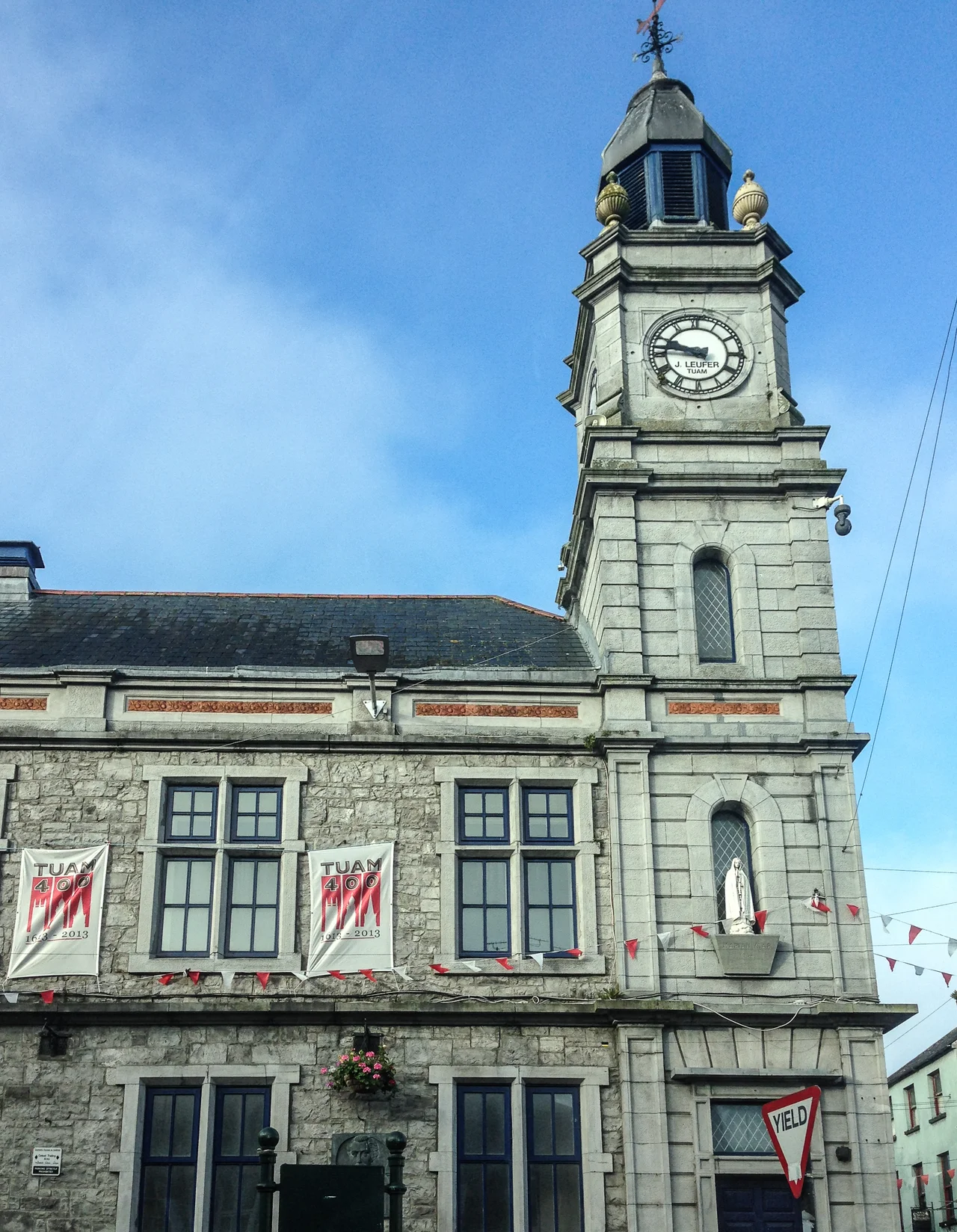
Stand in Market Square in Tuam and the most striking building is not a cathedral or a castle but a town hall: a six-bay neoclassical frontage in coursed limestone, with a four-stage clock tower at one end capped by an octagonal lantern. James Joseph Boylan designed it. The builder Andrew Egan put it up in coursed limestone, completed it in 1857. Sixty-three years later, in July 1920, the Black and Tans set it on fire in retribution for the killing of two policemen in an ambush nearby. The fire gutted the inside but the shell stayed standing. By 1926 the building was fully restored to Boylan's original lines, the clock still on the tower, the lantern still on top.
Before the Hall
There had been a market house on the southwest side of the square since 1700. It was a small arcaded structure - open on the ground floor so the country people could sell their produce out of the weather, with an assembly room above for the use of Tuam Corporation. The Corporation itself was a victim of the Municipal Corporations (Ireland) Act 1840, which abolished most of the old town governments. The market house then sat empty for three years until town commissioners were appointed in 1843. They decided the old building was inadequate and that Tuam needed something more substantial. The local landowner John Stratford Handcock of Carrowntryla House gave them the site on a leasehold at a nominal rent. His wife Elizabeth Penelope Handcock laid the foundation stone on 24 September 1857.
Boylan's Design
The town hall Boylan drew is a careful piece of Victorian classicism. The main block is five bays wide, with mullioned and architraved windows on both floors. The right-hand bay, faced in ashlar stone rather than coursed rubble, carries the four-stage tower, flanked by full-height pilasters. The first stage has a doorway with a rectangular fanlight. The second and third stages hold recessed round-headed lancet windows. The fourth holds the clock faces, with canted corners and finials around them, and an octagonal lantern surmounting the whole tower. At roof level there is a parapet decorated with terracotta panels. The principal interior space was the assembly hall on the first floor. Edward Townsend extended the building by three bays to the south in 1886. It was, in other words, a very respectable mid-Victorian civic statement, well enough made to outlast the country it was built for.
Burned
On 19 July 1920, in the bitter middle of the Irish War of Independence, the Irish Republican Army ambushed and killed two Royal Irish Constabulary officers near Tuam. The reprisal was immediate and brutal. Police auxiliaries, the Black and Tans, set the town hall on fire along with other buildings in Tuam. The fire gutted the interior of Boylan's hall. But the limestone shell stayed up, the clock tower stayed up, and over the next six years the building was completely restored. The work was done so carefully that a visitor today would not know the inside had been ruined, much less in living memory. The reconstruction was finished in 1926, four years after the establishment of the Irish Free State that the killings had ultimately helped bring about.
Plaques
Four plaques have been added to the front of the building in the decades since. The first, installed after John Waldron's death in 1987, commemorates the local historian. In 1998 two more went up: one for the Christian socialist and philanthropist Robert Malachy Burke, who had died that year; the other for Major Richard W. Dowling, the Tuam-born soldier who led Confederate troops to victory at the Second Battle of Sabine Pass during the American Civil War. In September 2017, in the wake of the Charlottesville violence in Virginia, an independent councillor proposed removing the Dowling plaque. The motion was not seconded; a Fianna Fail councillor said the plaque was about Dowling's business career and that Tuam had more important things to worry about. A fourth plaque, installed in 2013, commemorates local service personnel who died in wars foreign and domestic.
Where the March Began
On 26 August 2018, more than a thousand people gathered at the town hall before walking, in a slow vigil, to the site of the Bon Secours Mother and Baby Home a few hundred yards away. The timing was deliberate: while Pope Francis was celebrating Mass in Phoenix Park in Dublin during his Irish visit, the people of Tuam were standing at the spot where 796 children had died and where most had been buried in a disused septic tank. The names of the dead were read out. A sculpture in their memory was unveiled. The town hall was simply the starting point - the obvious civic gathering place, as it had been for 160 years. In 2020 Galway County Council announced it was considering proposals to convert the building, still used for community events, into a permanent arts centre. The clock keeps time over Market Square.
From the Air
Tuam Town Hall stands at 53.515 N, 8.851 W in the Market Square at the centre of Tuam, County Galway. Ireland West Airport Knock (EIKN) lies roughly 50 km north; Galway (EICM) about 30 km south. From the air at low altitude the clock tower is the most identifiable single point in the town centre, with the two cathedrals visible to the north and west. Best viewed in clear weather; the limestone frontage catches afternoon light particularly well.
Nearby Stories
- Marine Institute Ireland 1.8 km away
- Westport 2.9 km away
- Knock, County Mayo 3 km away
- Bellanagare Bog 4.3 km away
- Ballygar 7.4 km away
- Connemara Railway 8.1 km away
- Ardgraigue Bog 16 km away
- Inishmaan 21 km away