
Tugen Hills
Some places keep time better than others. The Tugen Hills, rising above the Kerio Valley in Kenya's Rift, are one of the rare spots on Earth where the rock has saved a nearly continuous record of the last fourteen million years - layer upon layer of ancient lakebeds and volcanic ash, stacked like the pages of a book no one could read until they learned how. Buried in those pages is one of the most important fossils in the story of human origins: a creature that lived around six million years ago and may have stood and walked on two legs long before our better-known ancestors did. Scientists gave it a name in the local Tugen language - Orrorin, "original man."
The Rift's Long Memory
The Tugen Hills owe their existence to the East African Rift, the great tear in the continent where the land is slowly pulling apart. As the rift stretched and dropped, volcanoes erupted and lakes formed and vanished, and each episode laid down sediment that trapped the bones and pollen of its age. The result is the Lukeino Formation and its neighbors, beds ranging back well beyond six million years, recording a world of forests and lakeshores utterly unlike the dry hills that stand there now. For paleontologists, this is the value of the place: not a single dramatic find but a deep, datable sequence, a way to watch an environment - and the animals living in it - change across millions of years.
Millennium Man
The discovery that made the Tugen Hills famous came in the year 2000, when a French-led team headed by Brigitte Senut and Martin Pickford recovered fossils from the Lukeino beds dating to roughly six million years ago. They named the species the following year: Orrorin tugenensis, the second word marking the hills where it was found. The press nicknamed it "Millennium Man" for the year of its discovery. The find was a sensation. At the time it was the oldest hominid ever recovered in Kenya and among the oldest anywhere - reaching back almost to the very split between the lineage that led to us and the one that led to chimpanzees.
Did It Walk?
What made Orrorin so provocative was not just its age but a single, ordinary-looking bone. Its thigh bones suggested that this chimpanzee-sized creature already walked upright - that bipedalism, long thought to be a relatively late hallmark of our family, might reach back six million years, far earlier than fossils like the famous Lucy. The claim stirred fierce debate, as claims about the deepest roots of humanity always do. Pickford himself had reason to keep coming back: he had found a lone fossil molar in these hills decades earlier, in 1974, a tantalizing hint that drew him to return and eventually helped form part of the new species. Among the world's oldest known hominins, only Sahelanthropus from Chad lays claim to being older.
A Crossroads of Evolution
Orrorin is the headline, but it is not the whole story the hills tell. Excavations here, including work by members of the famous Leakey family, have turned up a complete skeleton of a 1.5-million-year-old elephant, an extinct species of monkey, and the remains of hominids from across the last couple of million years. Older still are fossil Old World monkeys dating back more than twelve million years, fragments that help map the long, branching descent of monkeys, apes, and humans. The Tugen Hills are not a museum with neat labels; they are a working archive, much of it still poorly understood, where each new fossil reopens old arguments about who our ancestors were and when they became recognizably like us. Few landscapes on Earth hold so much of the human past in so little ground.
From the Air
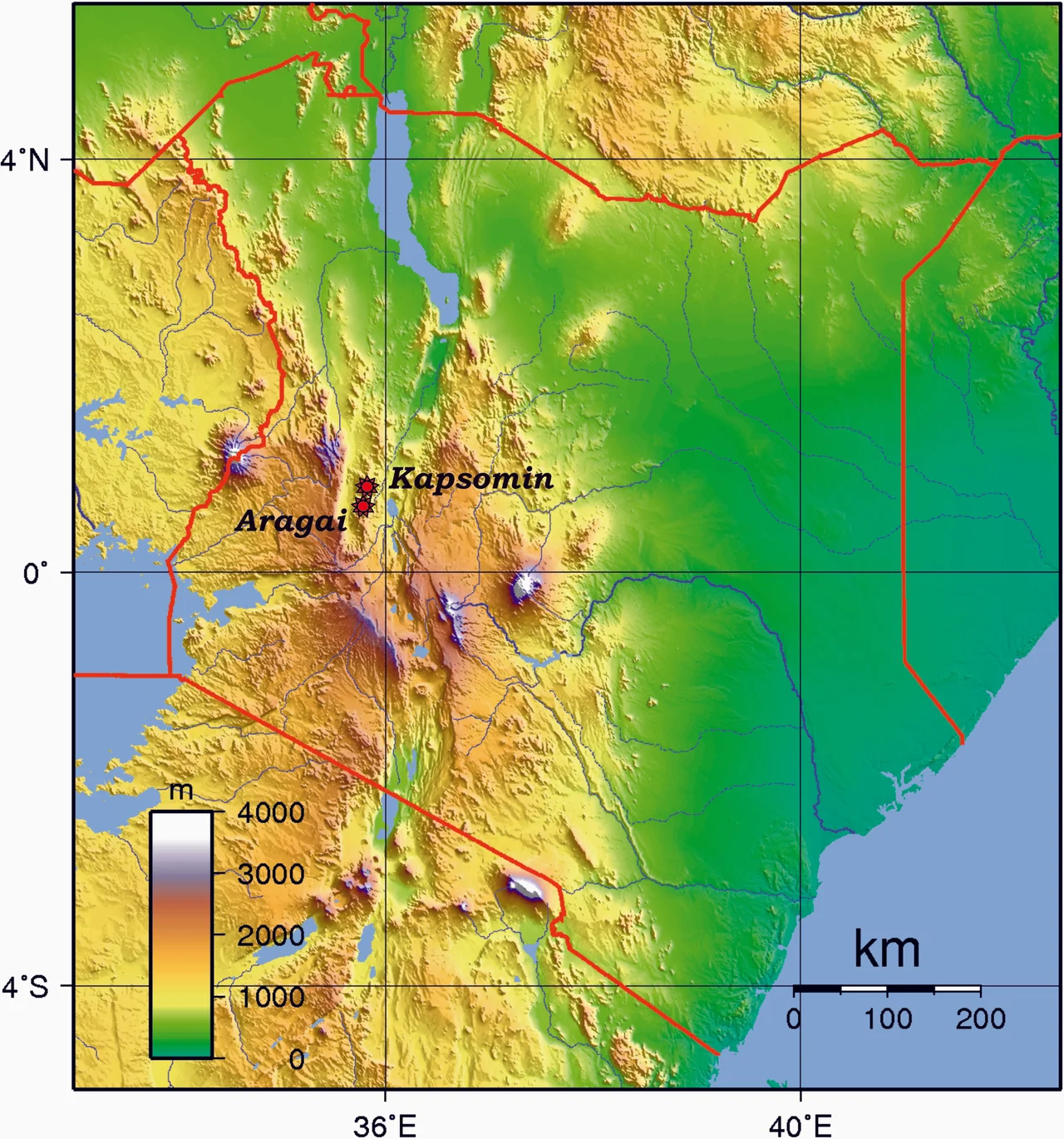
The Tugen Hills run roughly north-south at about 0.75°N, 35.87°E in Baringo County, in the western highlands of Kenya's Rift Valley. From the air, look for the long, fault-bounded ridge rising between the Kerio Valley to the west and the Rift-floor lakes - Baringo and Bogoria - to the east, a classic landscape of rift escarpments and down-dropped basins. The nearest major airport is Eldoret International (HKEL) to the west-southwest; Nairobi's Jomo Kenyatta International (HKJK) lies farther southeast. The highlands are clearest in the morning, with cloud often building over the ridges by afternoon.
Nearby Stories
- Great Rift Valley, Kenya 25 km away
- Eldoret 25 km away
- Cherangani Hills Forest 29 km away
- Kapenguria 66 km away
- Lewa Wildlife Conservancy 102 km away
- Samburu National Reserve 110 km away
- Suguta Valley 127 km away
- Marsabit 213 km away