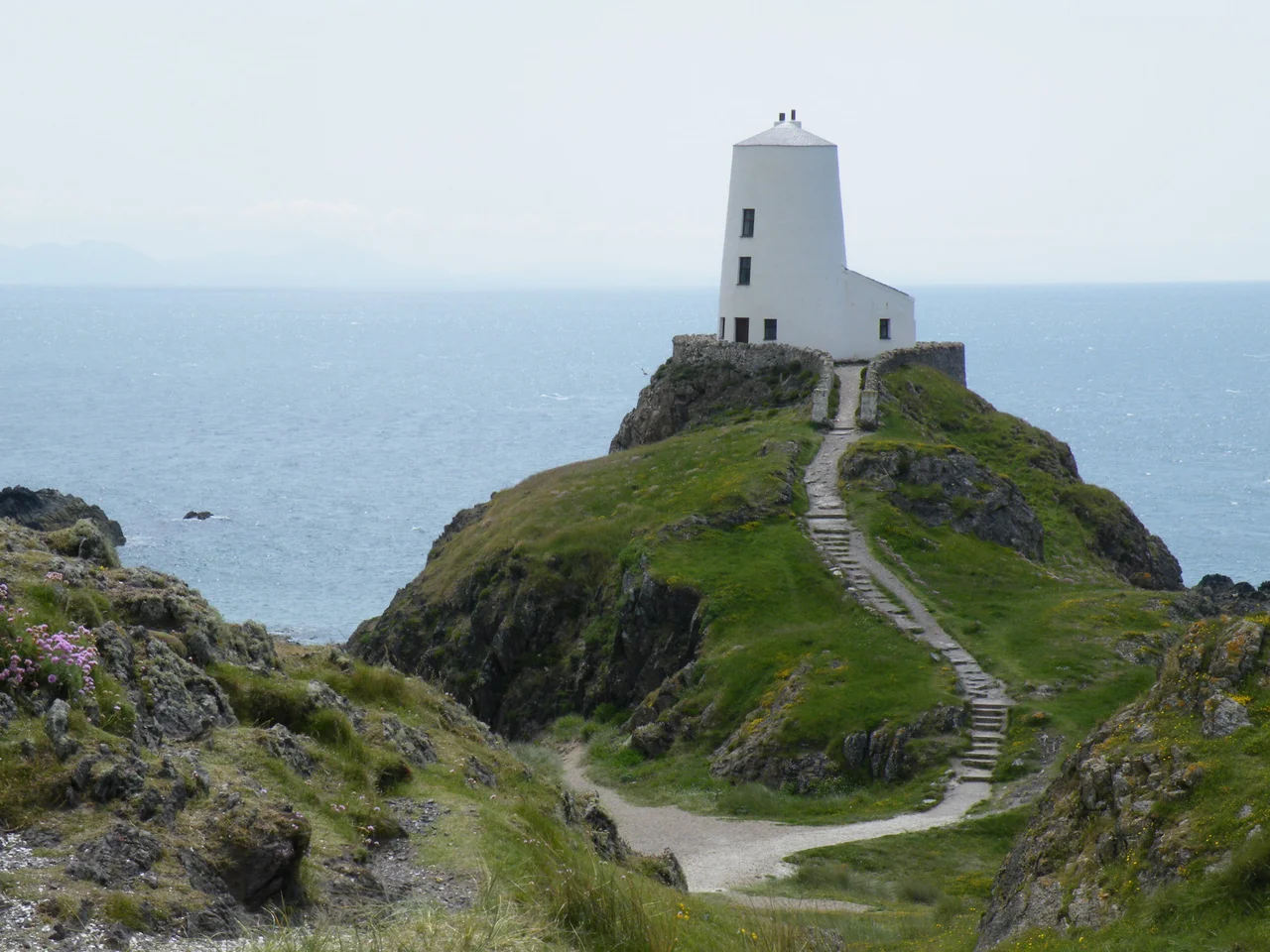

Tŵr Mawr Lighthouse
Ynys Llanddwyn is barely an island. At low water it is joined to Newborough Warren by a sand bar; at high water the bar disappears and the small green tongue of land floats free of the Anglesey coast. The Welsh have woven so much story into this place - it is the island of Saint Dwynwen, patron of Welsh lovers, whose ruined 16th-century chapel still stands here - that the lighthouses come almost as an afterthought. But the bigger of them, Twr Mawr - the Great Tower - was a serious piece of mid-19th-century maritime infrastructure. From 1846 until 1975, it marked the western entrance to the Menai Strait for any ship approaching Caernarfon harbour.
Before It Was a Lighthouse
Two towers stand on Ynys Llanddwyn. Neither appears on Lewis Morris's detailed chart of 1801, but both show up on the Ordnance Survey map of 1818-1823. They were almost certainly built first as 'day marks' - unlit navigational towers that gave fishermen and merchant captains a fixed visual reference for the bar of the Caernarfon harbour, which sits dangerously close to the dunes of Llanddwyn Point. Day marks are an older and quieter technology than lighthouses. They work in daylight, in fair weather, when you can see them. The Caernarfon harbour board, eventually deciding that daylight was not enough, commissioned improvements to one of the towers in 1842.
1846: The Light Came On
The Caernarfon harbour board's lighthouse came into service in 1846. The lantern and its fittings cost 250 pounds 7 shillings and 6 pence, including the adaptation of the existing day-mark tower. The light was made by De Ville and Co of London - James De Ville's optical workshop, which produced fittings for several British lighthouses in this period. It used six Argand lamps burning colza oil (rapeseed oil, then the standard lighthouse fuel before paraffin took over) with catoptric reflectors - the polished metal parabolic mirrors that throw the lamp's light forward in a tight beam. The original light was a fixed red, projected from a window on the ground floor of a small lean-to structure attached to the tower. The tower itself rises in plain stone, square-built, with the lantern window about six feet by two.
The Smaller Tower
The second, smaller tower on the island - Twr Bach, 'the Little Tower' - sits to the southeast. It is conical, with a domed top, the walls six feet in radius and three feet thick, with a door to the northwest. The west wall shows signs of cracking through its rubble-filled core. Twr Bach probably originated as the other day mark, built around the same time as its larger neighbour. For more than a century the two towers stood together: the great tower lit, the little tower silent. Then in 1975, in a clean inversion of roles, the larger tower was decommissioned and the lighting function moved to the smaller one. Twr Bach now carries the modern light - flashing red and white sector lights that warn ships off Caernarfon Bar and guide them safely toward the harbour entrance. Twr Mawr, the great tower of the name, has been quiet since.
The Saint's Island
Whatever you think you came to see at Twr Mawr, the rest of Ynys Llanddwyn keeps interrupting. The ruins of the 16th-century church of Saint Dwynwen lie on the island - she is the patron saint of Welsh lovers, the figure invoked on 25 January, Wales's version of Valentine's Day. A row of pilots' cottages, built for the men who guided ships across the bar, survives in restored form. A celtic cross. The bones of older crosses, eroded by sea and weather. The tower itself was Grade II listed in 1996, recognised as much for what it represents - a piece of mid-Victorian maritime engineering still standing in its working landscape - as for its present function, which is essentially that of an unlit landmark. Walk the island at low tide and the great tower is one feature among many. But on a clear evening it is still the highest object on the horizon between Newborough Warren and the open sea, doing the older and simpler job that day marks were built to do.
From the Air
Twr Mawr lighthouse stands on Ynys Llanddwyn at 53.135N, 4.416W, on the southwest tip of Anglesey at the western entrance to the Menai Strait. The island is connected to Newborough Warren by a tidal sand bar. Caernarfon Airport (EGCK) is 5 nm east-southeast; RAF Valley (EGOV) is 8 nm to the northwest. From the air, look for the small wooded green island just offshore from the wide arc of Newborough Beach, with the square Twr Mawr tower at the seaward end and the smaller conical Twr Bach (now the active light) to its southeast. The Lleyn Peninsula rises across Caernarfon Bay to the south. Excellent visual landmark for VFR approaches from the southwest.
Nearby Stories
- Wakestock 1.7 km away
- Trefriw 3.8 km away
- Irish Sea 8.7 km away
- Irish Sea Bridge 20 km away
- East–West Interconnector 30 km away
- Machynlleth 36 km away
- HMS Tyler 41 km away
- New Brighton Lifeboat Station 54 km away