.jpg)
Uluwatu Temple
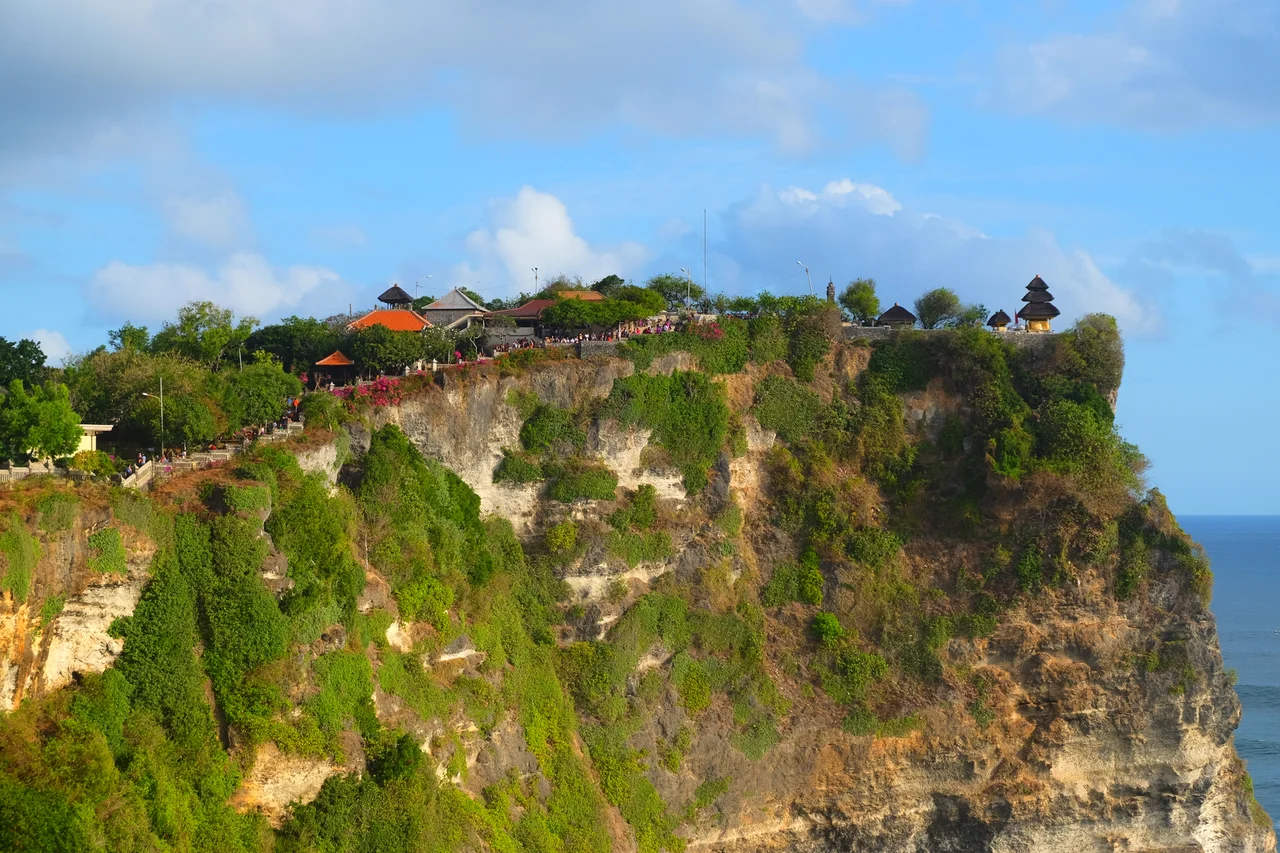
The name breaks down simply in Balinese: ulu means edge, watu means rock. Uluwatu Temple sits at the edge of a rock, and what a rock it is. A sheer 70-meter limestone cliff drops straight into the Indian Ocean, waves detonating against its base in plumes of white spray, while above, one of Bali's most sacred temples occupies the narrow promontory as if daring the sea to claim it. This is not a temple built for comfort or convenience. It is built for spiritual confrontation, positioned at the island's southwestern extremity to face down whatever malevolent forces the ocean might send. For over a thousand years, it has held its ground.
Two Priests, One Thousand Years
The temple's history spans at least two major periods of construction. In the 10th century, the Javanese Hindu sage Mpu Kuturan is credited with establishing the original shrine and introducing the Tri Kahyangan system, which classified Balinese temples into three categories: village temples, mountain temples, and sea temples. Uluwatu was designated a sea temple, or pura segara, charged with protecting the island from negative spiritual forces arriving from the ocean. Six centuries later, another priest transformed the site. Dang Hyang Nirartha, a Javanese Brahmin who arrived in Bali during the 16th century, expanded the temple and added the padmasana shrines that remain central to its ritual function today. Nirartha was one of the most influential figures in Balinese Hinduism, founding several major temples across the island. According to tradition, he achieved moksha, spiritual liberation, at this very cliff, dissolving into divine light above the waves. The temple holds his memory as both historical fact and sacred event.
The Ninth Pillar
Uluwatu occupies a singular position in Balinese cosmology. It is the only sea temple that is also one of the nine directional temples, the Pura Kahyangan Jagat, sometimes called Pura Kahyangan Padma Bhuwana. These nine temples are considered the spiritual pillars of Bali, positioned at cardinal and intercardinal points around the island to form a protective mandala. Most of the nine are mountain temples. Uluwatu alone holds its position from the coast, guarding the southwest. It is dedicated to Sang Hyang Widhi Wasa, the supreme god of Balinese Hinduism, in his manifestation as Rudra, the deity associated with storms, wind, and the destructive forces of nature. The dedication fits the location. Standing at the cliff's edge, watching waves crash against the limestone far below, the concept of a deity governing nature's raw power feels less abstract than it might in a quieter setting.
Sunset, Fire, and a Hundred Voices
Every evening at six o'clock, the cliff-side amphitheater at Uluwatu fills with visitors for a Kecak dance performance. The dance, based on episodes from the Ramayana, uses no musical instruments. Instead, a circle of fifty or more bare-chested men provides the accompaniment, chanting "cak-cak-cak" in interlocking rhythmic patterns that build from a murmur to a roar. The performers sway and thrust their arms in synchronized waves while dancers at the center enact the story of Prince Rama's rescue of his wife Sita from the demon king Ravana. As the performance unfolds, the sun drops into the Indian Ocean behind the stage, painting the sky in bands of orange and crimson. The timing is not coincidental. The Kecak was developed in its modern form during the 1930s, partly through the creative involvement of Walter Spies, the German artist who also influenced the collections of Museum Pasifika nearby. At Uluwatu, the dance and the landscape merge into a single experience that draws hundreds of spectators every day of the year.
The Macaque Confederacy
Visitors to Uluwatu quickly learn the temple's unofficial rule: the long-tailed macaques own the place. Troops of these gray-furred monkeys patrol the temple grounds, the parking areas, and the cliff-side paths with the confidence of creatures who have lived here for generations and know exactly what tourists carry. Sunglasses, hats, phones, sandals, water bottles, anything removable is fair game. The macaques are not merely opportunistic. Researchers have documented what appears to be deliberate bartering behavior: a monkey snatches an item, retreats to a safe perch, and waits for a temple attendant to offer food in exchange for the stolen goods. The more valuable the item appears, the longer the monkey holds out. Signs throughout the complex warn visitors to secure their belongings, and temple staff carry bags of peanuts for ransom negotiations. It is a system that works for everyone involved, except perhaps the tourist who watches a macaque sprint up a banyan tree with a pair of prescription sunglasses.
From the Air
Uluwatu Temple sits at 8.829S, 115.084E on the southwestern tip of Bali's Bukit Peninsula, occupying a dramatic cliff promontory jutting into the Indian Ocean. From the air, the temple compound is visible as a small cluster of structures at the very edge of the limestone plateau, with white surf breaking against the cliff base far below. The Bukit Peninsula's elevated tableland and surrounding reef breaks (including the famous Uluwatu surf break) are clearly identifiable. Ngurah Rai International Airport (WADD/DPS) lies approximately 20 km to the northeast. Approach from the southwest over open ocean for the most dramatic view of the cliff-top temple silhouetted against the green plateau.
Nearby Stories
- Pura Taman Ayun: The Garden That Floats on Sacred Water 8.9 km away
- When the Ground Moved at Dawn: Bali's 1979 Earthquake 17 km away
- Alas Purwo: Where Java Begins and the Surf Never Stops 27 km away
- The Invisible Frontier: Where Asia Ends and Australia Begins 46 km away
- The Tiger's Last Stand: West Bali National Park 53 km away
- The Silent Wave: Java's 1994 Tsunami Earthquake 245 km away
- When the Towers Fell: The Waru Wora Fire 408 km away
- Sumba's Hidden Kingdom of Wings 503 km away