
University of Aberdeen
Every few years, a procession sets out through the cobbled lanes of Old Aberdeen carrying a new rector aloft on the shoulders of students. Above them rises a wooden bull called Angus, mascot of the university, hoisted to shoulder-height by the toughest of the rugby and rowing crews. The ceremony ends at the St Machar Bar, where tradition obliges the new rector to buy a round. The post they have just inherited dates from 1495, the year a papal bull from Alexander VI founded King's College on a riverside plot in what was then a separate burgh. Five and a quarter centuries later, the university still teaches under the crown spire that Bishop Elphinstone raised over that first chapel.
Two Colleges Become One
For three and a half centuries Aberdeen was a city with two universities. King's College, founded 1495, sat in Old Aberdeen north of the Don, a Catholic foundation of priests and physicians built around Bishop William Elphinstone's vision of learning. Marischal College, founded 1593 by the 5th Earl Marischal, stood in New Aberdeen by the harbour, a Protestant counterweight to the older institution. For almost three hundred years the two ran in parallel, each granting its own degrees. In 1860 an Act of Parliament fused them into the single University of Aberdeen. Marischal College, rebuilt in the 1890s, became the second-largest granite building in the world after the Escorial in Spain; the Crown Tower of King's still rises above Old Aberdeen, silver in the light, looking out toward the Don.
Five Nobel Laureates and a Botanist Who Failed to Graduate
Aberdeen's alumni list is its quiet boast. Five Nobel Prizes have been won by people who studied or taught here: Frederick Soddy in Chemistry, John Macleod in Medicine for the discovery of insulin, George Paget Thomson in Physics, John Boyd Orr the Peace Prize for nutrition research, and Richard Synge in Chemistry for partition chromatography. Robert Brown, the botanist who would later observe the random jitter of pollen grains in water - what we now call Brownian motion - studied here but never graduated. Thomas Reid, founder of the Scottish School of Common Sense philosophy, taught here. James Gregory designed the first practical reflecting telescope while a student. James Blair founded the College of William and Mary in Virginia. William Thornton drew the original plans for the United States Capitol after studying medicine in this town.
The Library With Zebra Stripes
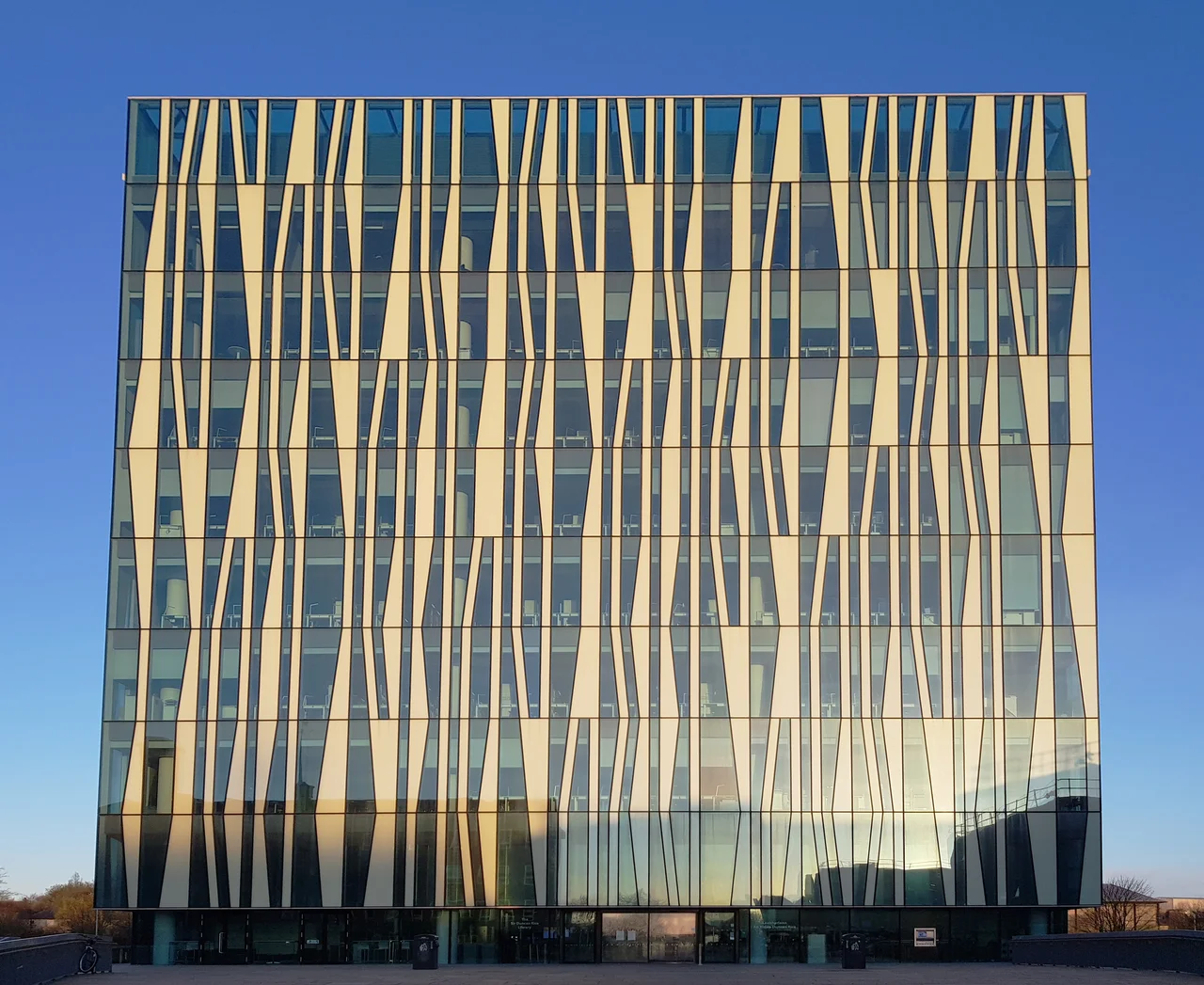
On the corner of Bedford Road and the Spital, on a base of Scottish stone, rises a seven-storey building wrapped in jagged white-and-glass stripes that have been compared to a zebra and to ice and to a half-finished bar code. The Sir Duncan Rice Library, designed by the Danish firm Schmidt Hammer Lassen and opened by Queen Elizabeth II in September 2012, holds more than a million volumes including the medieval Hortus Sanitatis. The exterior is sharply geometric; the central atrium twists organically through every floor, a void in the shape of a spiral staircase that no staircase could climb. The library has won architecture prizes by the armful. It replaced the Queen Mother Library, which had served since 1965, on a site whose collections trace back to the books Bishop Elphinstone left to King's College in his will of 1514.
Bajans, Semis and the Yellow Beak
Aberdeen's medieval traditions never quite faded. First-year students were called bajans, from the French bec jaune - yellow beak, a fledgling. Female undergraduates were bajanellas. Second years were semis. Third years were tertians. Final years were magistrands. Senior students tore the gowns of first years on principle. The Sponsio Academica, an oath in Latin sworn at matriculation, now arrives as a digital checkbox during online enrolment, but medical graduates still affirm a version of it before the Aberdeen senate. Every February on Founders' Day, the academic procession winds through the cobbles of Old Aberdeen, a candle is lit in King's College Chapel for Bishop Elphinstone and the patron fathers, and the university bows briefly to the fact that it is older than three of the four ancient universities of England.
From the Air
The University of Aberdeen straddles two main sites: the historic King's College campus in Old Aberdeen at 57.165 degrees north, 2.10 degrees west, and Marischal College in the city centre about a mile south. From the air, look for the Crown Spire of King's College Chapel - a distinctive stone crown shape rising above the leafy quad - and the silver-grey towers of Marischal College near Broad Street. The Sir Duncan Rice Library, a striped seven-storey block, stands out clearly. Aberdeen Dyce Airport (ICAO EGPD) is about five nautical miles north-west. Best viewed at 1500-3000 feet AGL.
Nearby Stories
- Monymusk Priory 3.9 km away
- Deer Abbey 8.6 km away
- Glendronach Distillery 9.8 km away
- Fettercairn Distillery 13 km away
- Dunnottar Castle 16 km away
- Piper Alpha 146 km away
- German submarine U-1274 151 km away
- HMS Nottingham (1913) 192 km away