
University of Limerick
Until 1989, no new university had been chartered in the Irish state since the founding of the country itself in 1922. Then the Oireachtas passed the University of Limerick Act and a college that had begun in 1972 as the National Institute for Higher Education suddenly had degree-granting status of its own. The University of Limerick was, and remains, the first university established in independent Ireland.
The Plassey Site
The campus sits at Plassey, five kilometers east of Limerick city centre in the Castletroy suburb, on a stretch of the River Shannon where the water broadens before bending toward the estuary. The 1972 Physical Education building came first; the 1974 Main Building followed; over the next five decades, the campus filled out with the Schrodinger Building (1978), the Foundation Building with its University Concert Hall (1993), the Glucksman Library (1997), the University Arena (2001), the Health Sciences and Engineering Research buildings (2005), the Jim Kemmy Business School (2007), the Bernal Building (2013), and others. Each new structure carried a name with weight - physicist Erwin Schrodinger, who fled Vienna and ended up in Dublin; Lewis Glucksman, banker and benefactor; Jim Kemmy, Limerick socialist and TD; John Desmond Bernal, the Irish-born crystallographer.
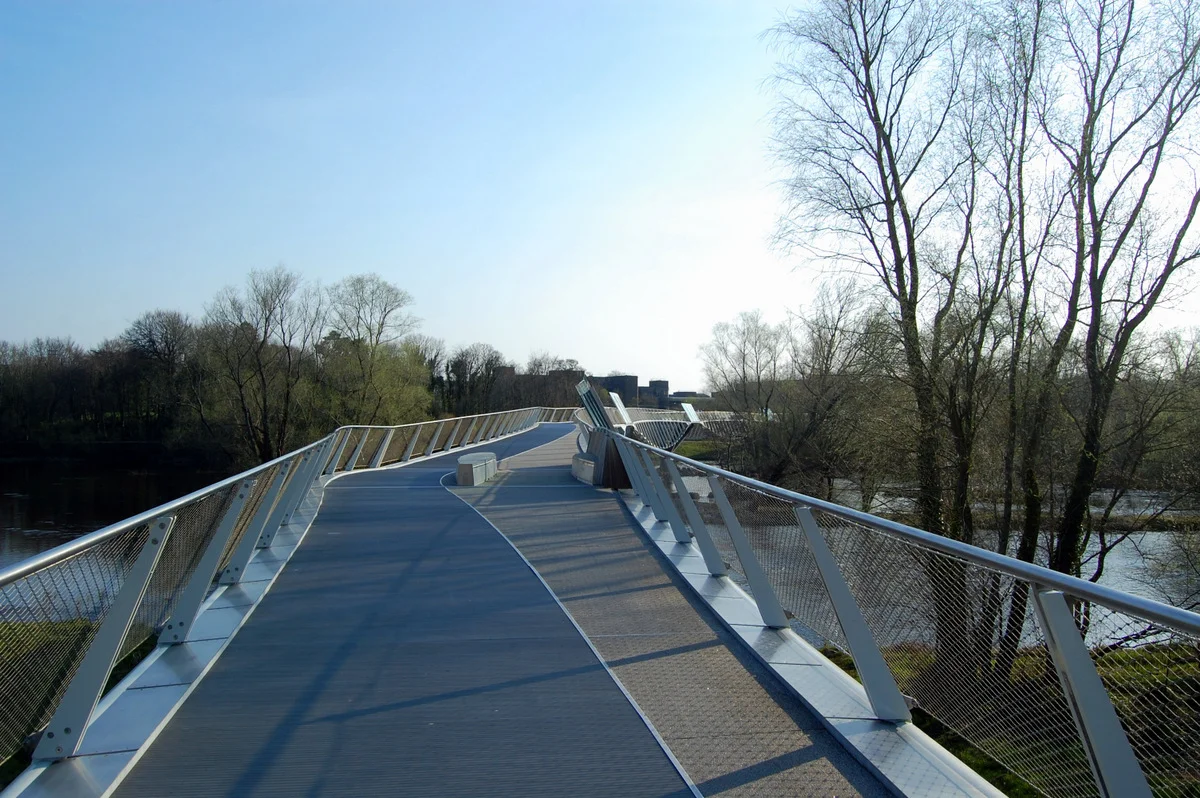
The campus crossed the Shannon in 2004 when the University Bridge opened, allowing expansion onto the north bank in County Clare. Thomond Village came first, then the Health Sciences Building, then the Living Bridge - a pedestrian crossing that ranks among the longest footbridges in Europe and looks, from certain angles, like something out of an architectural daydream. Cappavilla and Quigley villages followed, with the Irish World Academy of Music and Dance building completing in 2010.
Music, Sculpture, and the Concert Hall
The University Concert Hall opened in 1993 as Ireland's first purpose-built concert venue. A thousand seats, decent acoustics, and a willingness to host everything from the Irish Chamber Orchestra to touring rock acts have made it a cornerstone of Limerick's cultural life. The Irish World Academy of Music and Dance, also based at UL, takes the country's traditional music and submits it to academic scrutiny without smothering it - PhDs in traditional dance, choreography research, ensemble work with players from Clare and Donegal.
The campus art collection has grown into something serious. Antony Gormley has a sculpture in Central Plaza. So do Sean Scully, Michael Warren, Alexandra Wejchert, James McKenna, Tom Fitzgerald, and Peter Logan. The Bourn Vincent Gallery runs a steady program of temporary exhibitions. Walk the paths around the Foundation Building and you keep coming across pieces - some monumental, some easy to miss - that make the campus read more like a sculpture park than a university quad.
Olympic Pools and Living Bridges
The University Arena opened in 2002 and was, on the day it opened, Ireland's largest indoor sports complex. The 50-meter swimming pool inside is Olympic standard - the first such pool in the country. The 3,600-square-meter indoor sports hall has four wooden courts, a sprint track, an international 400-meter athletics track, and a suspended 200-meter jogging track three lanes wide. Munster Rugby trains here. The 2010 Special Olympics Ireland Games brought 1,900 Special Olympians to the arena for five days in June.
The all-weather sports complex on the north campus, opened in 2011, is the largest artificial-turf development in Ireland: two soccer pitches, a rugby pitch, a GAA pitch, all floodlit and built to World Rugby, GAA, and FIFA specifications. The boathouse on the south bank houses Ireland's only indoor rowing tank, which can hold eight rowers simultaneously and simulate water conditions for international training. The university accommodates over 500,000 sports facility users a year, and was named Ireland's only five-star institution for sports facilities.
Villages and Castletroy
Unlike most Irish universities, UL houses much of its student population on campus, in six "villages" - Plassey (1987), Kilmurry (1994), Dromroe (2001), Thomond (2004), Cappavilla (2006), and the postgraduate-only Quigley. Around the campus, Castletroy has effectively become a student town. Estates like Elm Park, College Court, Briarfield, and Oaklawns shift their population sharply at the start of each academic year. The new 30-million-euro Student Centre opened in October 2025, finally completed after the original contractor collapsed in 2021 and Monami Construction picked up the work in 2023.
UL is ranked 426th in the 2024 QS World University Rankings, with Sunday Times naming it Irish University of the Year in 2015. About 17,000 students study here. The university has signed onto the Limerick 2030 plan, which envisions students learning and recreating in the city center alongside the academic core at Castletroy. "Limerick is our city," said former president Don Barry, "and we are its university."
From the Air
The University of Limerick is at 52.675 N, 8.572 W, in Castletroy on the south bank of the River Shannon, about 5 km east of Limerick city centre. Shannon Airport (EINN) is 25 km west-northwest; Cork (EICK) is roughly 100 km south. Recommended viewing altitude is 2,000 to 3,500 feet AGL. The campus straddles the Shannon, with the Living Bridge connecting the south and north banks. Look for the broad green sweep of playing fields north of the river and the cluster of academic buildings on the south side. The Plassey area is distinguished by sharp meanders of the Shannon, which here is broad and slow-moving. Cloud cover is the norm in this part of Ireland - expect cloud bases below 2,500 feet on most days and only 3.5 hours of sunshine on average.
Nearby Stories
- Cloughjordan 4.8 km away
- Charleville 5.6 km away
- Kilfenora Cathedral 10 km away
- Shanbally Castle 10 km away
- Abbeyfeale 11 km away
- Holy Cross Abbey 15 km away
- 2003 Derrybrien Landslide 20 km away
- Kilrush 23 km away