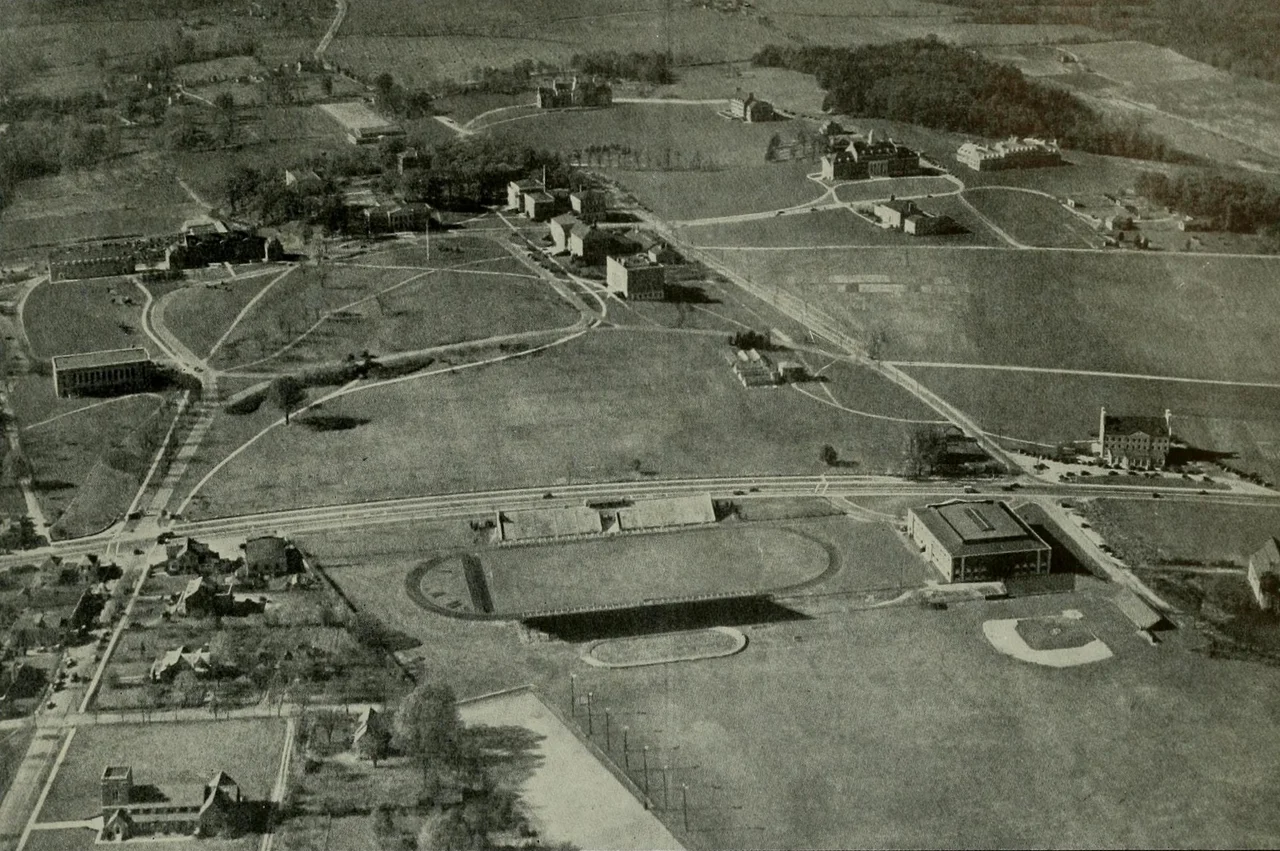

University of Maryland
Charles Benedict Calvert was a great-great-grandson of the first Lord Baltimore, a member of Congress, and a true believer in scientific farming. In 1858 he bought 420 acres of his family's Riversdale estate near what is now College Park and used the land to launch the Maryland Agricultural College, which had been chartered two years earlier. The first 34 students arrived on October 5, 1859. Calvert served briefly as acting president. The Civil War nearly destroyed the school - declining enrollment, sold-off land, bankruptcy, and a brief stint as a boys' preparatory academy - before it found steadier footing as a federal land-grant college after 1864. From those 420 acres the campus has grown to about 1,250, with a McKeldin Mall down its spine that is, by acreage, the largest academic mall in the United States.
Calvert's College
The agricultural college Calvert founded wasn't quite his idea alone - the federal Morrill Act of 1862 made land-grant universities a national project, providing federal land or money to states that established colleges teaching agriculture, mechanic arts, and military tactics. Maryland's took the Morrill funding in 1864, just as the Civil War was ending. The school spent most of the next sixty years as a small institution mixing experimental farming with classical instruction. The first female students, Elizabeth Gambrill Hook and Charlotte Ann Vaux, enrolled around 1916. In 1920 the agricultural college merged with existing professional schools in Baltimore to become the University of Maryland, with College Park serving as the undergraduate campus. The graduate school awarded its first PhD that same year. The Association of American Universities accredited the school in 1925. Phi Beta Kappa established a chapter in 1964; AAU membership followed in 1969.
The Queen's Game and the Mall
On October 19, 1957, Queen Elizabeth II of the United Kingdom watched her first and only American college football game at Byrd Stadium in College Park. She had asked, during her first U.S. tour, to see a typically American sport. The Terrapins beat the North Carolina Tar Heels 21 to 7. The game is still referred to on campus as The Queen's Game. The center of the campus is McKeldin Mall, named for Theodore McKeldin, the Republican mayor of Baltimore and twice governor of Maryland. McKeldin Library anchors the west end; the Thomas V. Miller Jr. Administration Building anchors the east. Regents Drive crosses the mall at a flower-planted mound called simply The M. The Rossborough Inn, built between 1798 and 1812 and still standing on campus, is older than the university itself.
The Federal Pipeline
Maryland is forty minutes from downtown Washington in moderate traffic, which has shaped the university's research portfolio in ways few schools can match. Faculty receive funding and institutional support from NIH, NASA, NIST, the FDA, the NSA, and the Department of Homeland Security. In 2004 the university began building the 150-acre M Square Research Park, now home to the Department of Defense, the FDA's Center for Food Safety and Applied Nutrition, and the NOAA-affiliated National Center for Weather and Climate Prediction. The National Archives at College Park sits on land donated by the university and opened in 1994 after lobbying by then-president William Kirwan. Total research and development spending hit $1.14 billion in fiscal year 2021, ranking Maryland 17th among American universities. The federal city is far enough away that students don't feel like they're in it, but close enough that the research dollars flow steadily north on Route 1.
Trees and Streams
The campus holds 7,500 documented trees and garden plantings, enough for the American Public Gardens Association to designate it the University of Maryland Arboretum and Botanical Garden in 2008. Nearly 400 acres of urban forest grow on campus land. The Paint Branch stream, a tributary of the Northeast Branch of the Anacostia River, runs through the grounds, with the Paint Branch Trail offering a recreational corridor that connects to the broader Anacostia Tributary Trails system. Knight Hall, the home of the Philip Merrill College of Journalism, opened in April 2010 as the university's first LEED Gold-certified building. In 2021, President Darryll Pines pledged that the university would achieve carbon neutrality by Earth Day 2025 - an ambitious target for a campus this large that drew both attention and skepticism from environmental observers.
Maryland Right Now
Today the university enrolls about 40,000 students across eleven colleges and schools. It competes in NCAA Division I as a Big Ten member; its athletic teams are the Terrapins, named for the diamondback terrapin, the state reptile. The selectivity has risen sharply - the Class of 2026 saw a 34 percent acceptance rate, with middle-50-percent SAT composite scores between 1340 and 1490. In 2017 the A. James and Alice B. Clark Foundation gave $219.5 million, then one of the largest gifts ever made to a public university. Maryland has had its difficult years too - the 2014 data breaches that exposed records for more than 300,000 students and faculty, the 2018 death of football player Jordan McNair from heatstroke during an offseason workout that led to the firing of the head coach and the resignation of the athletic director. Like all large state universities, Maryland is a small city embedded in another small city. What unites them now is mostly the trees, the mall, and the slow accumulation of buildings around them.
From the Air
The University of Maryland's main campus is centered near 38.9869 N, 76.9426 W in College Park, Maryland. The campus occupies about 1,250 acres immediately west of U.S. Route 1, with the M Square Research Park and the National Archives at College Park (Archives II) on adjoining parcels to the north. The site is just outside the inner Washington Flight Restricted Zone but well within the Special Flight Rules Area. College Park Airport (KCGS) sits one mile east. BWI Marshall (KBWI) is 22 miles north; Reagan National (KDCA) is 9 miles south. From altitude, McKeldin Mall is identifiable as a long rectangular open green corridor running east-west through the campus, with Byrd Stadium (now SECU Stadium) visible north of the mall axis.
Nearby Stories
- Reston, Virginia 1.7 km away
- Thomas Viaduct 9.2 km away
- Monocacy Aqueduct 9.7 km away
- Stafford County, Virginia 26 km away
- Harriet Tubman Underground Railroad 28 km away
- Gunston Hall 30 km away
- Adkins Arboretum 31 km away
- Bombay Hook National Wildlife Refuge 71 km away