
University of Richmond
The University of Richmond is the only major American university whose mascot is a spider. The choice was not strategic. In 1894, a Richmond baseball team featured a wiry pitcher named Puss Derrick who pitched with such gangly, long-limbed motion that a local sports reporter called him a spider. The nickname stuck — first to him, then to the team, then to the school. By 1969, the spider's school was nearly broke. Trustee and alumnus E. Claiborne Robins Sr. wrote a check that year for $50 million — at the time the largest gift any institution of higher education in America had ever received. Robins's goal was simple: make Richmond one of the best private universities in the country. The endowment leapt into the upper tier overnight. Almost everything else on the modern campus follows from that single signature.
From a Plantation Schoolroom
The university began as a single ministry student at a kitchen table. In 1830, the Baptist General Association of Virginia resolved to form an education society for training preachers. They had no money for a building, so they asked their vice president, Rev. Edward Baptist, to take students into his own home. In August 1830, William Allgood arrived at Baptist's Dunlora Plantation to study in what records described as "a building of three or four rooms." Nine students enrolled that first year at what came to be called Dunlora Academy. Two years later, the society bought Spring Farm north of Richmond for $4,000 and opened the Virginia Baptist Seminary under Robert Ryland. The curriculum was Latin, Greek, and mathematics. Students also worked three hours a day at farm labor — "improving the health," Ryland said, "and perhaps guarding the humility of the young preachers." The farming proved unprofitable and was dropped. By 1843 the seminary had become Richmond College, with sixty-eight students, three teachers, and a library of seven hundred volumes.
War and Bankruptcy
When the Civil War broke out, the entire student body of Richmond College formed a regiment and joined the Confederate army. The college's buildings were turned into a hospital for Confederate wounded, then later into barracks for Union soldiers occupying the city. The trustees had invested all the college's funds in Confederate war bonds. By Appomattox, the institution was bankrupt. It might have closed forever; in 1866, James Thomas Jr. — a Richmond tobacco manufacturer — donated $5,000 to reopen the school. The T.C. Williams School of Law opened in 1870. In 1894, the college elected Frederic W. Boatwright president. He would hold that office for fifty-one years. Boatwright's defining accomplishment was raising the money to move Richmond College in 1914 from its original uptown campus to a new 350-acre site in Westhampton — a wooded tract on the city's western edge that remains the campus today. As part of the move, he established Westhampton College for women, which opened that September with 82 students.
The Robins Gift
By 1969, the University of Richmond — renamed in 1920 — was facing existential trouble. Costs were rising, the endowment was thin, and serious discussion centered on turning the institution over to the Commonwealth of Virginia. E. Claiborne Robins Sr., a trustee and alumnus, made his pharmaceutical fortune at A.H. Robins Company. He wrote a check for $50 million. In 1969 dollars, this was unprecedented for higher education in the United States. In constant dollars, it remains one of the largest single gifts a university has ever received. The gift included a $10 million matching component that drew another $60 million in additional donations. President E. Bruce Heilman and development director H. Gerald Quigg leveraged the moment ruthlessly. Within a few years, Richmond's endowment per student was among the highest in the country. The cascade continued: in 1987 Robert S. Jepson Jr. pledged $20 million to establish the Jepson School of Leadership Studies, which opened in 1992 as the first undergraduate school of its kind in the United States entirely devoted to the academic study of leadership.
Spider Stories
The 1992 presidential debate brought George H.W. Bush, Bill Clinton, and Ross Perot to campus on October 15 for the first-ever "town hall" televised debate. An estimated 200 million people worldwide watched. President Obama returned the campus to the national stage on September 11, 2011, presenting the American Jobs Act before a crowd of nearly 9,000. The faculty roster has included former U.S. Senator Tim Kaine. Notable alumni include David Burd, who graduated summa cum laude from the Robins School of Business before becoming the rapper Lil Dicky. Seventeen NFL players have come through the program. The first three presidents of Hargrave Military Academy were Richmond graduates. In 2015, Ronald Crutcher became the institution's first African American president. In 2021, labor economist Kevin F. Hallock became the 11th president, coming from Cornell's SC Johnson College of Business.
The Campus Today
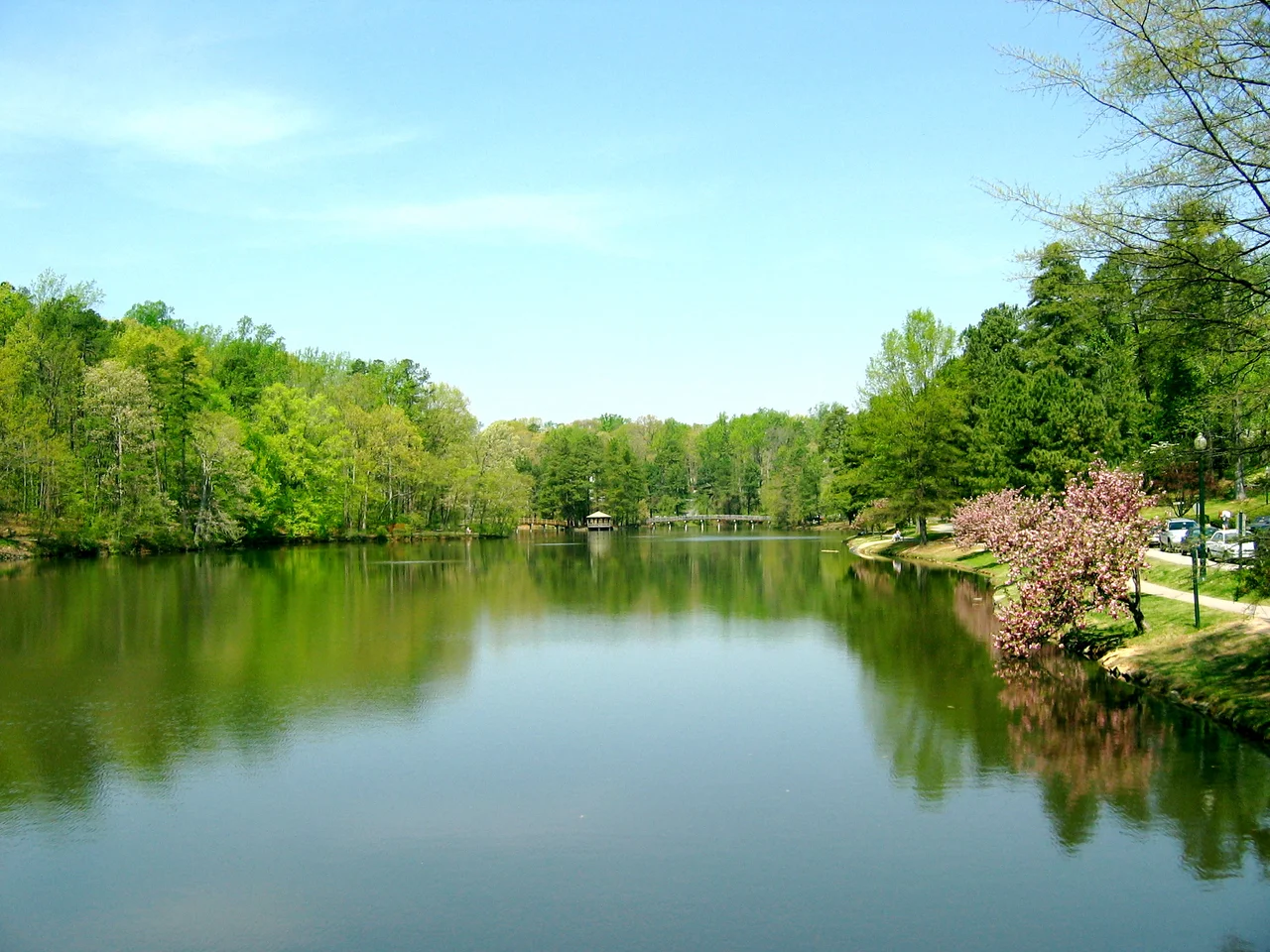
Boatwright's 1914 westward move bought the university room it has never outgrown. The 350-acre campus wraps around Westhampton Lake, with the Henry Mansfield Cannon Memorial Chapel, North Court, and Ryland Hall — added to the National Register of Historic Places in 2013 — anchoring the historic core. Five schools share the grounds: Arts and Sciences (38 majors and 10 concentrations), the E. Claiborne Robins School of Business, Jepson Leadership, the School of Law, and the School of Professional and Continuing Studies. About 3,900 students fill the dorms each year. The wooded setting is so dense that first-time visitors to Richmond often forget they are still inside the city. From the air, Westhampton Lake is the visual cue: a curved blue oval surrounded by a tight grid of Gothic-tinged academic buildings, with the spider-tinted athletic logo painted across the basketball court at the Robins Center.
From the Air
University of Richmond's main campus is at 37.58 N, 77.54 W in the West End, about 6 miles west of downtown Richmond. From 2,000 to 3,000 feet AGL, the campus reads clearly: Westhampton Lake at the center, the Henry Mansfield Cannon Memorial Chapel tower nearby, and the dense canopy of trees that separates the campus from surrounding suburbs. KRIC (Richmond International) is approximately 12 nautical miles east-southeast. The Boulevard Bridge over the James River is a few miles to the southeast.
Nearby Stories
- Kings Dominion 8.4 km away
- Battle of Hatcher's Run 9.7 km away
- Francisco's Fight 14 km away
- Piney Grove at Southall's Plantation 17 km away
- Jamestown Settlement 19 km away
- Battle of Amelia Springs 22 km away
- Menokin 29 km away
- Highland (James Monroe House) 42 km away