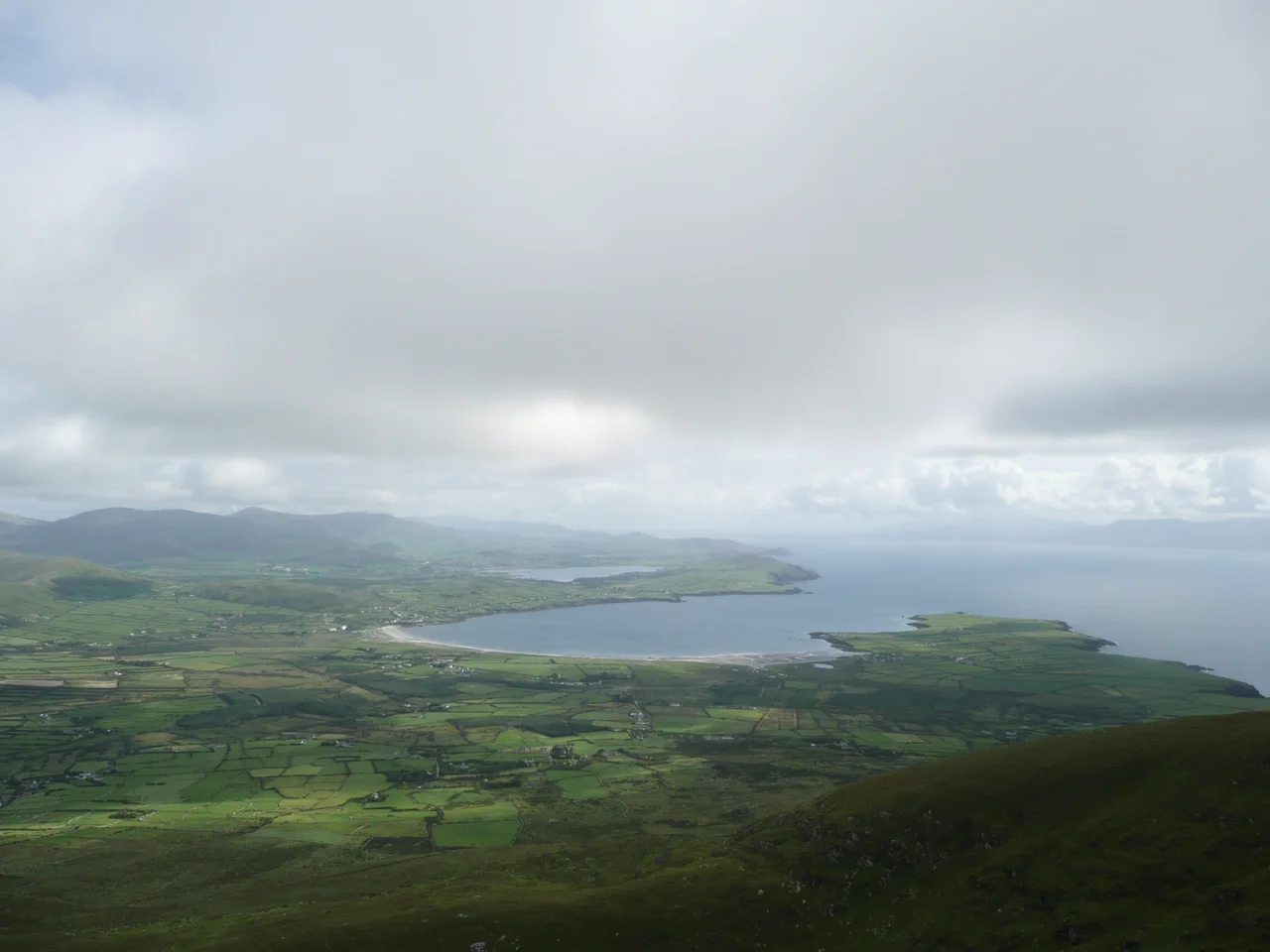

Ventry
On the fourth of October 1939, twenty-eight Greek sailors waded ashore at Ventry. Their ship, the MV Diamantis, had been torpedoed the day before by the German U-boat U-35, and rather than leave the crew to the Atlantic the U-boat's captain had picked them up and carried them, on the deck of a war machine, into a neutral Irish harbour. Ventry's official name is Ceann Trá, the head of the strand, and the village sits seven kilometres west of Dingle in a Gaeltacht where Irish is still the working language. The bay that received those sailors has been receiving travellers of one kind or another for at least two thousand years, and almost every century has left its mark on the long sandy beach.
A Battle in the Fenian Cycle
Six kilometres west of the village, on the lip of a cliff that drops straight to the sea, sit the ruins of Dún Beag, an Iron Age promontory fort. Nearby at Kilvickadownig stand beehive houses, drystone domes built without mortar, and the reputed grave of Caol Mac Crimthainn, who in the Fenian Cycle of Irish mythology was said to be the last man to die in the legendary Battle of Ventry. The Battle of Ventry is one of those long, half-historical contests that Irish storytellers liked to set on real shorelines, and the bay does lend itself to imagination. The strand is long, the cliffs are dramatic, and the light coming in off the Atlantic gives the whole place the slight unreality of a stage set. Whether or not Caol ever fell here, the cairn is still a place people walk to, and the story is older than the stones above it.
The Knight of Kerry's Castle
Inside the parish stands Rahinnane Castle, once the residence of the Knight of Kerry, a hereditary title held by the FitzGerald family. The castle was raised on the site of an older ringfort, and a second ring was added around it with walls six metres high, which from a distance gives the impression of a moat that was never there. The Knight of Kerry lived at Rahinnane until the Cromwellian conquest of Ireland in the mid-seventeenth century swept the old Gaelic and Anglo-Norman families off their lands. The shell of the castle still stands, and inside its walls a narrow set of stone stairs threads between the first and second floors, the kind of detail that survives because it was awkward to dismantle. Walking through, you can feel how compact medieval rooms were and how much the people who used them depended on staying close to one another.
Páidí, Goodman, and the Voice of Ventry
Ventry is a small place, but its names travel. Páidí Ó Sé, one of the great Kerry footballers of the modern era, kept a pub across from the parish church until his death in 2012; the building is still there and still a fixture of West Kerry life. In the nineteenth century, Canon James Goodman grew up in Ventry and went on to become Professor of Irish at Trinity College Dublin and one of Ireland's most important early collectors of traditional music, transcribing tunes that might otherwise have been forgotten. The sport shooter Dennis Fenton was born in the village too. For a Gaeltacht parish of this size to send a footballer, a musicologist, and an Olympic-level shooter into the wider world is the kind of statistic that says something about how much living goes on inside a small place.
The Diamantis Comes Ashore
The plaque went up in October 2009, seventy years after the event. The Greek ambassador came; the German ambassador to Ireland came; the mayor of Oinousses, the small Aegean island where many of the Diamantis crew were from, came across Europe to be there. The story it commemorates is strange even by the standards of the Second World War. Kapitänleutnant Werner Lott of U-35, having sunk the freighter the day before off the Scilly Isles, decided he could not in conscience leave the Greek crew adrift, and so he loaded them onto his submarine and steered for neutral Ireland. The U-boat surfaced in Ventry Bay, the sailors were ferried to the strand, and the war moved on. Standing on the beach today, with the R559 winding away toward Slea Head and the bay quiet under the kind of soft grey weather Ventry specialises in, it is hard to keep all of it in one head: Iron Age fort, mythological battle, Cromwellian castle, Olympic shooter, U-boat. The strand keeps everything.
From the Air
Ventry sits at 52.133 N, 10.366 W, on the Dingle Peninsula seven kilometres west of Dingle town. From the air the bay is unmistakable: a long crescent of pale sand at the head of a sheltered harbour, with Mount Eagle rising to the south-west and the R559 hugging the shoreline toward Slea Head. Nearest airport is Kerry (EIKY) about 65 km east; Shannon (EINN) lies about 105 km north-northeast. Best viewing altitude is 1,500 to 3,000 ft for a sweep along the strand. Atlantic weather can build quickly on the peninsula, so check the forecast for Dingle and expect rapidly shifting cloud.
Nearby Stories
- Ballyheigue Castle 1 km away
- Killemlagh Church 2.8 km away
- Pouldergaderry Sinkhole 6.8 km away
- Derreen Garden 11 km away
- Kilkee 59 km away
- The Laki Eruption: The Volcano That Changed World History 1366 km away
- The Northern Lights: The Sky Show That Vikings Thought Was Bridge to the Gods 1469 km away
- Sao Miguel 1935 km away