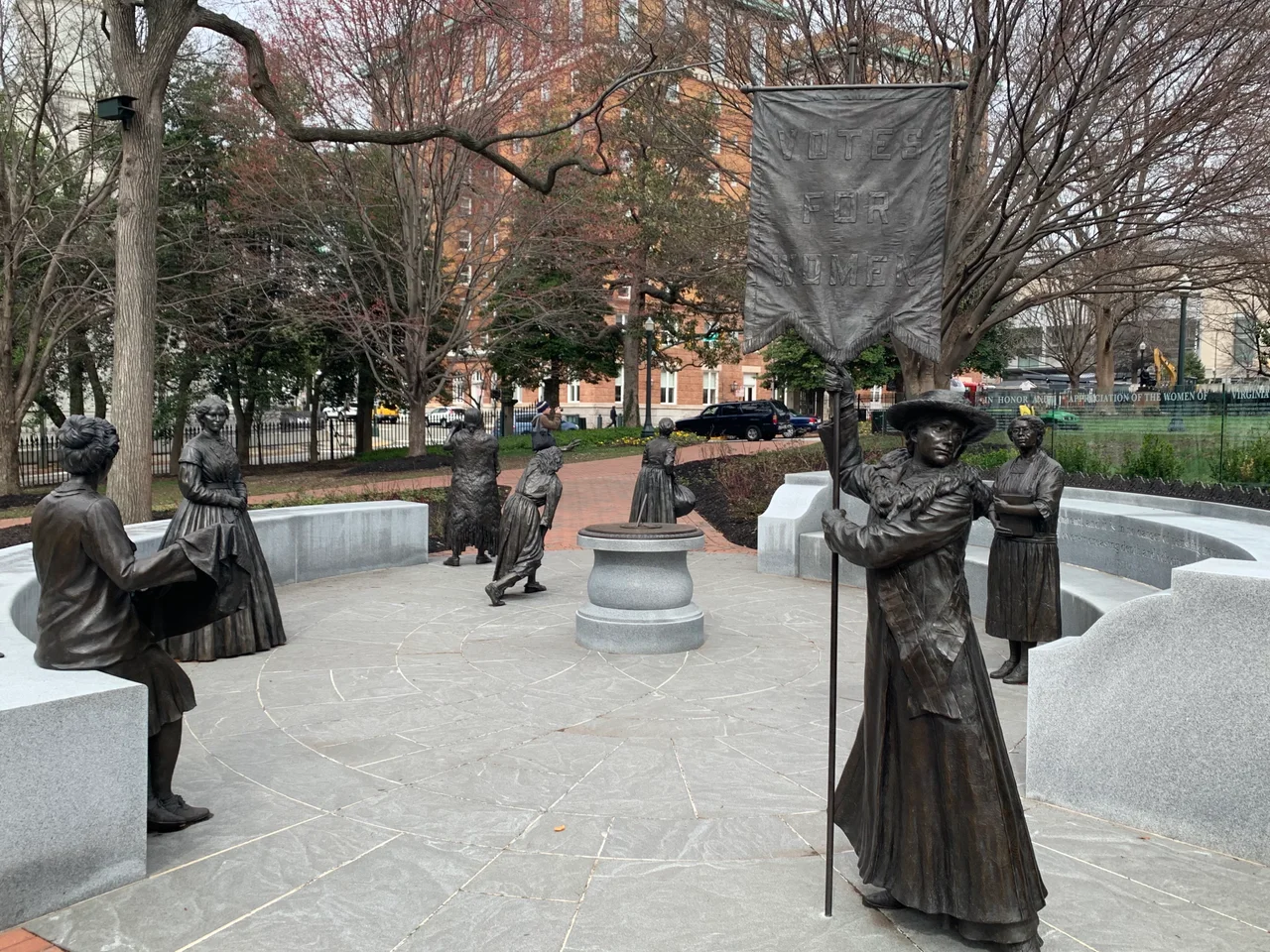

Virginia Women's Monument
The idea came from a 94-year-old. Em Bowles Locker Alsop — a Richmond writer who had once been screen-tested for the role of Scarlett O'Hara in Gone with the Wind — decided in 2009 that the grounds of the Virginia State Capitol needed something more than dead Confederate generals on horseback. She called her state senator, Walter Stosch, and asked him to introduce a resolution. In 2010 the Virginia General Assembly created the Virginia Women's Monument Commission by unanimous vote. Alsop died in 2015 at age 98, three years before the monument opened. The result is titled Voices from the Garden: The Virginia Women's Monument. Eleven life-sized bronze figures stand in a small oval granite plaza on Capitol Square, with two benches and a series of tempered glass panels — the Wall of Honor — etched with more than 200 additional names from four centuries of Virginia women's history.
The First Seven
The first seven statues were unveiled in October 2019, four hundred years after the first English settlement at Jamestown. The roster reaches deep into the Commonwealth's history. There is Anne Burras Laydon, who arrived in Virginia in 1608 as a teenager and became one of the first English women to survive the colony. Adèle Clark, the suffragist and artist who helped found the Equal Suffrage League of Virginia. Mary Draper Ingles, captured by Shawnee warriors in 1755 and famed for her escape and 800-mile trek home through wilderness. Elizabeth Keckly, who was born into slavery in Virginia, purchased her own freedom, became a celebrated dressmaker in Washington, and served as confidante and seamstress to Mary Todd Lincoln. Laura Lu Scherer Copenhaver, a teacher and folk-craft revivalist. Virginia Estelle Randolph, an African American educator whose pioneering work shaped vocational training in segregated Southern schools. Cockacoeske, the seventeenth-century Pamunkey chief who signed the 1677 Treaty of Middle Plantation in her own name. The selection committee deliberately reached beyond the well-known names.
Four More
In May 2022, four more statues were installed to complete the original commission. Sarah Garland Boyd Jones became the first African American woman to pass the Virginia medical board examination, in 1893; she co-founded the Richmond Hospital Association and what later became Richmond Community Hospital. Maggie L. Walker, born in Richmond to a formerly enslaved mother, became in 1903 the first African American woman to charter a bank in the United States — the St. Luke Penny Savings Bank. Her former home on East Leigh Street is now a National Historic Site. Clementina Rind became Virginia's first female newspaper printer and publisher when she took over the Virginia Gazette in 1773 after her husband's death. Martha Washington, born in nearby New Kent County in 1731, served as the inaugural First Lady of the United States. Together with the original seven, the eleven figures span more than four centuries of Virginia women's history, from precolonial sovereignty to twentieth-century civic leadership.
The Wall of Honor
Two benches line the sides of the oval plaza. Behind them, a series of tempered glass panels bears the names of more than 200 additional Virginia women — a roster that ranges across politics, science, the arts, sports, civil rights, medicine, and the messier corners of American history. Pocahontas (Matoaka) and Sally Hemings appear. So do computer scientist Grace Hopper, NASA mathematician Mary W. Jackson — one of the women dramatized in the film Hidden Figures — and Henrietta Lacks, whose cancer cells continue powering medical research seventy years after her death. The list runs from Patsy Cline to Ella Fitzgerald, from chef Edna Lewis to Barbara Johns, the teenage civil rights leader whose 1951 student strike at Robert Russa Moton High School helped bring about Brown v. Board of Education. Sojourners and writers, governors' wives and enslaved laborers, doctors and folk poets — the Wall is deliberately wide. Each name represents a different version of how a Virginia woman might leave a record.
Capitol Square
The monument sits on the same Capitol Square that holds Thomas Jefferson's 1788 Capitol building and Houdon's marble statue of George Washington — long the visual definition of Virginia state authority. By placing eleven bronze women within sight of those older monuments, the General Assembly made an explicit revision to the public space of the Commonwealth. The original plan had included Sally Louisa Tompkins as a separate statue, in addition to the Wall of Honor recognition; the final design substituted other figures. The granite plaza, the benches, the glass panels — the whole installation reads less like a triumphalist monument and more like an invitation. There is room to sit. The bronze figures are life-sized rather than monumental. You can stand beside Cockacoeske at her actual height. You can read 200 names in glass at eye level. The effect is more like joining a conversation than viewing a memorial.
The Politics of Standing Still
Voices from the Garden opened to the public in 2019, in the same Capitol Square where Confederate commemorations had been a fixture of Virginia public space for more than a century. Within two years, most of the major Confederate statues along nearby Monument Avenue had been removed. The Women's Monument stayed put — added to, not subtracted from. It became one of the most-photographed installations on Capitol Square. School groups walk through it. Statehouse visitors detour around it. The eleven bronze women, life-sized and gathered, look like people who have decided to stand in a public square. Which, after centuries of being left out of the official version of Virginia history, is essentially what the monument is saying: they were always here. The state finally noticed.
From the Air
Virginia Women's Monument stands on Capitol Square at 37.54 N, 77.43 W in downtown Richmond. From 1,500 to 2,500 feet AGL, the plaza is visible just south of the Virginia State Capitol building (Jefferson's neoclassical structure with the white-columned portico). KRIC (Richmond International) is approximately 7 nautical miles southeast. Pair with the Capitol grounds, Main Street Station's clock tower a few blocks east, and the James River bend visible to the south.
Nearby Stories
- Kings Dominion 8.4 km away
- Battle of Hatcher's Run 9.7 km away
- Francisco's Fight 14 km away
- Piney Grove at Southall's Plantation 17 km away
- Jamestown Settlement 19 km away
- Battle of Amelia Springs 22 km away
- Menokin 29 km away
- Highland (James Monroe House) 42 km away