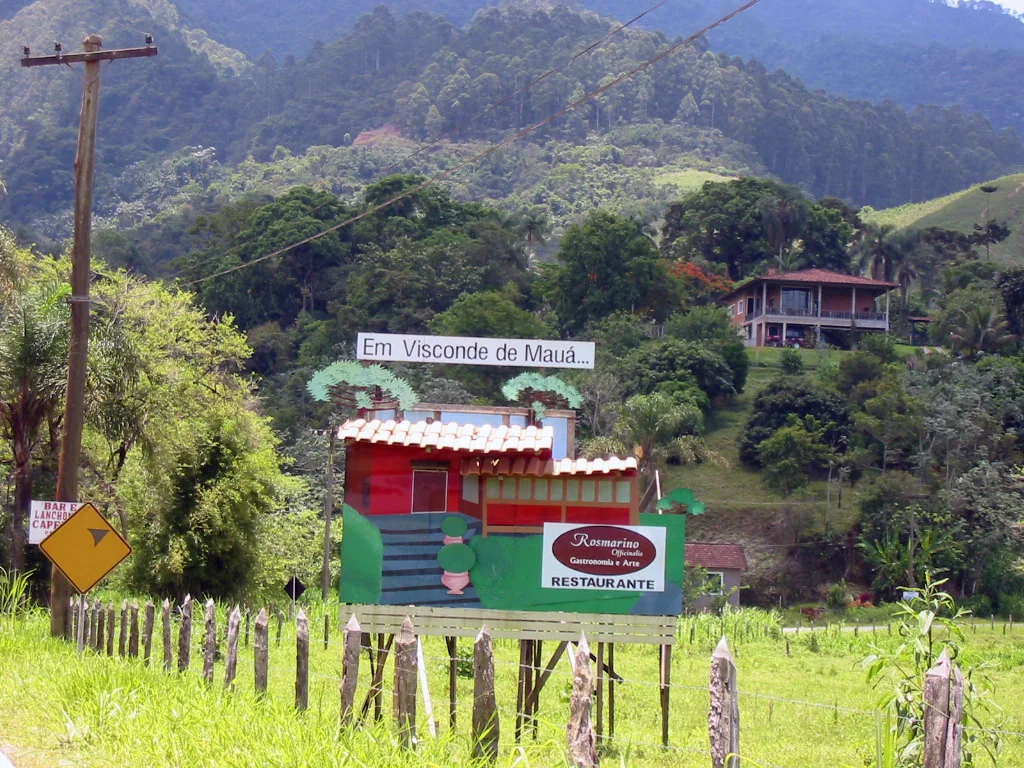

Visconde de Mauá, Resende
Irineu Evangelista de Sousa, Viscount of Mauá, was one of the most important industrialists of imperial Brazil - a banker, railroad builder, and abolitionist who helped modernize the country. In 1870 the imperial government granted him lands high in the Serra da Mantiqueira to harvest timber for charcoal. The viscount never once set foot there. More than a century later, the region bears his name and his absence equally: Visconde de Mauá, a cluster of villages at 1,200 meters elevation, visited each year by thousands of tourists honoring a man who never made the trip.
A Failed Colony, a Stranded German Family
In 1889, the last year of the Brazilian Empire, the viscount's son Enrique Irineu de Souza tried to establish a colonial nucleus on his father's granted lands - a settlement of European immigrants carved from the forested highlands. The enterprise collapsed almost immediately. Most colonists returned to their home countries, unable to make a go of it in the cold, wet mountains. In 1908 the federal government bought the land back and tried again, founding the Colonial Nucleus Visconde de Mauá in a second attempt to attract European settlers. That effort lasted only eight years before closing in 1916. But a handful of German families stayed behind, stubborn on the land their neighbors had abandoned. They were the seed of what the region became.
The Hippies Discover Maromba
Starting in the 1930s, the remaining Germans began inviting relatives and friends from Europe to visit - the earliest tourist activity in a place that now lives off tourism. But the real transformation came in the 1970s, when hippies discovered the village of Maromba. The countercultural migration into the Mantiqueira mountains followed a pattern seen elsewhere in Brazil - urban refugees seeking cheap land, cold rivers, and distance from the cities. By the 1980s, word had spread, and Visconde de Mauá became one of the favorite mountain destinations for tourists from Rio de Janeiro and São Paulo. The hippies brought trout farms, bakeries, pottery studios, and pousadas - small inns that now number over 100 across the three main villages of Mauá, Maringá, and Maromba.
Three Villages and Their Valleys
The name Visconde de Mauá actually refers to a cluster of villages strung across valleys carved deep into the Mantiqueira range. Mauá, Maringá, and Maromba are the principal settlements, but the broader region includes the Vale das Cruzes, Alcantilado, Pavão, and Grama valleys - each with its own waterfalls, its own inns, its own character. The area crosses three state lines and three municipalities: Resende in Rio de Janeiro state, Itatiaia also in Rio, and Bocaina de Minas across the border in Minas Gerais. The villages sit on average 40 kilometers from any of those town centers, tucked into a preserved stretch of Atlantic Forest at 1,200 meters elevation. About 6,000 people live here year-round. Many more cycle through on weekends.
Trout and Pine Nuts
Tourism has shaped what Visconde de Mauá eats. More than a dozen restaurants specialize in trout - raised in the cold mountain streams that the hippies first recognized as perfect for the Northern Hemisphere fish - and in pine nuts from the araucária trees that dot the higher elevations. The araucária, a distinctive umbrella-shaped conifer, is an icon of southern Brazilian highlands and gives these meals their distinctly regional flavor. The climate is what Brazilians call tropical of altitude: mild summers with evening rains, cold and dry winters from June to August when temperatures can drop near freezing. The preservation area surrounding the villages protects the remaining Atlantic Forest, one of the most biodiverse and most threatened ecosystems on Earth.
The Road Still Unpaved
Getting to Visconde de Mauá requires effort. From Rio de Janeiro, it's 200 kilometers on the Dutra highway - BR-116 - until the access point at exit 311, then 34 kilometers on RJ-163, the last 15 of which remain unpaved. From São Paulo it's 300 kilometers and a similar final stretch on gravel. The villages have no banks. Some inns and restaurants don't accept credit cards. GSM phone signal doesn't reach here. Residents and visitors accept these inconveniences as the price of the altitude, the Alcantilado Waterfalls, the cold rivers, the pine nuts roasted over wood fires in kitchens that look out over mist-filled valleys. The viscount who lent his name never came. The mountains themselves are reason enough.
From the Air
Visconde de Mauá sits at 22.33°S, 44.54°W at 1,200 meters elevation in the Serra da Mantiqueira, near the triple border of Rio de Janeiro, São Paulo, and Minas Gerais states. From cruising altitude, look for the dramatic relief of the Mantiqueira range and the much higher Pico das Agulhas Negras in Itatiaia National Park just to the west - at 2,791 meters, one of the highest peaks in southeastern Brazil. Nearest international airports are Rio/Galeão (SBGL) about 200 km east-southeast and São Paulo/Guarulhos (SBGR) about 300 km southwest. Best viewed midday when the mountain valleys are clear of morning fog.
Nearby Stories
- Basilica of Our Lady of Aparecida 31 km away
- Cambuquira 44 km away
- Itajuba 47 km away
- Ibitipoca State Park 48 km away
- Miguel Pereira 49 km away
- Christ the Redeemer: The Statue Built from Soapstone Carried Up a Mountain 81 km away
- Três Corações 95 km away
- Campos do Jordao 115 km away