
Voidokilia Beach
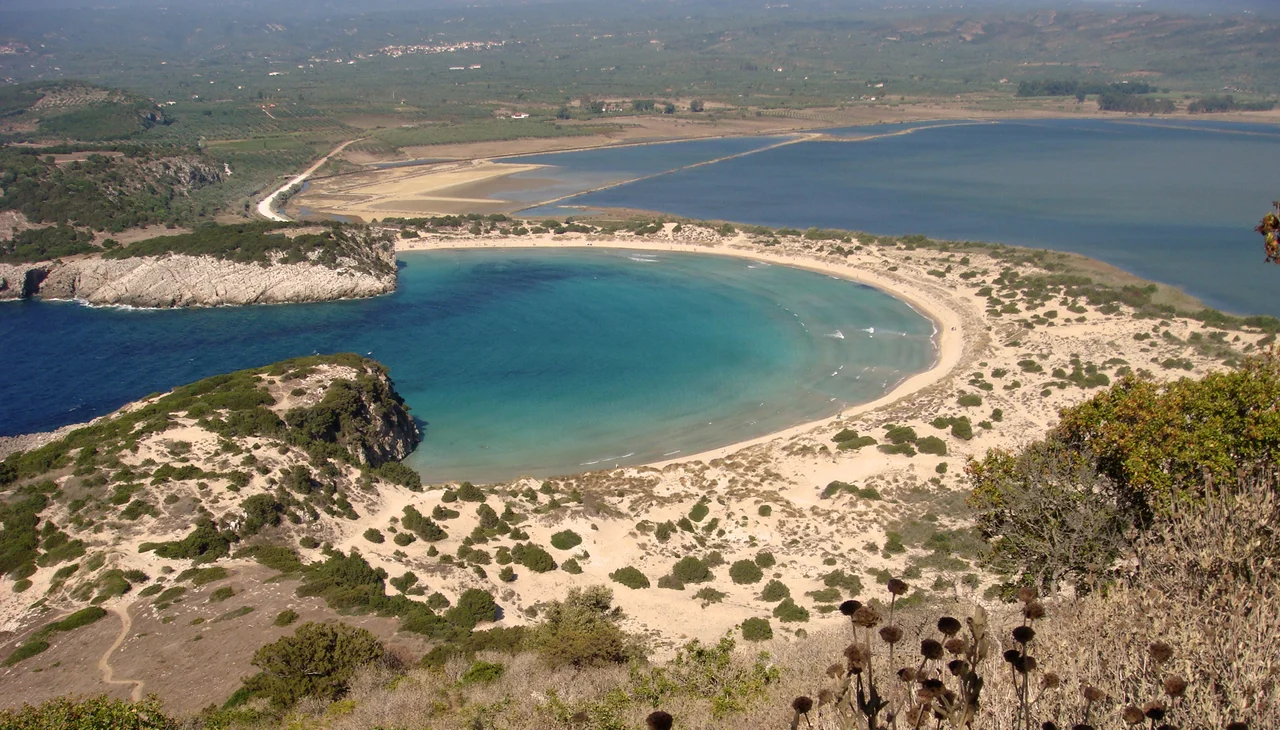
The shape is the thing. Seen from above — from the cliffs of the Frankish castle on the headland, or from any aircraft approach over the Ionian Sea — Voidokilia Beach describes a near-perfect omega, the Greek letter (Ω), in white sand. The geometry feels deliberate, mythological, as if the bay were a sign rather than an accident of geology. Homer called this stretch of coast "sandy Pylos," and scholars have generally agreed: this is probably where Telemachus beached his ship and was welcomed by King Nestor, searching for word of his missing father, Odysseus. The beach has been designated a Place of Particular Natural Beauty and is protected as a Natura 2000 site. It has earned both distinctions.
The Omega Bay
The beach takes its name from the Greek word for ox-belly — an older reference to the bay's curved shape. The white sand forms a semicircular strip of dunes roughly 1.3 kilometres long. On the landward side of the dunes, sheltered from the sea, lies the Gialova Lagoon, one of the most important bird habitats in Greece and the southernmost Habitat of National Importance in the Balkans. The lagoon hosts 258 recorded species of birds, of which 79 are listed in the Greek Red Book as threatened with extinction. Flamingos are present year-round. Rare raptors pass through on migration. The contrast between the open Ionian and this enclosed, reed-fringed lagoon gives Voidokilia an ecological double life: wild sea on one side, still water and wings on the other. Parking is reached via sand tracks from the lagoon side, and the beach is approached on foot across the dunes.
Myth Stacked Upon Myth
Above the southwestern end of the beach, a path climbs to Nestor's Cave — a triangular opening in the limestone cliff, 20 metres wide, 16 metres deep, and up to 30 metres high. The cave carries at least two mythological identities. According to one tradition, Hermes hid here the cattle he had stolen from Apollo. According to the traveller Pausanias, it was where King Neleus kept his own cattle. The cave was first investigated archaeologically by Heinrich Schliemann in 1874. Later excavations, continuing through the 1980s, found material spanning the Final Neolithic through to the Late Helladic period — meaning people had been using this cave for several thousand years before the Mycenaeans built their palace on the hill behind it. From the cave, the path continues upward to the ruins of the Frankish Old Navarino Castle, known as Paliokastro, built around 1278 by Nicholas II of Saint-Omer using stone quarried from the classical city of Pylos that had stood on the same headland.
The Tomb on the Headland
At the northeastern end of the beach, overlooking the bay from a low rise, stands the tholos tomb of Thrasymedes — son of Nestor, according to mythology. The tomb itself is modest in scale: the domed chamber is 5 metres wide, its floor paved with pebbles. It contained about seven burials. Among the finds were arrowheads, necklaces of carnelian and amethyst, and two Mycenaean pottery vessels. The tomb dates from the Mycenaean period, though the site shows occupation as far back as 4000 BC — Neolithic people were burying their dead here long before anyone built a palace up the hill. Around the tomb, archaeologists found Late Classical and Hellenistic votive tablets and a small model of an altar, suggesting the place was used for hero cult centuries after the original burials. The dead of Voidokilia were remembered for a very long time.
Where the Layers Overlap
What makes Voidokilia unusual, even among Greece's extraordinarily layered archaeological landscape, is the density of time compressed into a single view. From the water's edge, you can see the cave where Hermes (or Neleus, depending on your source) kept stolen cattle. Climb ten minutes and you reach the cave. Climb another ten and you walk through the ruins of a medieval Frankish castle. The tholos tomb sits to your right. The lagoon stretches behind you. Homer's Telemachus may have stood on this beach. Neolithic people left bones in a cave above it. Frankish knights looked down from the cliff. The beach itself — white, curved, protected — remains largely unchanged through all of it. The sand does not seem to mind what century it is.
From the Air
Voidokilia Beach sits at approximately 36.964°N, 21.663°E on the western coast of Messenia, just north of the mouth of Navarino Bay. The nearest airport is LGKL (Kalamata International), about 45 km to the northeast. From the air, the beach is unmistakable: the perfect omega-shape of white sand is visible from several kilometres away, especially on a clear day. Approach from the northwest at 1,500–2,000 feet for the full panorama — the enclosed lagoon on the landward side, the open Ionian Sea beyond, and the ruined castle on the headland to the south. In summer, the water is a vivid turquoise-green against the white sand. Gialova Lagoon directly behind the beach is a distinct dark patch amid the dunes.
Nearby Stories
- 1986 Kalamata Earthquake 2.8 km away
- Peloponnese 20 km away
- Kalamakia Cave Site 21 km away
- Lepreum 22 km away
- Strofades 29 km away
- 2018 Ionian Sea Earthquake 55 km away
- Apidima Cave 67 km away
- Valletta 597 km away