_02.jpg)
Volimidia
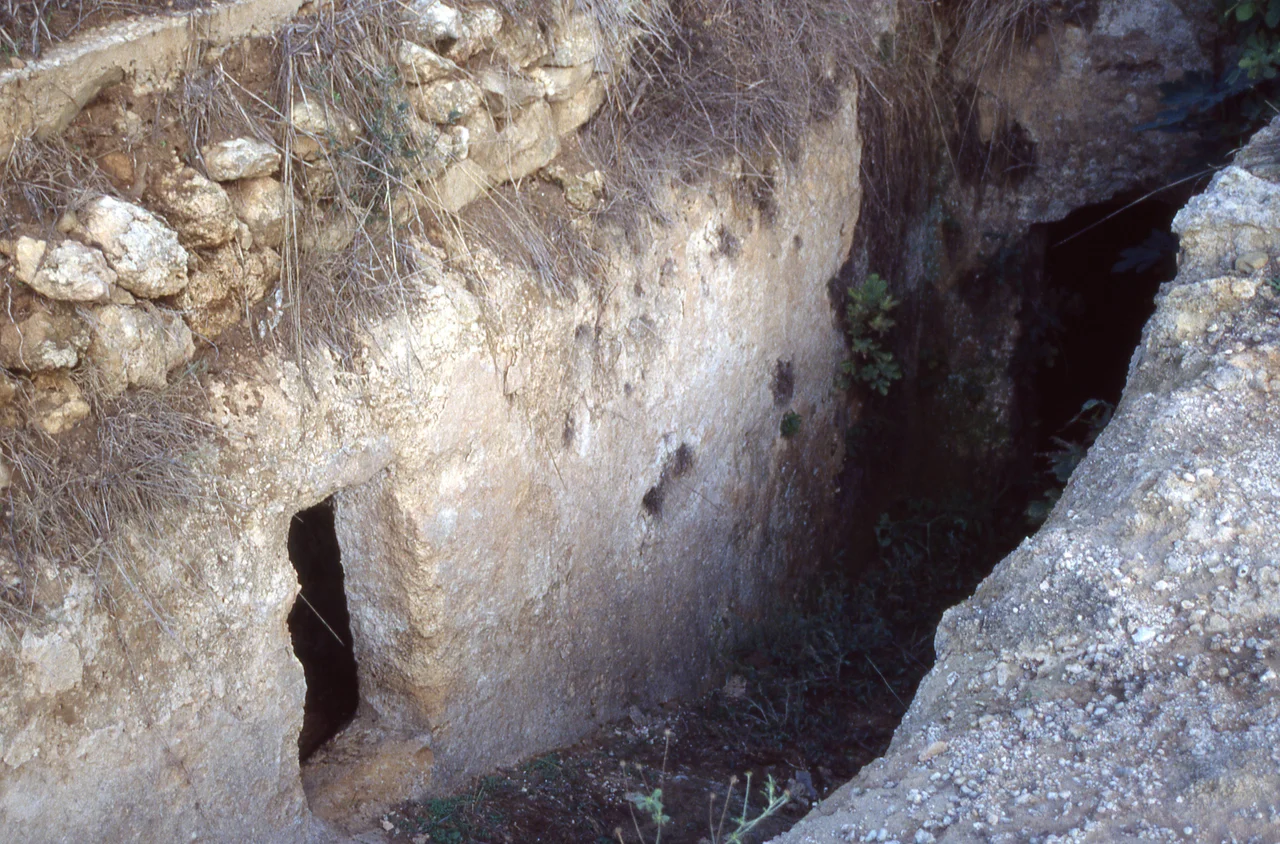
The very name gives the site away. Volimidia comes from the Greek word βουλιάζω — the tendency of ground to collapse. Walk the hillside about 800 metres north-northeast of modern Chora and you understand: the earth here is soft and full of holes, tunnelled out over three thousand years by the people who made this place their cemetery. Thirty-five Bronze Age tombs have been identified at Volimidia, dug from the Late Bronze Age and used, reopened, venerated, and refilled long after the Mycenaean world had ended. It is one of the most continuously inhabited burial grounds in Greece.
Tombs Unlike Any Other
The chamber tombs at Volimidia are architecturally unusual. Most Mycenaean chamber tombs have square rooms and sloped roofs; these have rounded chambers and domed ceilings, closer to the grander tholos tombs built by elites elsewhere in Messenia. Scholars still argue about what this means. Spyridon Marinatos, who excavated most of the site between 1952 and 1965, believed the Volimidia tombs were actually the origin of the circular chamber form, predating the great tholos tradition. Carla Antonaccio has suggested they might simply be categorised as small tholos tombs. What is clear is that the community that built them was doing something architecturally distinct from its neighbours — making tombs that punched above their apparent social weight. The 35 tombs are organised into five named clusters, roughly 100 metres apart, each cluster probably representing a different family or kin group. The largest, the Angelopoulos cluster, contains eleven tombs.
What the Dead Were Given
The burials at Volimidia are striking not just for their architecture but for their restraint. Most Mycenaean elite graves are famous for what they contain: gold death masks, bronze swords, amber beads, imported Minoan luxury goods. Volimidia is notable for what it lacks. Bronze weapons are almost entirely absent. Jewellery is rare. The bodies were placed in an extended position — a practice shared with tholos burials — and the grave goods were mostly pottery drinking vessels, along with occasional flint and obsidian arrowheads. Two tombs in the Angelopoulos cluster held sealstones. One tomb contained a stirrup jar similar to Minoan Cretan examples, possibly an import or a local imitation. The picture that emerges, according to scholar Andreas Vlachopoulos, is of a community that was relatively modest in wealth and not particularly invested in using funerary display to signal social status. They buried their dead carefully, without show.
Remembering the Dead for Centuries
The tombs at Volimidia were not sealed and forgotten after the Mycenaean period ended around 1180 BC. They were reopened. Generation after generation came back to leave offerings, conduct sacrifices, and inter additional burials in the chambers their ancestors had cut. This practice of "tomb cult" — re-engaging with Mycenaean burials as sacred ancestor-sites — intensified after 369 BC, when Messenia won independence from Sparta. Susan Alcock has argued that under Spartan domination (which lasted from roughly the eighth century until 369 BC), the cult activity at Volimidia may have served as a form of cultural resistance — a way for Messenians to maintain a sense of shared identity and deep-rootedness in their own land. After independence, the evidence for ritual activity at the site increases dramatically. The Hellenistic reuse of the tombs included funerary pyres, pig sacrifices, coin offerings, and pit burials — an extraordinary palimpsest of worship compressed into chambers first dug more than a thousand years earlier.
Servants of the Goddess
Volimidia may have been more than just a cemetery. Linear B tablets from the Palace of Nestor mention a religious centre near Pylos called Sphagianes — a place dedicated to the goddess Potnia, possibly the chief goddess of the Pylian religious calendar. Most of the people listed as holding land at Sphagianes are described with titles connected to religious cult, including forty-six individuals recorded simply as "servants of the god." One of them is the priestess Eritha, whose land dispute survives as one of the most detailed accounts of an individual from Mycenaean Greece. In 1972, scholar John Chadwick suggested that Volimidia and Sphagianes were the same site. The hypothesis has been endorsed by several subsequent scholars, though not universally accepted. If correct, the tombs at Volimidia were not just the resting place of a local community — they were part of a living sacred landscape, watched over by a goddess, served by dozens of named people whose records survived in a burning palace four kilometres to the southwest.
From the Air
Volimidia sits at approximately 37.058°N, 21.724°E, about 800 metres north-northeast of Chora in Messenia. The nearest airport is LGKL (Kalamata International), roughly 40 km to the northeast. The site is not visually dramatic from the air — it appears as a low hillside amid agricultural land — but it lies within a rich landscape that rewards aerial observation. To the south-southwest, Voidokilia Beach's omega shape is visible, as is the ruined headland castle above it. The Palace of Nestor at Epano Englianos lies approximately 4 km to the southwest. Approach from the east at 2,000 feet for the clearest view of the Messenian plain and the relationship between these interconnected Mycenaean sites.
Nearby Stories
- 1986 Kalamata Earthquake 2.8 km away
- Peloponnese 20 km away
- Kalamakia Cave Site 21 km away
- Lepreum 22 km away
- Strofades 29 km away
- 2018 Ionian Sea Earthquake 55 km away
- Apidima Cave 67 km away
- Valletta 597 km away