.jpg)
Walnut Tree Viaduct
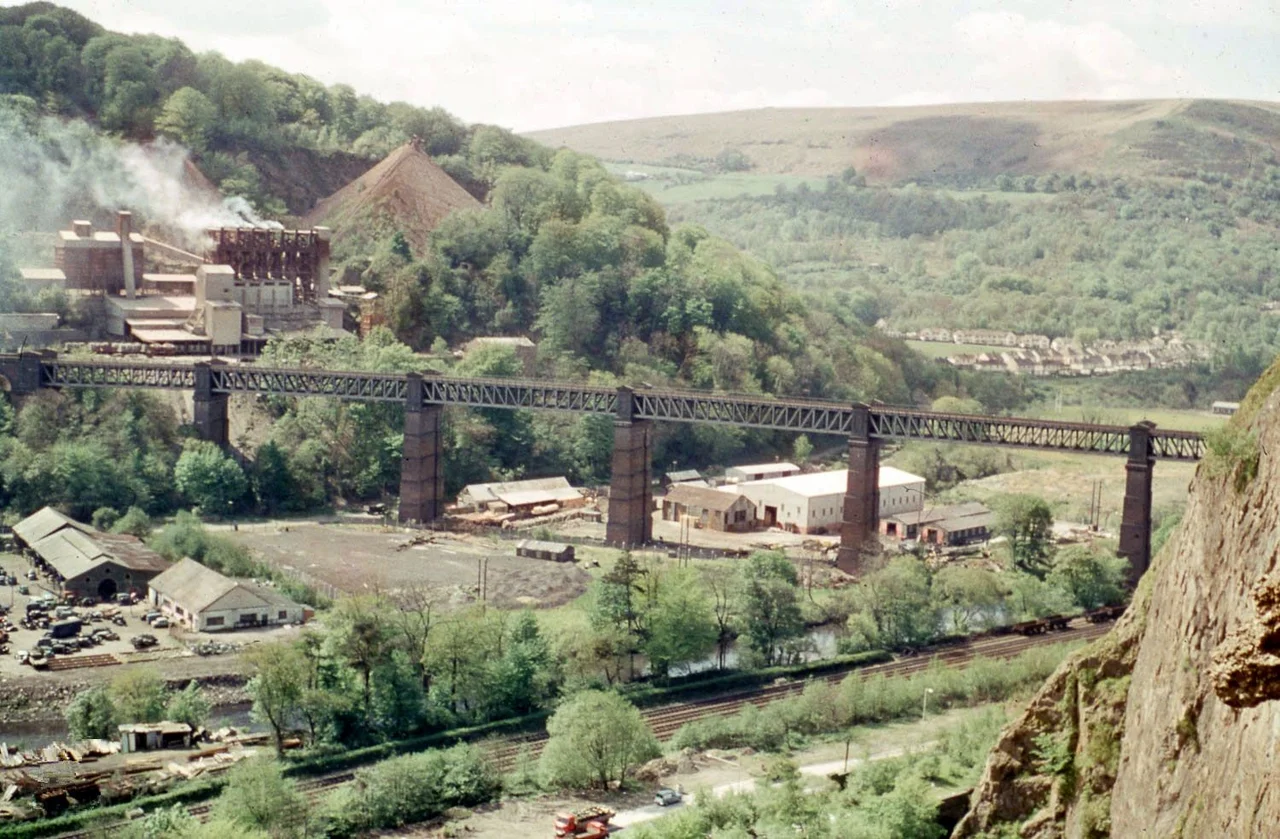
Drive south from Pontypridd on the A470 toward Cardiff and you will pass, on the right just north of Radyr, two solitary brick pillars rising out of nothing. They look like the entrance gateposts to a vanished estate. They are in fact what is left of the Walnut Tree Viaduct, a steel-girder structure 1,548 feet long and 120 feet high that crossed the River Taff at Taffs Well from 1901 to 1969. The road improvements of the 1960s needed the line that the viaduct stood on, and the demolition crew that spent five years dismantling the piers had to do most of the work by hand because the valley was too congested for heavy machinery. By 1974 there was nothing left of it but the two pillars, kept because the contractors could not quite work out how to take them down without damaging the road.
Breaking the Bute Monopoly
The viaduct was born of frustration. By 1880 the Taff Vale Railway and Cardiff Docks - both controlled by the Marquess of Bute and his estate - had become the only practical export route for South Wales coal. Pontypridd station was a bottleneck. The single double-track line south of it could not be widened because the valley pinched in too tight. Mine owners watched their loaded wagons sit for hours waiting for clear track. David Davies of Ocean Collieries had had enough. He gathered other industrialists - coal owners, iron makers, fellow rebels against the Bute interests - and proposed a new railway altogether, terminating not at congested Cardiff but at Barry, where deep water and easier tides would allow a more modern dock. The Barry Dock and Railway Bill failed in 1883 under Bute opposition. Davies brought it back in 1884, and on 14 August the Act passed. Construction began. By 1889 the Barry Railway connected Barry Docks to the Taff Vale line at Hafod Junction in the Rhondda.
The Llanbradach Branch
Davies wanted more. He wanted access to the Rhymney Valley and the great iron works at Dowlais up at Merthyr Tydfil. So the Barry Railway proposed a branch from its main line at Tynycaeau Junction near St Fagans, running northeast through Walnut Tree across the Taff valley to a junction with the Brecon and Merthyr Railway at Llanbradach. No passenger stations - it was a pure freight artery, built for coal trains running at maximum speed. The line passed through the 490-yard Walnut Tree Tunnel, served a dolomite siding, then curved across the squeeze-point just north of Radyr where the Taff, the Taff Vale Railway, the Cardiff Railway and the River Taff all crowded into a narrow gap. Above all of that, the viaduct had to span 1,548 feet, curve at one end to meet a rock shelf on the eastern hillside, and stand high enough that the trains above would not interfere with the railways below. James Szlumper, the Barry Railway's chief engineer, surveyed the site. He had built the main line and he knew the valley.
Steel, Not Stone
Szlumper studied the Crumlin Viaduct, Charles Liddell's earlier iron triumph forty years east. He reached the same conclusions: a stone bridge of this height would create dangerous wind compression around its piers, and importing the stone would be expensive because the local rock was poor for masonry. So he specified steel lattice girders set on brick supporting piers. The structure went up in under twelve months, an extraordinary pace for a Victorian engineering project of this scale. Seven spans crossed the valley. The maximum height was 120 feet. The whole structure curved slightly at its western end where the line bent onto the rock shelf. It opened in 1901, just as the South Wales coal trade was hitting its peak. Coal trains rolled across it day and night, hauling Rhondda steam coal down toward Barry rather than toward Cardiff, exactly as David Davies had intended.
The Short Glory
The Llanbradach branch had a short life. The Great Western Railway absorbed the Barry Railway in 1922 under the grouping that consolidated Britain's railways into four large companies. By the early 1930s the GWR had decided the line north of Penrhos Lower Junction was redundant. Three viaducts on that section - including the Penrhos, the Penyrheol and the great Llanbradach Viaduct - were demolished and sold for scrap by the end of 1937. Today only one brick arch survives at Llanbradach, hidden in undergrowth. The southern section through Walnut Tree kept working into the British Railways era, but slowly. After a fire destroyed the Tynycaeau Junction signal box on 31 March 1963, BR did not rebuild it. The section south of Walnut Tree tunnel was downgraded to a long siding. Double track was lifted in August 1965. By the late 1960s only one customer remained - the Steetley Dolomite limestone quarry just south of the viaduct - and the last train ran across the viaduct in 1967.
Down by Hand
The A470 road improvements made the demise certain. Two of the viaduct's brick pillars stood directly in the path of the planned new road. Demolition began in 1969 and dragged on until 1974. The valley bottom was too congested for cranes and explosives - the railways below were still active, the river ran through, the road carried traffic. So the contractors took the viaduct down piece by piece, mostly by hand, working from scaffolding bolted to the surviving spans. Photographs from the period show the structure shrinking month by month. By 1974 it was gone. All that survives are the two brick pillars that the contractors decided to leave standing - perhaps because removing them would have been more trouble than it was worth, perhaps as a quiet memorial. They are still there today, mossed and scarred, standing in line with the A470. Drivers pass them at sixty miles an hour and rarely notice. For nearly seventy years a viaduct ran above this spot, and the trains that crossed it carried out an industry that no longer exists.
From the Air
The two surviving pillars of the Walnut Tree Viaduct stand at 51.5372 degrees north, 3.26167 degrees west, at the southern edge of Taffs Well in the Taff valley. From the air the location is identifiable by the A470 dual carriageway running through a narrow valley between wooded hillsides about 5 nautical miles north of Cardiff. Cardiff Airport (EGFF) lies about 9 nautical miles south-southwest; Bristol (EGGD) is about 31 nautical miles east. The two surviving brick piers are best seen from low altitude visual flight - they sit immediately east of the A470 carriageway and are visible from the road. The Taff valley's tightly stacked geography of road, river and railway is one of the most photogenic transport corridors in Wales.
Nearby Stories
- Tidal Lagoon Swansea Bay 2.6 km away
- Skenfrith Castle 3 km away
- Caerwent 3.7 km away
- Brecon Beacons National Park 5.2 km away
- Cheddar Gorge 6 km away
- Battle of Cadfan 9.3 km away
- Minehead Lifeboat Station 16 km away
- Ilfracombe Lifeboat Station 22 km away