
Warrington rail crash
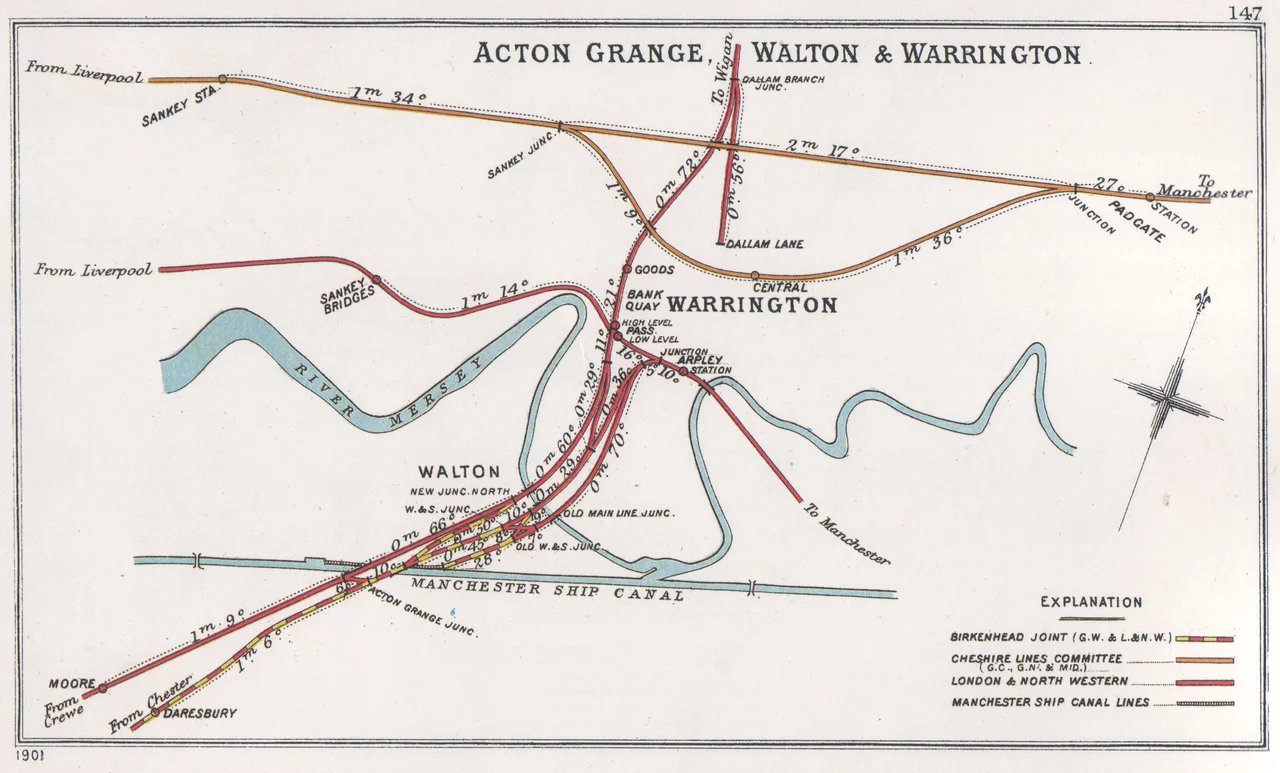
The London-bound express was running ten minutes late out of Liverpool Lime Street on the morning of 29 June 1867, which is the sort of detail that gets recorded after an accident and rarely matters before one. The driver had left Warrington Bank Quay station at 11:35, building speed for the run south. About a mile out, just past where the line crossed the Mersey on Walton Bridge, the tracks of the London & North Western Railway diverged from those of the Birkenhead Railway at Walton Junction. A coal train was being shunted across the junction. The driver of the express could see it on the line ahead, but he assumed the points would be thrown back to clear his route before he reached them. They were not. Five passengers died where the engine struck the coal wagons. Three more died of their injuries in the days that followed.
The Pointsman in the Dock
The coroner's jury did not equivocate. They blamed John Rowson, the pointsman on duty, for failing to reset the junction. But they used the same verdict to send a message to the railway company: the system itself, not just the man, was at fault. They recommended that Walton Junction adopt a new method of signalling and points. Rowson was charged with manslaughter in July 1867. He was a working man, employed to move heavy iron levers in a wooden cabin, expected to remember every train movement in his head and his pencil-marked register. The Birkenhead Railway expected human memory to do work that today would be done by automatic interlocking. When his memory failed, eight people died and he was sent to the assize court.
How Eight Deaths Changed a Network
The Board of Trade enquiry made a recommendation that ended up shaping British railways for the next century and a half. Points, the enquiry said, must be interlocked with signals. A train should only be able to receive a clear signal into a section of track when the points along that section are physically and mechanically committed to the route the signal implies. If the points are set wrong, the signal cannot be cleared. If the signal is cleared, the points cannot be moved. The principle is so straightforward that it seems strange to learn there was a time when British railways did not work this way. Walton Junction in 1867 was one of the deaths that pushed the Board of Trade and Parliament toward making interlocking compulsory across the network. By the 1889 Regulation of Railways Act, it was.
The Junction That Vanished
Walton Junction did not survive long after the accident that made it famous. In the 1890s the Manchester Ship Canal was driven through Cheshire on its way to Manchester, and the canal builders needed to cross the Mersey south of Warrington. Rather than build separate bridges for the LNWR and the Birkenhead Railway, the engineers consolidated the two lines onto a single four-track bridge a little to the north of the original alignment. The old Walton Junction, where the 1867 collision had happened, no longer carried through trains. It became a stub serving a marshalling yard, then faded out of operational use altogether. Acton Grange Junction, where the new four-track bridge crossed the canal, took over. Today a flyer skirts the area south of Warrington Bank Quay station, and few of the cars on the M62 just to the north realise that the embankments they pass were once a busy main-line junction.
The Quiet Inheritance
There are no memorials at the site of the Warrington rail crash. The names of the dead were recorded in the Times across four days in July 1867, and then mostly forgotten outside specialist railway histories. But the principle that came out of the enquiry, that points must lock with signals and signals with points, is still the foundation of every signal box, every relay interlocking, and every modern computer-based interlocking on the British network. Every time a passenger train rolls through a major junction in the United Kingdom without piling into the back of a slower one ahead, the mechanism that keeps it safe traces its ancestry, in part, to a pointsman named John Rowson who forgot to throw a lever on a summer morning a hundred and fifty-eight years ago.
From the Air
The accident site lies at approximately 53.362N, 2.625W, on the line south of Warrington Bank Quay station. From the air, the modern equivalent is Acton Grange Junction, where the West Coast Main Line crosses the Manchester Ship Canal on a four-track girder bridge about a mile south of Warrington. The original Walton Junction was a short distance to the south, now buried under railway embankments and industrial land. Recommended viewing altitude 2,500-4,000 ft for the junction layout, the river crossing, and the canal. Nearest airports: Liverpool John Lennon (EGGP) 14 nm west, Manchester (EGCC) 16 nm east, Hawarden (EGNR) 18 nm southwest.
Nearby Stories
- Anson Engine Museum 1.3 km away
- West Kirby 2.9 km away
- Battle of Nantwich 6.2 km away
- Winter Hill Air Disaster 8.3 km away
- Horseshoe Pass 8.8 km away
- Caverswall Castle 12 km away
- Murder of Lindsay Rimer 15 km away
- Piel Castle 50 km away