_June_2013.jpg)
Anacostia
Frederick Douglass spent the last seventeen years of his life in a house on a hilltop in Anacostia, surveying the Capitol dome across the river from his front porch. He moved there in 1878, after Reconstruction had failed and the country was sliding back into the violence of Redemption. The neighborhood directly below his house, Uniontown, would not let him buy a home within its segregated streets. So he bought Cedar Hill - higher ground, better views, and just outside Uniontown's covenant restrictions. The house is now a National Historic Site, and Douglass is still claimed by Anacostia as its Sage. The neighborhoods east of the Anacostia River are the part of Washington most metropolitan residents reflexively flinch from. They are also the part with the longest continuous Black history, the highest concentration of public parkland, and a particular kind of view of the federal city most visitors never see.
The Nacochtank's River
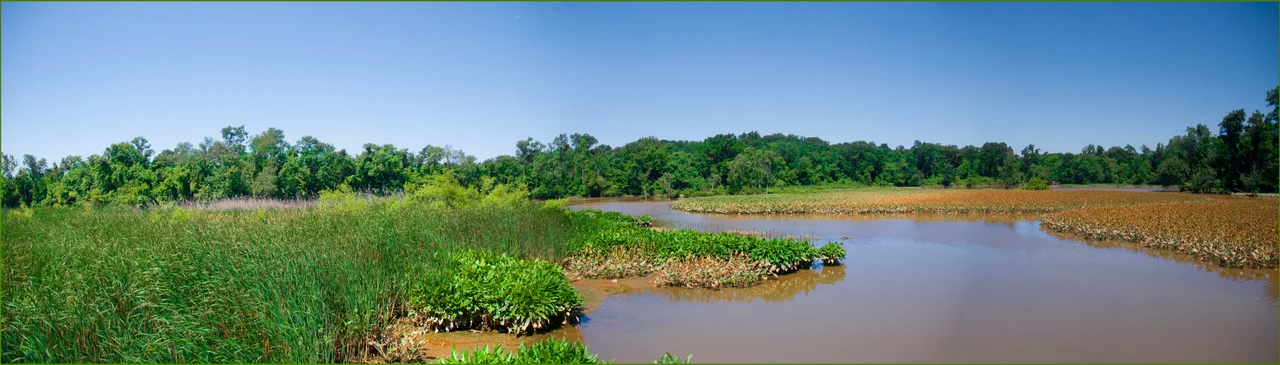
The river that gives the neighborhood its name carries the memory of the Nacochtank people, who lived in a small settlement on its banks before European colonization. The English called them Anacostan; over time the name shifted to Anacostia. Most of what is now East of the River was once tidal marsh. The marshes were drained, mostly, in the 19th and 20th centuries as Washington grew - except for one preserved corner at Kenilworth Aquatic Gardens, where Civil War veteran and amateur horticulturalist Walter B. Shaw purchased the land in 1879 and began planting water lilies in the early 1880s. His daughter Helen Shaw Fowler turned the operation into a commercial water-lily farm and lobbied to save it from the federal dredging that wiped out most of the rest of the wetland. The gardens became part of the National Park Service in 1938. In July the lotus blooms cover acres of shallow ponds in deep pink and bright yellow.
Uniontown and the Sage
Uniontown was platted in the 1850s on the south side of the river to give workers at the Washington Navy Yard cheaper housing close to their jobs. The deeds prohibited sale to Black residents, which is why Frederick Douglass bought outside the development boundary at Cedar Hill in 1877. Douglass was already in his sixties, already famous as the most prominent Black intellectual of the nineteenth century, already a former U.S. Marshal for the District of Columbia. From Cedar Hill he wrote, spoke, and ran an unofficial salon. He died at the house on February 20, 1895, after returning from a National Council of Women meeting. His widow Helen Pitts Douglass preserved the house and its contents; the home opened as a museum in 1922. The Smithsonian Anacostia Community Museum, two miles east, opened in 1967 as the first federally funded community museum in the country.
How a White Neighborhood Became Black
After World War II, Anacostia changed faster than perhaps any neighborhood in any major American city. In 1950 the population was nearly 90 percent white. By 1970 it was over 90 percent Black. Three forces drove the change. First, the 1950 desegregation of D.C. public schools - the first fully integrated system in the country - prompted white families to leave the city for the suburbs of Maryland and Virginia, where the schools were still legally segregated. Second, the construction of Interstate 295, the Anacostia Freeway, severed the Anacostia neighborhoods from their own riverfront in the 1960s. Third, a series of massive public housing projects concentrated D.C.'s lowest-income residents east of the river, far from the services concentrated downtown. By 1957 Washington was the first majority-Black city in the United States, and a large share of that Black population lived in Anacostia and the neighborhoods around it.
The Famous, the Notorious, the Local
Marvin Gaye grew up in Deanwood, a neighborhood in Northeast D.C., attending Cardozo High School before he moved north to Motown. He returned often, including to record demos and visit family. Ezra Pound, the poet, was confined at St. Elizabeths Hospital in Anacostia from 1945 to 1958 - found unfit to stand trial for treason after his wartime broadcasts for fascist Italy - and wrote much of the Pisan Cantos and the Rock-Drill section while incarcerated there. Marion Barry, who served four terms as D.C. mayor between 1979 and 1999, lived for years in Ward 8 and represented it on the D.C. Council after his federal conviction for crack cocaine possession in 1991. The 1990 arrest happened in a downtown hotel, captured on FBI surveillance video that became one of the most replayed political moments of the decade. Barry's later return to elected office, repeatedly, said something specific about who Anacostia felt was looking out for it and who wasn't.
The Big Chair and What's Coming
The Big Chair is exactly what it sounds like: a 19-foot, four-and-a-half-ton mahogany chair built in 1959 as a marketing piece for Curtis Brothers Furniture on Martin Luther King Jr. Avenue. Curtis Brothers is long gone. The chair is still there, replaced with an aluminum cast in 2006 because the original had finally rotted out. It is the unlikely visual anchor of the neighborhood. Around it the conversation about Anacostia's future continues: development at the 11th Street Bridge, the Anacostia Riverwalk Trail that finally reconnects parts of the neighborhood to its river, the slow accretion of restaurants on MLK Avenue. Ron Suskind's 1998 book A Hope in the Unseen followed Cedric Jennings from Ballou High in Anacostia to Brown University - an exceptional journey from a school system that has been failing the neighborhood for decades. The homicide rate has come down sharply from its early-1990s peak, though it remains higher than the rest of the city. What Anacostia has needed for as long as anyone alive can remember is reliable federal investment in a part of the federal city that the federal city kept building over. The conversation about whether that will finally happen is the conversation about whether the next chapter of the neighborhood looks different from the last one.
From the Air
Anacostia is centered at approximately 38.867 N, 76.966 W in southeast Washington, D.C., on the high ground east of the Anacostia River. The neighborhood sits within the inner ring of the Washington Flight Restricted Zone, prohibiting general aviation traffic without explicit clearance. Reagan National Airport (KDCA) is four miles southwest. Joint Base Anacostia-Bolling, formerly Naval Support Facility Anacostia and Bolling Air Force Base, sits along the river immediately west of the neighborhood. From altitude, Cedar Hill (Frederick Douglass National Historic Site) is identifiable on the highest ridge in the area, with broad views back toward the Capitol; Kenilworth Aquatic Gardens forms a distinct circular pattern of pondscape at the river's northern bend.
Nearby Stories
- Reston, Virginia 1.7 km away
- Thomas Viaduct 9.2 km away
- Monocacy Aqueduct 9.7 km away
- Stafford County, Virginia 26 km away
- Harriet Tubman Underground Railroad 28 km away
- Gunston Hall 30 km away
- Adkins Arboretum 31 km away
- Bombay Hook National Wildlife Refuge 71 km away