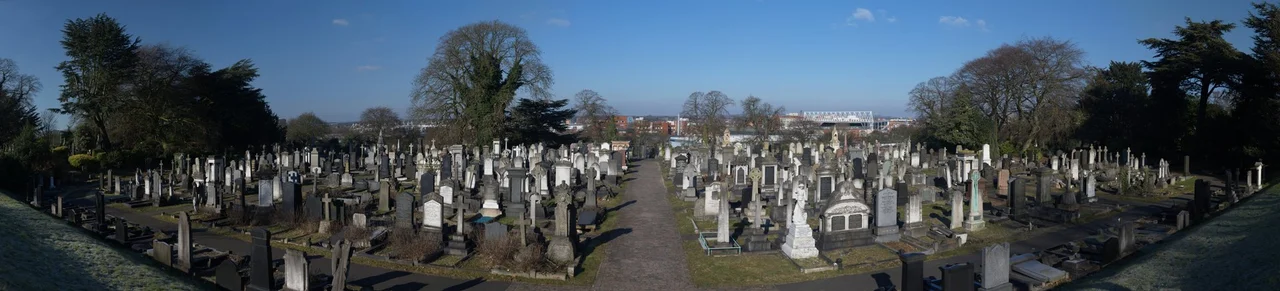

Welford Road Cemetery
Thomas Cook is buried in Welford Road Cemetery, and that is something to think about. The man whose name became a global travel company and an English verb for going on holiday, the man who took working-class teetotallers on rail excursions to Loughborough in 1841 and from there built an empire that put package tours in the reach of ordinary people, ended up in the same Leicester churchyard as Napoleonic veterans, cricketers, cyclists, and architects. He died in 1892. His company outlasted him by 127 years before going bankrupt in 2019. He is still here.
A Victorian Necessity
The Leicester General Cemetery Company was founded in 1845, and the cemetery itself opened in 1849. The mid-nineteenth century was producing dead Leicester residents faster than the city's parish churchyards could accommodate them, and the new commercial cemeteries were both a public health necessity and a Victorian moral project. J. R. Hamilton and J. M. Medland, who also designed cemeteries for Birmingham and Plymouth, laid out Welford Road with roughly equal areas of consecrated ground for Anglicans and unconsecrated ground for everyone else, a small architectural acknowledgment of religious dissent. The two chapels at the centre have since been demolished, as has a Gothic Revival lodge by the main entrance. What survives is a war memorial whose statue was designed by Sir Reginald Blomfield, the architect who also gave Britain the Cross of Sacrifice that stands in Commonwealth War Graves cemeteries worldwide.
One Hundred Stories Under the Trees
Leicester City Council publishes a leaflet identifying one hundred notable burials within the cemetery, and a careful afternoon's walk among them is a tour of nineteenth- and twentieth-century English life. William Green served as a soldier through the Napoleonic Wars and survived to be buried with his medals here. Ewart Astill played cricket for Leicestershire County Cricket Club for decades, an all-rounder good enough to tour with England. Bert Harris was a professional cyclist of the late Victorian era, when bicycle racing drew crowds the size of football matches. John Flower (1793-1861) painted Leicestershire's churches and country houses with a precise topographical eye. Arthur Wakerley designed the buildings around the city centre that still give Leicester its distinctive Edwardian character. Commemorative plaques throughout the cemetery tell their stories, biographies in a hundred words or fewer, a quietly democratic local history project.
The Toppled Headstones
Between 2002 and 2004 Leicester City Council carried out a stability assessment on around a thousand of the cemetery's memorials, and laid them flat. The procedure is known in the cemetery industry as topple-testing, and it follows a series of incidents elsewhere in Britain in which decaying gravestones fell on visitors. The intent was protective. The execution caused enormous distress, particularly among the descendants of 119 people of Polish origin whose family graves were among those laid down. Many of these were Poles who had come to Leicester after fighting alongside the British in the Second World War, and the sight of their parents' and grandparents' memorials flattened to the ground felt like a second loss. The council had not obtained a faculty, the formal church-court permission required to alter consecrated ground, before doing the work. They applied for one retrospectively. The Consistory Court rejected the application. On appeal to the Court of Arches in 2006, the faculty was granted, but only on the condition that the council work with the Friends of Welford Road Cemetery and the local Polish community to restore the toppled memorials. The work is ongoing decades later. A cemetery, it turns out, is not just stone and grass but a covenant between the living and the dead, and that covenant is not easily set aside.
What a Cemetery Is For
Welford Road Cemetery is still an active burial ground, although most of its space is now occupied by people who died long before anyone alive can remember them. The Friends of Welford Road Cemetery run guided walks and research the unmarked graves. The Leicestershire and Rutland Family History Society publishes detailed indexes for genealogists tracing relatives back through nineteenth-century Leicester. The grounds, with their mature trees and stone monuments, are also a quiet green corner of an otherwise dense city. Joggers use the paths. Birds nest in the avenues. The whole place is a working demonstration that what cities most need from their dead is not separation but proximity, and that a Victorian commercial cemetery, founded as a practical solution to a public health problem, can become with time something closer to a museum, a park, and an ongoing conversation among generations.
From the Air
Welford Road Cemetery, Leicester (52.621 N, 1.128 W). The cemetery occupies roughly 28 acres on Welford Road, half a mile south of Leicester city centre, between the Royal Infirmary and the King Power Stadium of Leicester City FC. East Midlands Airport (EGNX) is 22 miles north-west. From low altitude the cemetery is visible as a tree-filled rectangle of green among the dense terraced housing of central Leicester. Best viewed in autumn when the mature limes and chestnuts colour the grounds.
Nearby Stories
- National Shell Filling Factory, Chilwell 1 km away
- Staffordshire Regiment Museum 2 km away
- Rutland Water 3.3 km away
- Grantham 4.4 km away
- Wellingborough 9.9 km away
- Croxden Abbey 11 km away
- Bordesley Abbey 14 km away
- Electric Railway Museum 17 km away