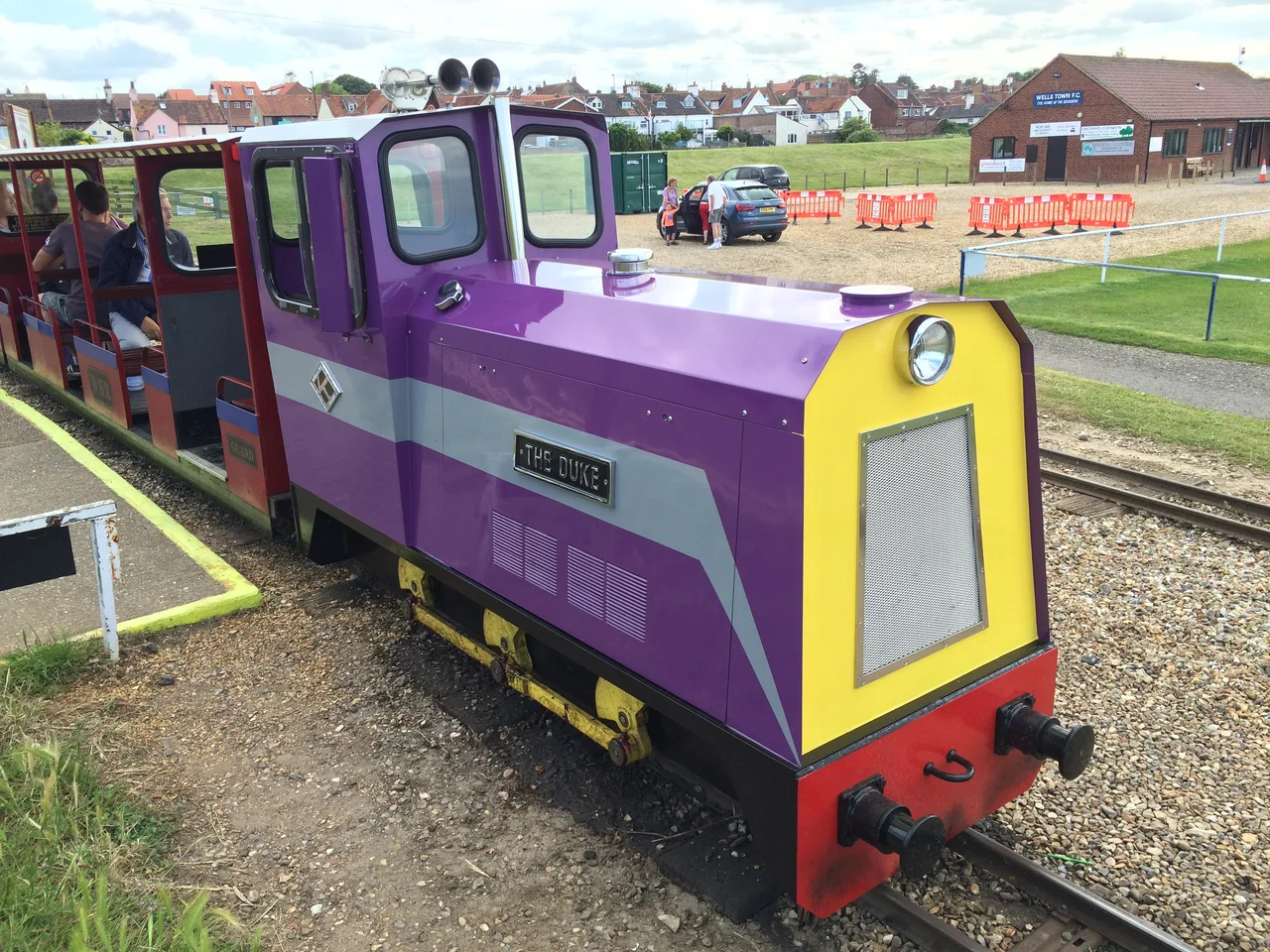

Wells Harbour Railway
For 45 summers, a small steam engine pulled open carriages through the pines of north Norfolk, its whistle announcing the start of a beach day for generations of families. The Wells Harbour Railway ran just 1,200 yards — a little over half a mile — connecting the harbour at Wells-next-the-Sea to the Pinewoods Holiday Park. It was miniature in scale and enormous in local affection, and its closure in 2021 without ceremony left a gap that an electric bus has not quite filled.
A Railway for a Beach Town
Roy Francis founded the Wells Harbour Railway in 1976, laying the 10¼-inch gauge track alongside Beach Road on the western edge of the harbour approach. The railway replaced a withdrawn bus service, giving visitors a gentler way to reach the long, pine-backed beach that Wells is known for. In its first two years of operation, the line carried over 80,000 passengers — a figure that speaks to how immediately it was embraced.
Nature tested it almost from the start. In January 1978, a severe North Sea storm washed away a substantial section of track. The railway was rebuilt and back in service by July of the same year, an act of determination that set the tone for how the railway's operators would respond to the challenges of running a small line on an exposed coast.
Engines and Carriages
The original rolling stock had a handmade quality appropriate to a small enterprise starting on a shoestring. Engineer David King built the first carriages — two open and two covered, with wooden bodies on steel underframes — and also constructed the locomotive Edmund Hannay. A second engine, Densil, followed in time. By 1998 the railway had grown enough in ambition to commission four new covered carriages from specialist builder Alan Keef, these with steel bodies on steel underframes.
The engine shed sat at the Pinewoods end of the line. The railway operated seasonally: weekends from Easter to the May Day bank holiday, then daily through September, then back to weekends through October. It was a timetable shaped by the school holidays and the brief window of North Norfolk's tourist season.
The End of the Line
In April 2021 the Holkham Estate — the railway's landlord — announced it was reviewing whether to renew the operators' lease, which was due to expire in 2022. The news arrived as 'devastating' to many; the station had become a fixture, woven into the childhood memories of thousands of Norfolk visitors. Despite public protest, closure came in September 2021, without ceremony, as the estate confirmed it would seek an alternative transport arrangement.
The track and rolling stock were removed over six days in November 2021. Most of the equipment went to Lappa Valley Steam Railway in Cornwall, where the rails would renew a life-expired aluminium track. Densil, one of the locomotives, left on the same lorry bound for Cornwall but was purchased mid-journey by the Watford Miniature Railway, taking a different final destination. The replacement service — an electric bus, augmented by a vintage open-top bus in high season — began operating in 2022.
From the Air
Located at 52.97°N, 0.85°E, at the northern edge of Wells-next-the-Sea. From above, the line's former route is visible as a track running parallel to Beach Road, between the harbour channel and the dark pine woodland of Holkham. Norwich International Airport (EGSH) is approximately 45 km to the southeast. The beach and pine belt are clearly distinguishable from 1,500 ft in good visibility.
Nearby Stories
- Wroxham 3.2 km away
- East Dereham Windmill 8.5 km away
- Alford Windmill 11 km away
- Mundesley 14 km away
- Batemans Brewery 14 km away
- Wisbech 15 km away
- HMS Cobra 24 km away
- SM U-97 118 km away