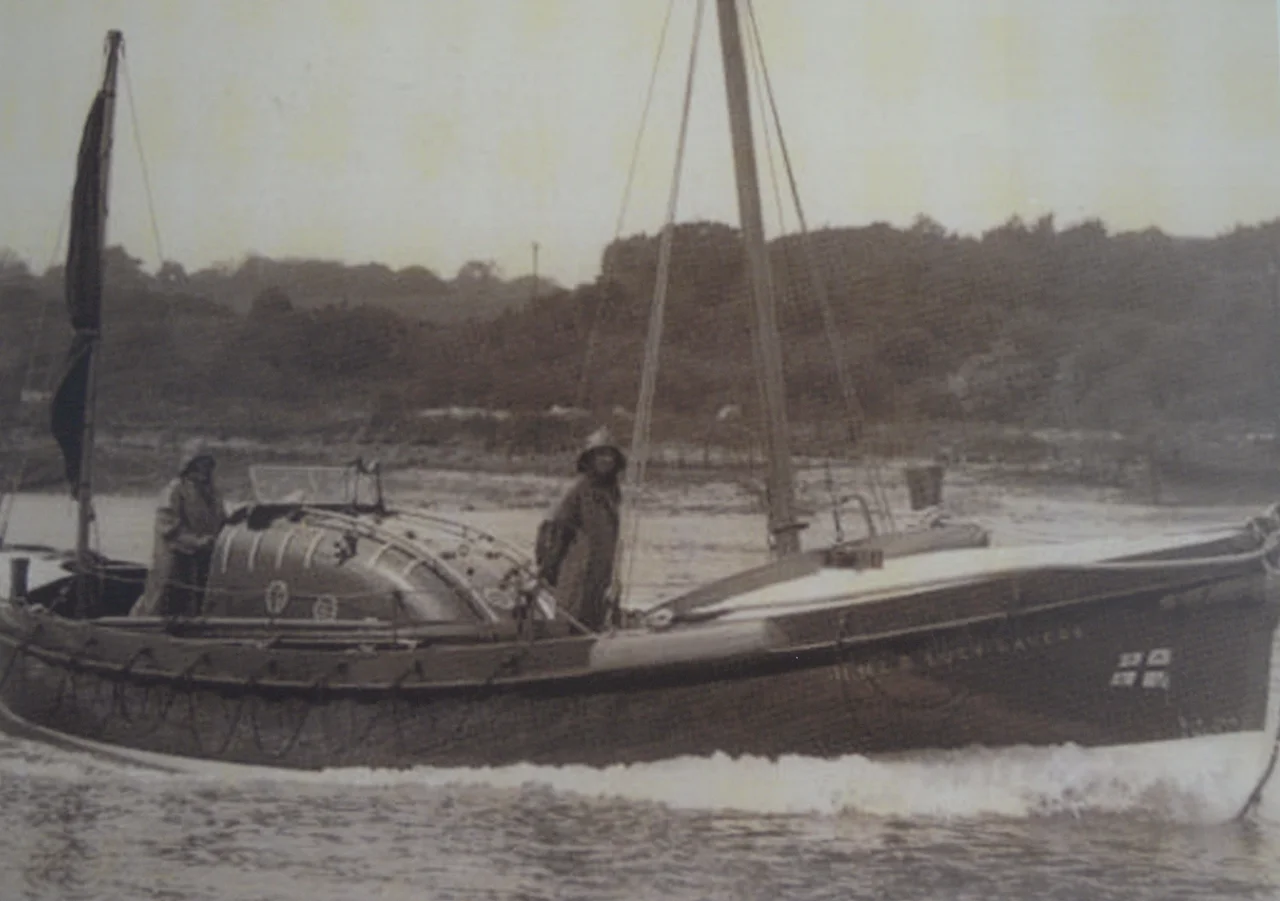

Wells-next-the-Sea Lifeboat Station
The North Norfolk coast does not give rescuers an easy approach. The entrance to Wells Harbour runs across a shifting sand bar, and at low water the channel can be impossibly shallow. Early lifeboat crews discovered this the hard way in 1893, when the RNLB Baltic was launched three times in a single year to assist vessels in distress — and arrived too late to help at every one. The station moved north the following year, a mile closer to the open sea, determined not to be beaten by the tide again.
Before the RNLI
The first organised rescue service at Wells was run by the Norfolk Shipwreck Association, which established a station here in 1830 by sending an unnamed lifeboat from Cromer. For twenty-one years it operated, then closed in 1851. Before the Norfolk Shipwreck Association, rescues had been left to private citizens — and the record suggests some of them were more interested in claiming salvage rights over rescued vessels than in saving lives. The first genuinely public-spirited service came with the NSA, though it would take the RNLI, arriving to re-establish the station in 1869, to bring professional standards and continuity.
The 1869 boathouse was built on the Wells quay to house the self-righting RNLB Eliza Adams. It is still standing — a Grade II listed building now used jointly as the Harbour Master's Office and a small maritime museum. The original site had a fundamental problem: at low water the lifeboat simply could not reach the open sea.
Into the Storm
The January 1978 storm that destroyed the Wells Harbour Railway's track also hit the lifeboat station hard. Winds reached hurricane force 12. Waves peaked at 40 feet. It was still snowing heavily when the Wells lifeboat was released from service and began the return to harbour — arriving home between six and seven in the evening after approximately eleven hours at sea. The coxswain received an RNLI Silver Medal for his actions that night.
The station's honours board across its history includes a list of awards that reflects both the frequency of callouts and the quality of the crews who answered them: Silver Medals to coxswains David James Cox in 1979 and Francis Robert Taylor in 1963, Bronze Medals across multiple decades, and numerous letters of thanks from the Institution inscribed on vellum. The people who have served here were volunteers, arriving when the pagers sounded, often in the middle of the night, through the winter, into weather that would keep most people indoors.
A New Boathouse, and a New Boat
The original 1895 beach road station served the crew for over a century, undergoing renovations in 1983, 1986 and the mid-1990s — including the reuse of greenheart timber salvaged from a demolished Eastbourne lifeboat station to shore up the eroding sandy headland beneath it. But the structure aged beyond renovation, and in October 2022 it was demolished to make way for a new boathouse built at the beach on the western side of the harbour mouth.
The new all-weather lifeboat, the Duke of Edinburgh (Civil Service No. 53), arrived at Wells in October 2022, partly funded by a local fundraising campaign from 2014 to 2015 and partly by the Civil Service charity The Lifeboat Fund. It replaced the Doris M. Mann of Ampthill in early 2023. The smaller inshore lifeboat Peter Wilcox (D-797) has been on station since 2016. The crew that serves them remains, as it always has been, entirely voluntary.
From the Air
Located at 52.97°N, 0.85°E, at the end of Beach Road north of Wells-next-the-Sea town centre. The new boathouse (2022) sits on the western side of the harbour mouth — visible from the air as a structure at the edge of the tidal flats where the channel meets the beach. Norwich International Airport (EGSH) is approximately 44 km southeast. The sandy beach north of Wells, with the pine woodland to the west, provides a clear orientation marker at 1,500–2,000 ft.
Nearby Stories
- Wroxham 3.2 km away
- East Dereham Windmill 8.5 km away
- Alford Windmill 11 km away
- Mundesley 14 km away
- Batemans Brewery 14 km away
- Wisbech 15 km away
- HMS Cobra 24 km away
- SM U-97 118 km away