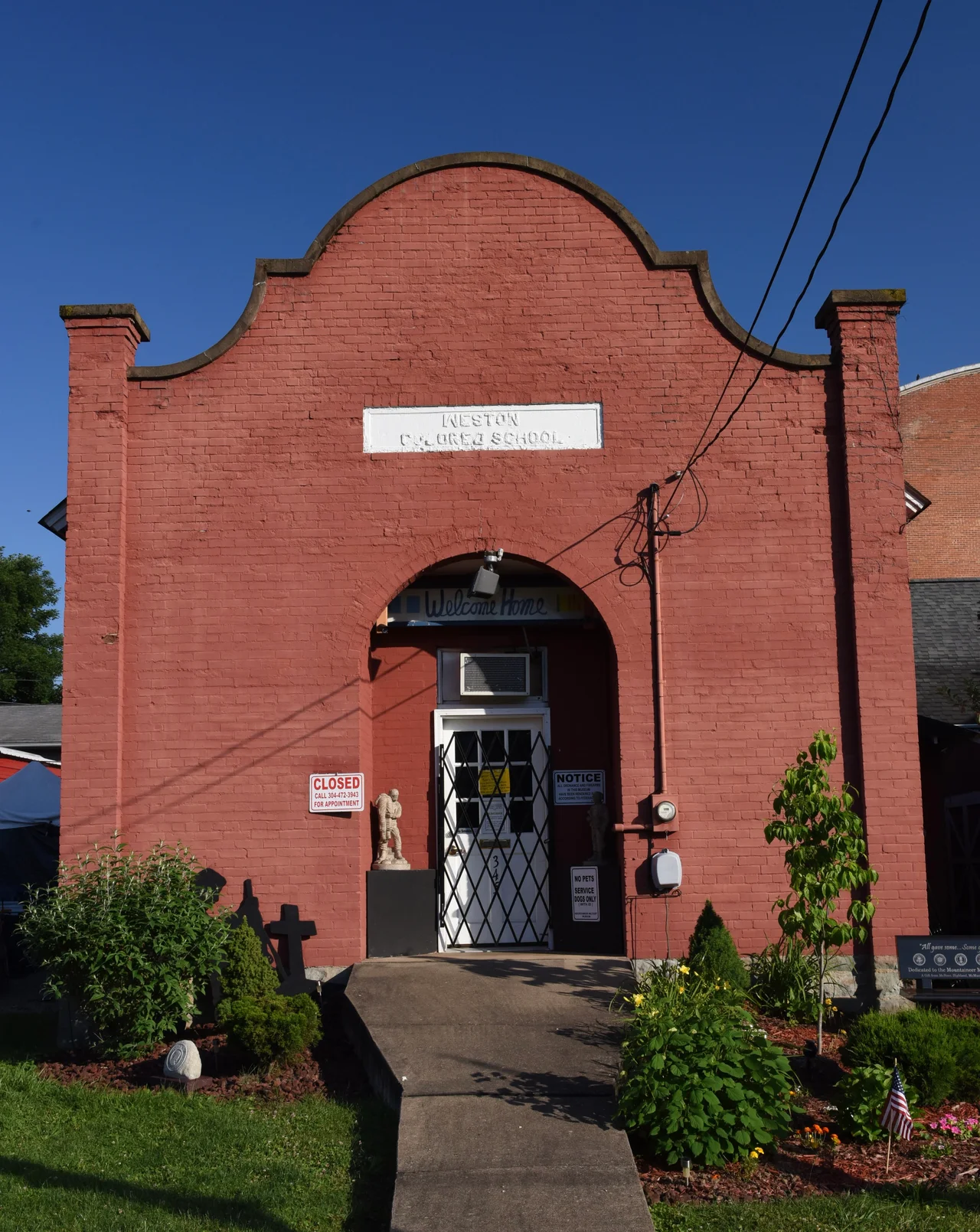

Weston Colored School
The Weston Colored School was built in 1882 to teach the African-American children of Weston, West Virginia, because the white schools of Lewis County would not admit them. The building still stands - a single-story rubbed red brick structure on a fieldstone foundation, modest in scale, located on a quiet street in downtown Weston - and it kept teaching Black children continuously for seventy-two years, from the year it was built until the year the Supreme Court's Brown v. Board of Education decision finally made school segregation unconstitutional in 1954. The teachers who taught here, the students who learned here, and the building itself together form one of the more important small pieces of African-American history surviving in central West Virginia.
Why Such a School Existed
Weston in 1882 was a small, prosperous county seat in a state that had been admitted to the Union in 1863 over the question of slavery. West Virginia had separated from Confederate Virginia precisely because its western residents would not fight for slavery; nonetheless, the state's African-American population - around six percent at the time - faced systematic legal segregation that did not differ much from what their counterparts faced in Virginia or Kentucky. State law required separate schools for Black and white children. The Black community of Weston, who lived primarily in a small neighborhood near the West Fork River, needed a school of their own. The county built one. The building was small because the community it served was small. It was located on the African-American side of a town that, like most American towns of the period, had a clear racial geography that everyone understood without anyone needing to write it down.
The Building and Its Expansion
The original 1882 structure was a single rectangular room of rubbed red brick set on a fieldstone foundation. The brickwork is plain, the proportions modest, the architectural ambition limited - a working schoolhouse, not a civic monument. In 1928 the school was expanded by 12.5 feet to the east, increasing its capacity and adding a small additional space for activities. The architectural style is sometimes described as Mission Revival, though the details are subdued. The simple plan of the building reflects the curriculum: a single teacher worked with all grades at once, moving from younger to older students through the day, in the standard one-room school pattern that characterized rural and small-town American education for a century. Black teachers - most of them educated at Bluefield State College or West Virginia State College, the two historically Black institutions in the state - rotated through the position over the decades.
What the Teachers Taught
The Black schools of West Virginia operated under the legal and financial constraints of Jim Crow but in many cases produced excellent results. Teachers were often highly credentialed - West Virginia State, in particular, supplied a network of well-trained Black educators across the state - and the small classes of segregated schools sometimes allowed for closer instruction than the larger white schools could offer. Students who came through the Weston Colored School in the early twentieth century went on to college, professional careers, and military service in numbers that would be impressive in any small school. The curriculum was the standard American grade-school curriculum of the period: reading, writing, arithmetic, geography, history, music, and basic civics. The teachers, working within the constraints of an unjust system, did the work of teaching.
1954 and What Came After
On May 17, 1954, the Supreme Court decided Brown v. Board of Education and ruled that legally segregated public schools were inherently unequal and therefore unconstitutional. West Virginia, unlike many southern states, moved relatively quickly to comply. The Weston Colored School closed shortly afterward as Black students were integrated into the previously white schools of Lewis County. The building was used for storage for some years, then as an agricultural classroom annex for Lewis County High School, then as a workshop space for adult students with intellectual disabilities. Each new use left some mark on the building. None of them quite erased its original function. By the early 1990s the building was vacant again and at risk of demolition. The Central West Virginia Genealogical and Historical Society, operated by the Hacker's Creek Pioneer Descendants, took on the property and opened it as a library and museum dedicated to local family history.
On the Register, in the Memory
The Weston Colored School was added to the National Register of Historic Places in 1993. It is also part of the Weston Downtown Residential Historic District, listed in 2005, which protects a larger neighborhood of nineteenth- and early twentieth-century buildings around it. The building's significance is documented in the Clio digital history project, which has reconstructed the names of teachers and students from school records, newspaper accounts, and oral histories. Today the small brick schoolhouse functions as a research library; on its walls, however, the history of segregated education in central West Virginia is preserved in photographs and interpretive panels. The students and teachers who passed through here over seventy-two years were real people, with families and ambitions and complicated lives, working within and against a system that did its best to limit them. The building that taught them is still here. That fact, in itself, counts as a small victory of memory.
From the Air
The Weston Colored School is at 39.04 N, 80.46 W in downtown Weston, Lewis County, central West Virginia, near the West Fork River. Best viewed at 2,500-4,000 feet AGL; the small grid of downtown Weston is easy to locate, with the dramatic Trans-Allegheny Lunatic Asylum complex just south providing the most visible landmark. Nearest airport: Mid-Ohio Valley Regional (KPKB) about 50 nm northwest at Parkersburg; North Central West Virginia (KCKB) about 25 nm north at Clarksburg. US-19 and US-33 cross through Weston; the West Fork River winds through the city. The small brick schoolhouse itself is too modest in scale to be visible from aviation altitudes.
Nearby Stories
- Appalachia 13 km away
- State of Kanawha 17 km away
- Weston and Gauley Bridge Turnpike 18 km away
- Tucker County, West Virginia 20 km away
- Sinks of Gandy 20 km away
- Garrett County, Maryland 46 km away
- The Ohio River Museum 51 km away
- West Virginia Penitentiary 70 km away