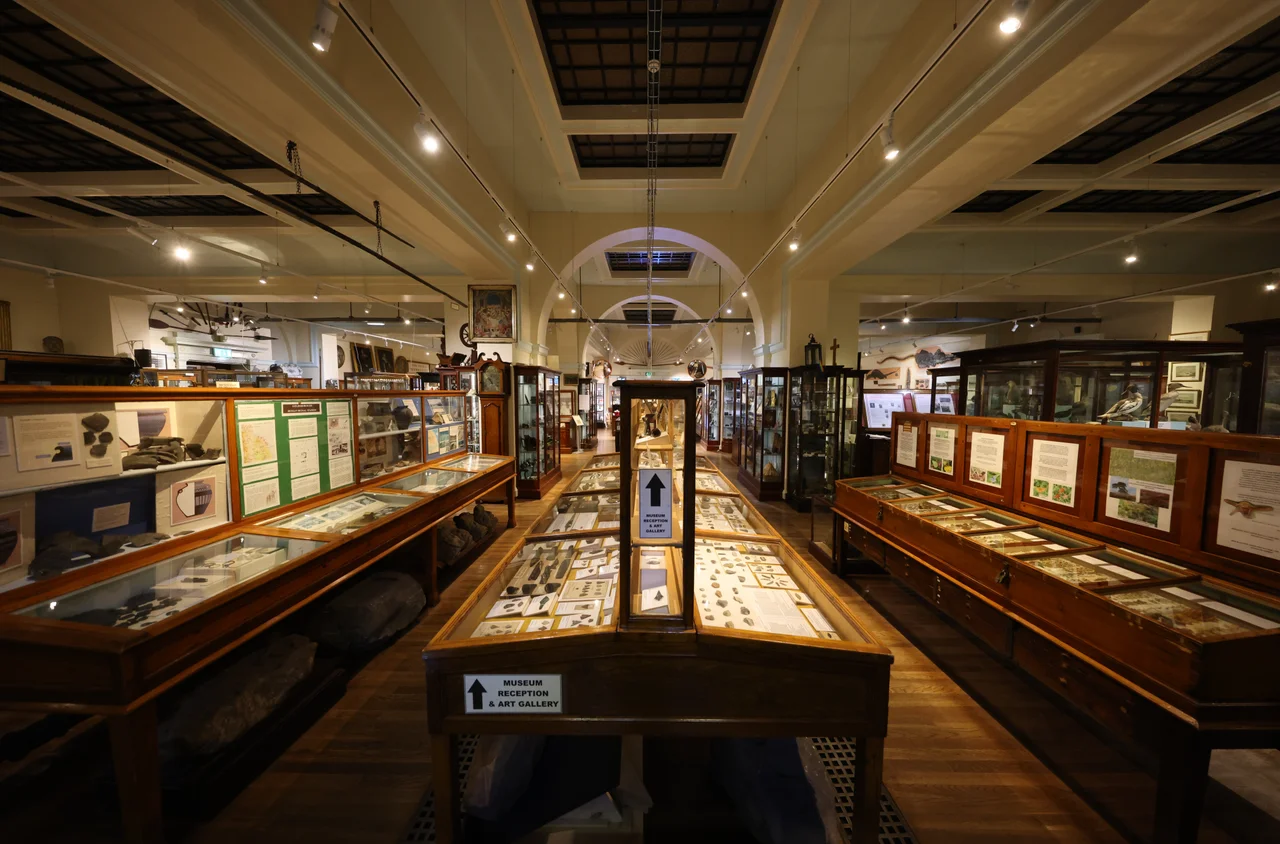

Whitby Museum
The Hand of Glory is real. Whitby Museum has it - a withered, blackened human hand, taken from the body of a hanged man and prepared, according to the old grimoires, to render thieves invisible and put householders into magical sleep. It was discovered behind the wall of a thatched cottage in Castleton in 1935 and given to the museum in the same condition: dried, mounted on a wooden plinth, and entirely uncanny. It is by no means the strangest thing in the building. In 1823, a Whitby vicar and a handful of citizens started the Whitby Literary and Philosophical Society, which began collecting almost anything interesting that came its way. Two centuries on, the museum they founded is still owned by the same Society, run partly by volunteers, and proud of its refusal to update.
Marine Monsters in Jet
Whitby's cliffs are Jurassic. For two hundred years, fossil hunters have pulled extraordinary creatures out of those rocks: ichthyosaurs, plesiosaurs, ammonites the size of dinner plates, the long jaws of marine reptiles that swam in warm shallow seas 180 million years ago. The museum holds one of the finest provincial collections of Jurassic marine reptiles in Britain. Some specimens were assembled by Victorian fossil dealers who supplied gentry collectors and natural history societies; others came from professional palaeontologists and amateurs who knew the local rocks better than anyone. Whitby jet - the polished black lignite that the Romans wore and the Victorians used for mourning jewellery - has its own gallery here. The same Jurassic forests that became the marine creatures' graveyards also became the jet.
Cook and the Endeavour
The museum's Captain Cook collection traces the great Yorkshire navigator's career from his apprenticeship in Whitby through his three Pacific voyages. The original Endeavour was a Whitby collier, built locally and bought by the Admiralty for Cook's first expedition in 1768. The exhibits include letters, models, prints, and items associated with the crew and the ships - a parallel collection to the dedicated Captain Cook Memorial Museum a few hundred yards away in Grape Lane. Where the Memorial Museum focuses on Cook's apprenticeship years, the Whitby Museum collection ranges across the whole of his career and into the wider story of Whitby's whaling fleet, which by the early nineteenth century made the town one of the most important whaling ports in England.
Sutcliffe's Whitby
Frank Meadow Sutcliffe was the museum's curator and one of the finest pictorialist photographers of late Victorian England. His glass-plate negatives of Whitby - the harbour at low tide, the fishwives in their headscarves, naked boys playing on the slipway, the steep stone stairs leading to the abbey - record a working town that was already half-disappearing as he photographed it. The most famous image, Water Rats, shows a knot of boys bathing from a coble in the harbour; it was so popular that Sutcliffe sold it as a postcard by the thousands. The museum holds his archive, including the original negatives. Looking at them is the closest thing to a time machine for Whitby. They are also, more than a century later, still beautiful.
An Egyptian, Briefly
Between the 1890s and 1930, the museum displayed the mummy of an Egyptian man who had died around 300 BC. The mummy had belonged to Sir George Elliot, an industrialist who had donated it on his death. In 1930, when Whitby found itself short of funds, the curator of the Hull Municipal Museum bought the mummy for fifteen pounds and took him to Hull, where he now resides in the Hands On History Museum. The transaction would horrify modern museum ethics, but in 1930 it was unremarkable. The museum building itself dates to 1931, when the Society moved its collection from cramped rooms above the old public baths to a new purpose-built home in Pannett Park. The architecture is straightforward Edwardian-style provincial museum: high windows, cabinets, polished wood. Walk through the rooms and you walk through the precise sensibility of a 1930s learned society - with a Hand of Glory thrown in for good measure.
From the Air
Coordinates 54.4854°N, 0.6217°W. Whitby Museum sits in Pannett Park, on the west side of Whitby above the River Esk, about half a mile west of the harbour. The town's signature landmarks - the ruined Whitby Abbey on the east cliff, the harbour mouth, and the parallel piers - make Whitby unmistakable from the air. Best viewed 2,000-3,500 ft in clear conditions. Nearest airports: Durham Tees Valley (EGNV) about 40 nm northwest, Newcastle (EGNT) about 60 nm north-northwest, Humberside (EGNJ) about 50 nm south.
Nearby Stories
- Sledmere House 8.6 km away
- Hartlepool 10 km away
- RAF Linton-on-Ouse 17 km away
- Middlesbrough Cathedral 17 km away
- SM UC-75 23 km away
- Arctic Viking (H452) 26 km away
- Breagh Gas Field 28 km away
- German submarine U-2367 50 km away