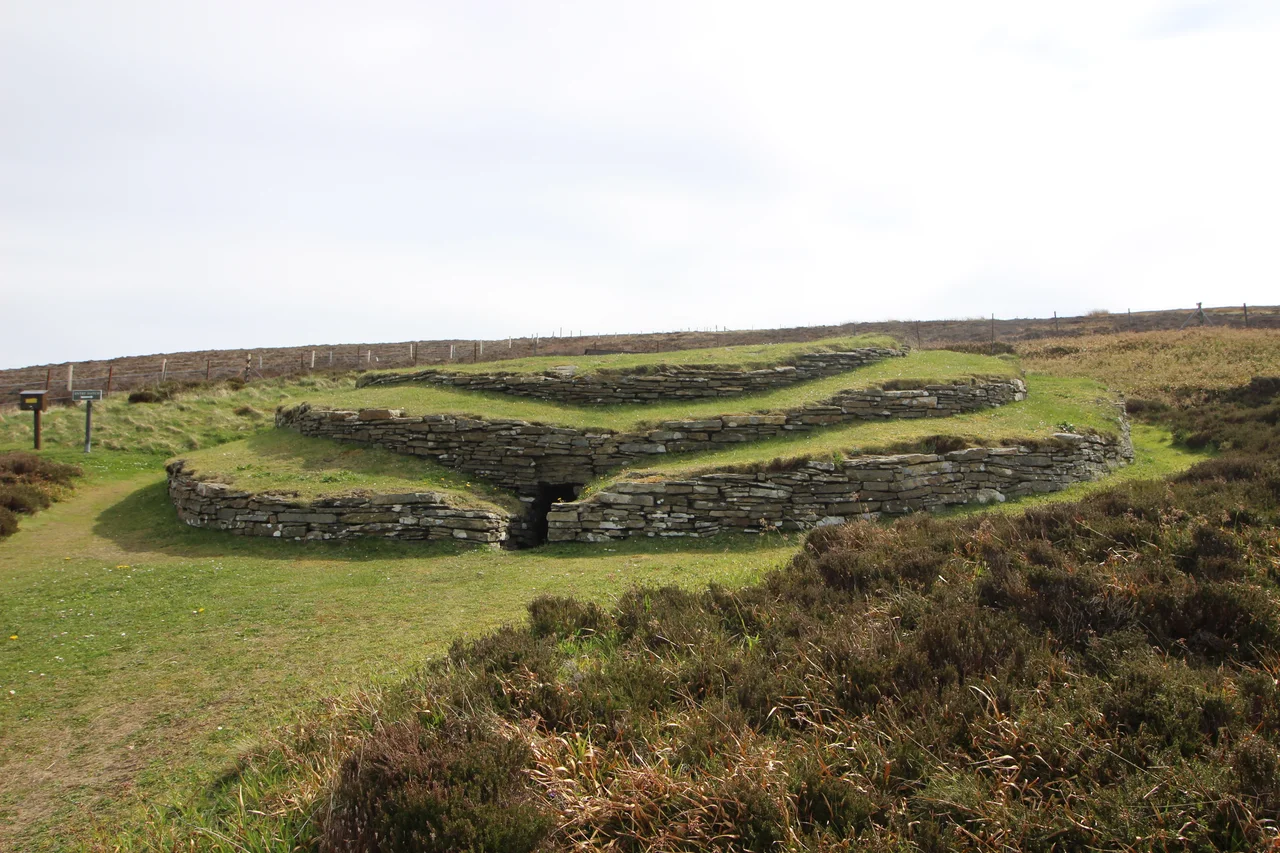

Wideford Hill Chambered Cairn
You climb a hill above Kirkwall. The Bay of Firth opens to your left, the Bay of Kirkwall to your right. Sheep crop the bracken. At a small concrete cap set into the slope you stop. There is a hatch. You lift it. A vertical iron ladder drops away into black, and there is a torch waiting for you because the site managers know nobody finds the experience funny otherwise. Down you go, foot by foot, into the corbelled chamber that Orkney's Neolithic people cut into the bedrock here around 3000 BC. The roof above is a 20th-century concrete reconstruction. Everything beneath is original. Four thousand years of darkness, and now you.
Cousins to Maeshowe
Wideford Hill is a sibling, in design, of the great chambered cairn at Maeshowe just a few miles southwest. Both belong to a family of late-Neolithic tombs scattered across Orkney that share a common architectural grammar: a main chamber with corbelled side cells, an entry passage, and a deliberate orientation toward the surrounding landscape. The Maeshowe tomb is famous because it is monumental and aligned to the midwinter sunset. Wideford Hill is smaller and tucked into a steep west-facing slope, but the engineering instincts are the same. Whoever planned these places thought in stone, in long time, and in the relationships between living settlements and the dead they sheltered. The cairn looks across to the Bays of Firth and Kirkwall, and that view, those waters, were almost certainly part of the point.
What the Excavator Found
George Petrie, an Orkney antiquarian, dug into the cairn in the 1840s. He found rubble. Not bones, not pottery, not the grave goods that other Neolithic tombs in Orkney yielded so generously. The main chamber had been deliberately backfilled with stone before the cairn was sealed, and Petrie concluded that the tomb had been emptied and abandoned in antiquity, its purpose long over before he ever pried back the turf. The empty chamber posed a question that has never been answered: was Wideford Hill stripped by Bronze Age people who found Neolithic religion meaningless? By Vikings? By medieval treasure hunters? Or, more likely, was the deliberate filling itself a ritual act, a closing of a sacred space by the same culture that built it, marking the end of one community's relationship with this particular hill?
The Ladder Today
Historic Environment Scotland scheduled the cairn as a protected monument in 1994. The 20th-century concrete roof and the metal ladder are concessions to physical reality. Without them, the chamber would either collapse or remain inaccessible. The visit is free, the site unstaffed, the experience entirely your own. A torch is provided. Whatever else you bring is on you. Most people climb down, stand in the silence that is not silence because the wind keeps finding ways through the corbelled cells, and emerge a few minutes later changed in some small way they cannot quite identify. The cairn is one of three lesser-known but accessible Neolithic tombs near Kirkwall, the others being Cuween Hill and the cairns of Eday. None of them get the crowds of Maeshowe. All of them reward the climb.
From the Air
Located at 58.99 N, 3.03 W, on the west-facing slope of a hill northwest of Wideford Hill summit, about three miles west of Kirkwall. The nearest airport is Kirkwall (EGPA), about four miles east-southeast. The cairn itself is a low concrete dome in pasture and difficult to spot from altitude; navigate by Wideford Hill's distinctive twin summits and the Bay of Firth to the north. Best viewed at 2,000 feet AGL on the western approach to EGPA. Maeshowe lies further west.
Nearby Stories
- Pentland Skerries 5.4 km away
- Thurso 13 km away
- HMS Daring (H16) 42 km away
- Wolfburn Distillery 42 km away
- Orcadian Basin 55 km away
- Fair Isle 57 km away
- Jarlshof 119 km away
- The Laki Eruption: The Volcano That Changed World History 941 km away