
Widnes
John Hutchinson opened his first factory in 1847 on a strip of land between the Sankey Canal and the St Helens and Runcorn Gap Railway. He chose the site because everything he needed could arrive by boat or by train, and everything he made could leave the same way. He was producing alkali by the Leblanc process, which is to say he was making the chemical foundation of mid-Victorian Britain: soap, glass, paper, textiles, all of it required cheap soda ash. Within a generation, half a dozen more factories had crowded onto the same strip of land. The collective name for that strip became Spike Island, and the town that grew up around it earned, by 1888, the dubious title of the dirtiest, ugliest and most depressing town in England. The phrase was repeated for a century. The work of unsticking the town from that reputation took most of the twentieth century, and is still going.
Boundary River, Border Town
The Mersey is older than Widnes by several thousand years. The river takes its name from the Anglo-Saxon maeres ea, the boundary river, which once divided the Danelaw from Saxon Mercia. Vikings raided up the estuary in the ninth century; Widnes sat at the southern edge of their territory. After the Norman Conquest, William the Conqueror handed the Earldom of Lancaster to Roger the Poitevin, who passed the barony of Widnes to a man named Yorfrid. Yorfrid had no sons. His daughter married William fitz Nigel, the second Baron of Halton, and the barony of Widnes merged into Halton's holdings, where it remained for centuries. The Norman church of St Luke's was built at Farnworth around 1180, and a school was founded on its grounds in 1507 by Bishop William Smyth, the same Smyth who co-founded Brasenose College, Oxford. Through the medieval and early modern periods Widnes was not a town at all. It was a handful of hamlets scattered around the marshes.
Spike Island and the Chemical Years
What turned the scattered hamlets into a single industrial town was the arrival of John Hutchinson and the chemists who followed him. McClellan, Gossage, Muspratt, Gaskell, Deacon, Brunner, Mond, Hurter; the names of the founders of British heavy chemistry read like a roster of Widnes residents in the 1850s and 1860s. From the late 1880s, Polish and Lithuanian families fleeing persecution and poverty in eastern Europe arrived to work the factories, joining Irish and Welsh migrants who had come for the same reason. By 1890 the United Alkali Company had absorbed most of the town's works into a single firm, which would in turn become a founding component of ICI in 1926. By the 1950s, Widnes housed forty-five major chemical factories. The air was acrid; the soil was contaminated; the river was a chemical sink. But the work was steady and the town's population grew with it. Charles Glover Barkla, born in Widnes in 1877, won the 1917 Nobel Prize in Physics for his work on X-ray spectroscopy. The local chemical labs at ICI Widnes were where Charles Suckling first synthesised halothane, the anaesthetic that made modern surgery safer.
Bridges and a New Identity
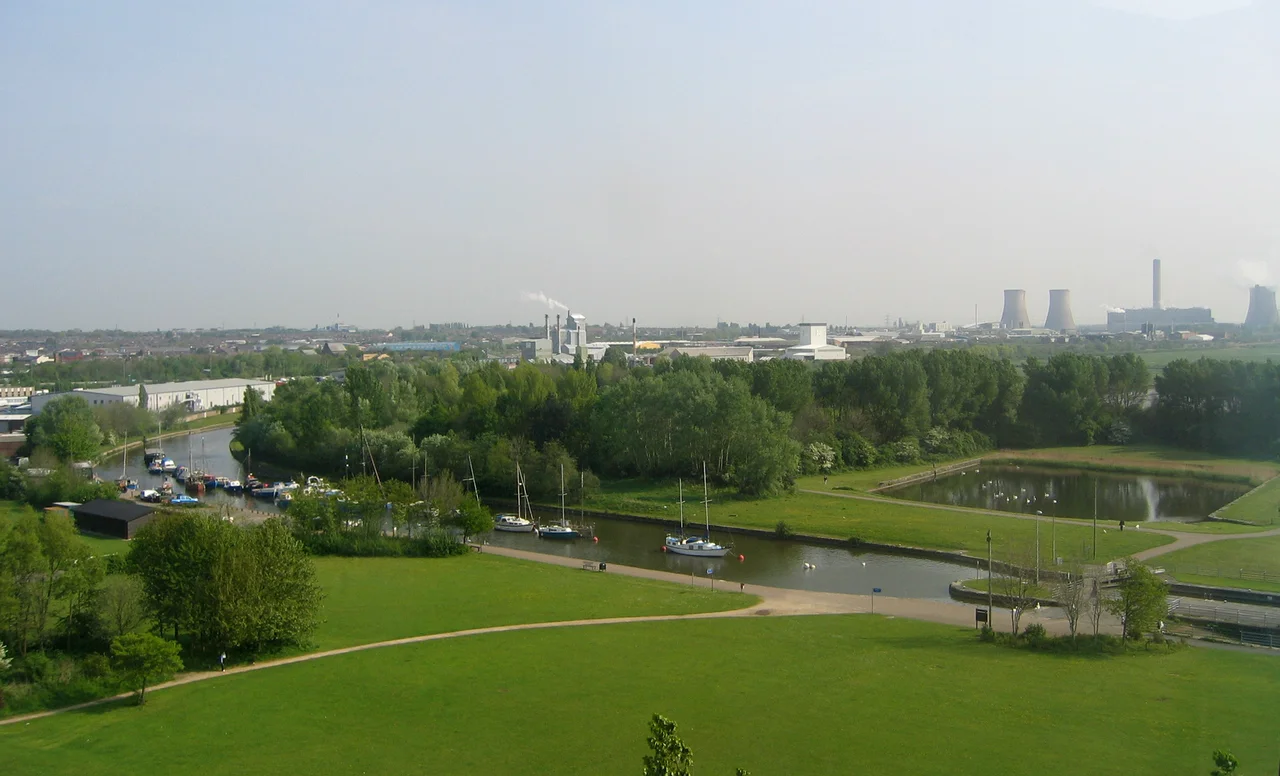
For a long time the only way across the Mersey at Widnes was the Widnes-Runcorn Transporter Bridge, opened in 1905, which lifted railway wagons and motorcars across the gap on a swinging gondola. The transporter served until 1961, when the new Silver Jubilee Bridge superseded it. A second crossing, the cable-stayed Mersey Gateway, opened in October 2017 and the two bridges now operate together as paired tolls. Both are visible from Spike Island, where Hutchinson's first factory once stood and where there is now a public greenspace with footpaths along the old Sankey Canal towpath. The Catalyst Science Discovery Centre occupies Hutchinson's former Tower Building, an industrial-era headquarters reborn as a hands-on museum of chemistry. The town's transformation has not been quick or complete; many of the old chemical works simply closed and left contaminated ground behind. But Pickerings Pasture, a wildflower meadow on the riverbank, sits on what used to be a household and industrial landfill, and the air no longer smells of acid.
Vikings on the Pitch
Rugby league is the town's sporting heart. Widnes Vikings won the World Club Championship in 1989, beating Australia's Canberra Raiders at Old Trafford, and the cup-king reputation of the Vikings in the 1970s and 1980s still echoes through Halton. The DCBL Stadium on Lowerhouse Lane is the home ground, owned and operated by the council. There is also a famous piece of pop trivia attached to Widnes railway station: in the early 1960s, Paul Simon spent a long, miserable night there waiting for a connection back to London, and the song Homeward Bound came out of that wait. Simon has confirmed the story in his own words: if you know Widnes, he said, you will understand. The Belle and Sebastian song The Stars of Track and Field also name-checks the town, as does Elvis Costello's Watch Your Step. Three popular songs in three different decades, each using Widnes as shorthand for somewhere you would rather not be. The town has, in fairness, spent the last fifty years trying to change that meaning.
From the Air
Widnes sits at 53.36N, 2.74W on the north bank of the Mersey at Runcorn Gap, directly across the river from Runcorn. From the air, the three Mersey crossings dominate the south side of town: the 1868 stone-arched Runcorn Railway Bridge, the green steel arch of the 1961 Silver Jubilee Bridge, and the white cable-stayed 2017 Mersey Gateway. Spike Island is the green spit of land between the Sankey Canal and the river, southeast of the town centre. The Catalyst Science Discovery Centre occupies the old Tower Building at the western edge of Spike Island. Recommended viewing altitude 2,500-4,000 ft for the bridges and the canal-river relationship. Nearest airports: Liverpool John Lennon (EGGP) 6 nm north-northwest, Manchester (EGCC) 17 nm east, Hawarden (EGNR) 11 nm southwest.
Nearby Stories
- Anson Engine Museum 1.3 km away
- West Kirby 2.9 km away
- Battle of Nantwich 6.2 km away
- Winter Hill Air Disaster 8.3 km away
- Horseshoe Pass 8.8 km away
- Caverswall Castle 12 km away
- Murder of Lindsay Rimer 15 km away
- Piel Castle 50 km away