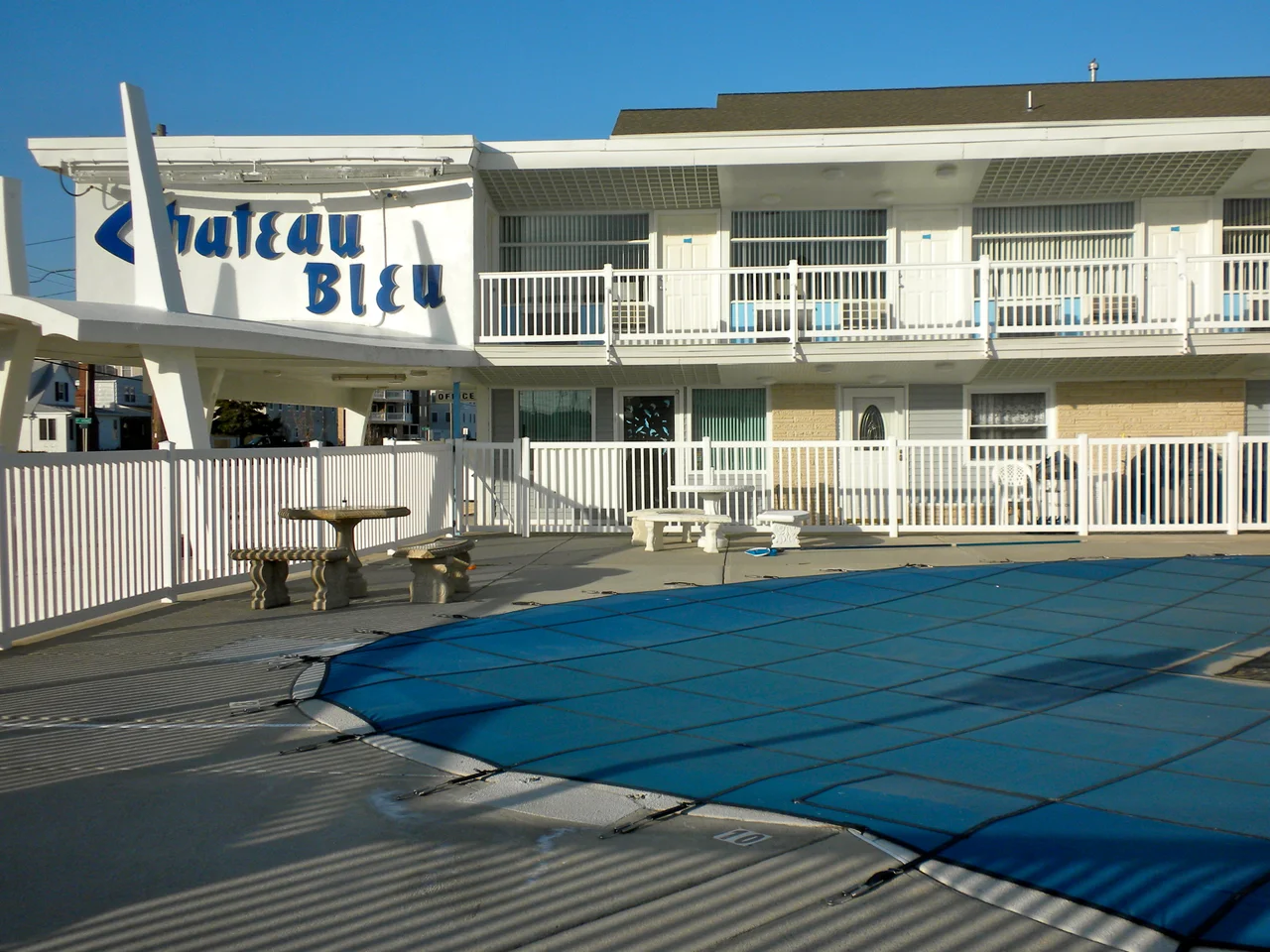

Wildwoods Shore Resort Historic District
There used to be more than three hundred of them. Lined up along Atlantic and Ocean Avenues on a two-mile strip of barrier-island sand in Wildwood Crest, the motels of the 1950s and 1960s bristled with plastic palm trees, neon signs that competed for the passing motorist's attention, and architecture that promised something just slightly more interesting than ordinary life. The buildings called themselves the Caribbean and the Singapore and the Royal Hawaiian. They had heart-shaped pools. They had names like the Pan American and the Satellite, painted in the language of a future that was supposed to arrive any minute. Most of that imagined future never made it. But enough of these motels survived the condo wave of the early 2000s to constitute the largest collection of mid-century vacation architecture in America, and in the early 1990s it finally got a name: Doo Wop.
Naming the Style
The architecture historians had a problem in the 1990s. The motels of the Wildwoods were clearly part of a larger movement - the same Googie or Populuxe style that produced Las Vegas casino marquees, California car washes, and Florida diner roofs that looked like flying saucers. But the Wildwoods examples felt different. They were vacation buildings, summery rather than urban, suburban rather than commercial. Cape May's Mid-Atlantic Center for the Arts coined the term Doo Wop in the early 1990s to capture exactly that distinction. The name borrowed from the harmony-rich pop music of the same era - a genre that was unpretentious, optimistic, and aimed at teenagers with leisure money. It fit. The term took hold. The Doo Wop Preservation League adopted it. Tourists learned it. A style that had no name for forty years suddenly had one.
Sub-Styles for a Vacation
Architects who study the district have classified the buildings into recognizable sub-styles. Blastoff borrows from the jet-age airport - sweeping angles, projecting roofs, the optimism of the Sputnik era. Vroom thrusts the building forward, as if the motel itself were a car about to merge onto a highway. Chinatown Revival nods to imagined Asia with pagoda roofs and curving eaves. Tiki, also called Polynesian Pop, leans into the postwar fascination with the Pacific and gives us the plastic palm tree, first installed at the Caribbean Motel in 1958. Phony Colonee parodies the mass-market Colonial Revival of the same period with brick veneers and lamppost decorations. Most of these motels mix categories freely. The Pan American is pure Vroom. The Singapore is unapologetic Chinatown. The Crusader leans into a medieval theme. The buildings are not subtle, and they were never trying to be.
The Neon Wars
The signs were the architecture. Every motel competed to have the most distinctive, brightest, most memorable neon - because the customers were arriving by car, often at night, often deciding on the spot where to stay. Two firms supplied most of the work: Ace Sign Company and Allied Sign Company. The best-known designer was W. Robert Hentges, who worked first for Ace, then for Allied, then founded his own shop. Local laws banned flashing signs and limited revolving ones, which forced the designers to do more with the static composition - color, scale, novel materials, abstract shapes. The Pan American's rotating sign was one of only two rotating signs in the Wildwoods. When the Satellite Motel was demolished in 2004, its rooftop sign survived. It now lives at the Doo Wop Experience museum in the Neon Garden, where the lights still burn at night.
The Caribbean Saved Itself
The Caribbean Motel, built in 1958, is the canonical Doo Wop survivor. It was owned by the Rossi family for more than thirty years and slated for demolition by 2004 as the condo boom swept the district. George Miller and Caroline Emigh bought it instead. They had read the Doo Wop Preservation League's design guidelines and admired the work of Philadelphia architect Anthony Bracali, whom they hired to oversee the restoration. The interior designer was Darleen Lev, a New Yorker who happened to be staying at the motel when Miller and Emigh closed the deal. Her designs drew from the Technicolor films of the 1950s and from the Caribbean theme the original builders had been chasing. The motel was added to the National Register of Historic Places in 2005, the first Doo Wop motel to receive that recognition. Wildwood Crest's heart-shaped-pool Chateau Bleu in North Wildwood made the list the year before.
Demolition by Condominium
Between 2003 and 2006, more than fifty motels disappeared. The Satellite went down after the 2004 season. The Kona Kai followed. The Sea Rose, owned for decades by the Stefankiewicz family, came down that fall. The Rio. The Fantasy. The Waterways. The math was simple - oceanfront land in New Jersey was worth more as condominium acreage than as a one-story motel with a plastic palm tree. The Oceanview Motel, the largest motel ever built in the Wildwoods, was scheduled for the same fate in 2009 but rejected by the New Jersey Department of Environmental Protection. Acquired in 2022, it is being remodeled as the Madison Resort Wildwood Crest. The Doo Wop district survived not because preservation won - the demolitions kept coming - but because enough buildings persisted that the style still reads as a coherent place. The Pan American, the Crusader, the Waikiki, the Newport, the Jolly Roger, the Tangiers. They are still here, neon on, palm trees standing.
From the Air
The Doo Wop motel district stretches along the Atlantic shore of the Wildwoods barrier island at approximately 38.97 degrees north, 74.84 degrees west. From cruising altitude, look for the densely developed barrier-island strip between Cape May to the south and the gap of Hereford Inlet to the north. Cape May County Airport (KWWD) sits four nautical miles south of Wildwood Crest. Atlantic City International (KACY) lies about thirty nautical miles northeast. The grid of motel parking lots, swimming pools, and neon signs is most distinctive at low altitudes; from cruise, the Wildwoods appear as the southernmost developed island in the Cape May chain.
Nearby Stories
- Woodbine, New Jersey 9.4 km away
- Absalom Jones 15 km away
- USS Jacob Jones (DD-130) 16 km away
- USS General G. W. Goethals 18 km away
- Bombay Hook National Wildlife Refuge 22 km away
- Atlantic Shores Offshore Wind South 24 km away
- Arthur W. Perdue Stadium 42 km away
- The Burning of the Morro Castle: Murder, Fire, and a Ship That Beached Itself at a Resort 115 km away