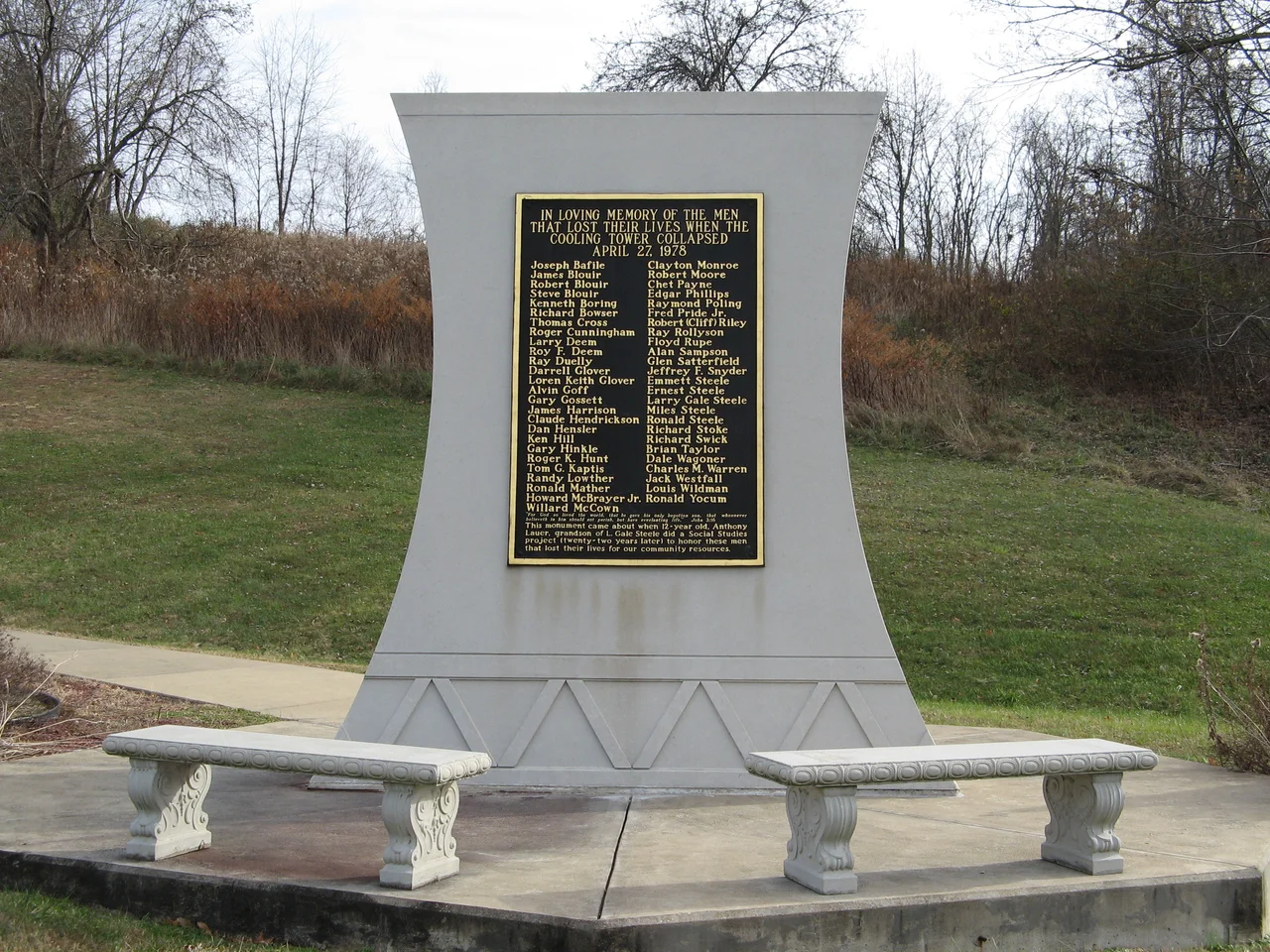

Willow Island Disaster
Just after 10:00 a.m. on April 27, 1978, the concrete poured the day before gave way. Fifty-one men stood on scaffolding 166 feet above the bottom of an unfinished cooling tower at Willow Island, West Virginia, and in the seconds it took for the ring of new concrete to unwrap counter-clockwise around the rim, every one of them fell into the hollow drum below. It remains the deadliest construction accident in U.S. history, and on the wooded bank of the Ohio River where Pleasants Power Station once operated for four decades, the two squat cooling towers that did get built read, to anyone who knows the story, as a kind of memorial.
A Boom Along the River
In the 1970s, the Ohio River valley was thick with construction. Coal-fired power plants were rising along its banks at a pace that demanded crews, cranes, and concrete in unprecedented quantities. The Allegheny Power System's expansion at Willow Island was meant to add 1,300 megawatts to the grid through two new generators, on top of the smaller units already humming on site. The cooling towers - the iconic hyperboloid shells that draw clouds out of themselves on cold mornings - were going up by an ingenious leapfrog method. Each day, workers poured a five-foot 'lift' of concrete into wooden forms; once that ring had cured enough to hold weight, crews would strip the forms, bolt the scaffolding to the new section, and pour the next lift from buckets hoisted by cranes mounted on the scaffolding itself. The tower lifted itself, ring by ring, into the sky.
The Morning It Came Apart
Tower number 2 had reached 166 feet on the morning of April 27. The previous day's concrete - hardened for less than 24 hours - was carrying the entire weight of the scaffolding, the forms, the crane, and the men standing on it. Sometime after ten o'clock, that concrete began to fail. Witnesses on the ground saw the scaffolding peel away from the top of the tower, first unspooling counter-clockwise, then ripping open in both directions at once. Wooden forms, twisted metal, half-set concrete, and fifty-one workers cascaded into the hollow center of the unfinished shell. Coworkers who had been at ground level ran to the wreckage and began digging by hand. There were no survivors. Many of the dead could be identified only by what they carried in their pockets. Of the fifty-one, all but one was recognized by friends and family on the site.
Investigation
OSHA investigators reached Willow Island the same day. A team from the National Bureau of Standards - now the National Institute of Standards and Technology - arrived two days later, and over the following months built a detailed forensic reconstruction of why the tower had failed. The young concrete had simply not been strong enough to support the loads placed on it. Bolts that should have anchored the scaffolding into older, fully-cured concrete had been driven into the previous day's pour. The forms had been stripped too soon. The leapfrog method had no tolerance for any one of those compromises, and at Willow Island, several had stacked up at once. The 1979 NIST report became a touchstone in construction-safety education, and the disaster reshaped how OSHA approached high-rise concrete work.
Not the Only One
Cooling towers have collapsed before and since - Ferrybridge in England lost three of them to 85 mph winds in 1965; Bouchain in France and Turow in Poland fell in 1979 and 1987; Vermont Yankee's tower came down in 2007. None of them killed anyone. The closest analog to Willow Island came in November 2016, when scaffolding gave way during construction at the Fengcheng power plant in eastern China and at least 74 workers died. Willow Island made clear what the Fengcheng collapse later confirmed: the riskiest moment in a cooling tower's life is while it is still being built, and the men standing on the freshest concrete bear the consequences of every compromise made below them.
What Remains
Pleasants Power Station was eventually completed and ran for more than four decades along the Ohio River before ceasing coal-fired operations in 2023. From the air the two stout, jar-shaped cooling towers and their smokestacks are unmistakable; the plant is often confused, from a distance, for a nuclear facility because the shapes are so familiar. There is a small memorial on site, and in the towns of St. Marys, Belmont, and Marietta - places where many of the dead had families - April 27 still moves through the calendar with a weight that locals notice. The men were ironworkers and carpenters, fathers and sons. Several were related to each other; some shifts that morning included brothers. The river runs past as it always has, and the towers, in their finished form, stand as quiet evidence of what it cost to put them there.
From the Air
Located at 39.37 N, 81.29 W on the West Virginia bank of the Ohio River, about 6 nautical miles south of Parkersburg. Best viewed at 3,000-5,000 feet AGL; the two squat hyperboloid cooling towers and the tall smokestacks of Pleasants Power Station are unmistakable from the air. Nearest airports: Mid-Ohio Valley Regional (KPKB) about 8 nm north, and Marietta-Washington County (KMPD) about 12 nm northwest. The river bends sharply around Willow Island itself, providing a useful visual landmark.
Nearby Stories
- Mountaineer Power Plant 5.3 km away
- Burning Springs Complex 7 km away
- Glenville, West Virginia 10 km away
- Strouds Run State Park 11 km away
- Salem University 26 km away
- West Virginia Penitentiary 42 km away
- The Y-Bridge of Zanesville 44 km away
- The Wheeling Suspension Bridge: The Longest Span in the World 81 km away