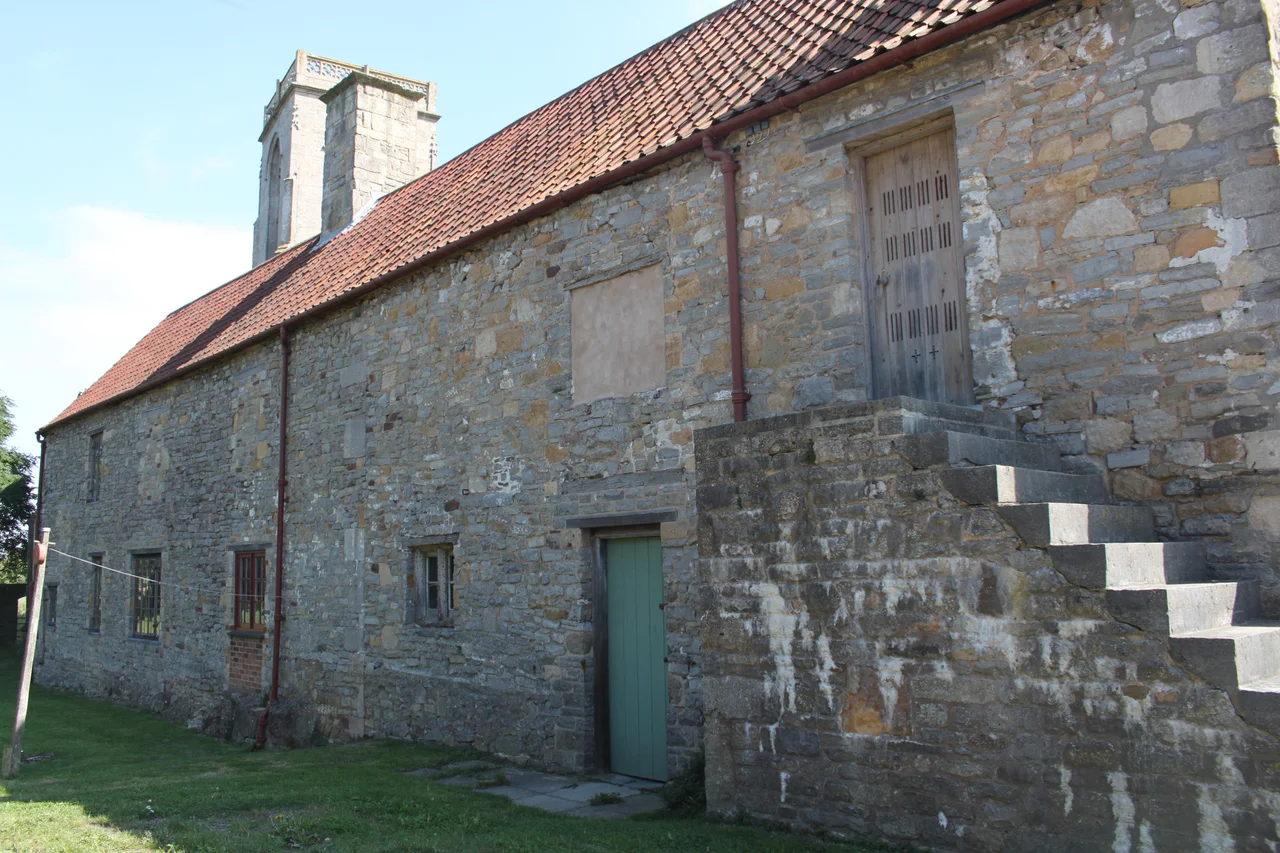

Woodspring Priory
Roger Tormenton was elected prior of Woodspring in 1525. Nine years later, when Henry VIII broke with Rome and acknowledged himself Supreme Head of the Church in England, Tormenton signed the Act of Supremacy without protest. By then he had already sold a third of the priory's property to Thomas Horner of Mells Manor - the same family that gave us "Little Jack Horner" and his Christmas pie. Faced with what was coming, Tormenton chose self-preservation over piety. The First Suppression Act passed in 1536, dissolution followed, and Woodspring's seven centuries as a religious house ended quietly, with the prior probably saving himself rather than the institution. What survives today is the husk: a 13th-century church, a 15th-century barn, a gatehouse, a farmhouse, and a Tudor garden hinted at in the patterns under the lawn.
Founded From the Sea Edge
Woodspring Priory sits on the Somerset coast just inside the scenic limestone promontory of Sand Point, where it looks across the Severn Estuary towards Wales. The first buildings had been completed by 1242 - we know this because they are described in a letter to Jocelin of Wells. Edward II formally confirmed the foundation in 1325. The priory housed a small community of Victorine Canons, a branch of Augustinian canons whose order had been founded at the Abbey of St Victor in Paris and who established St Augustine's Abbey in Bristol - the building that would later become Bristol Cathedral. The Victorines were influenced by the Cistercians, with their emphasis on manual labour and self-sufficiency, so the canons of Woodspring spent more time draining salt marshes than illuminating manuscripts. Along with Glastonbury Abbey and Wells Cathedral, they helped reclaim huge tracts of the Somerset Levels from the sea.
Never Rich, Always Working
Woodspring was not a wealthy house. William de Courtenay had granted them the manors of Woodspring, Worle and Locking, but for most of its existence the priory got by on legacies and farm income. William Button left 210 marks in 1277 - a respectable bequest but hardly a fortune. The canons farmed, drained, fished, prayed. Their work on the salt marshes was an act of slow geological engineering, building dykes and ditches to push the estuary back and turn waterlogged grazing into reliable cropland. Excavations in 1885 found floor tiles bearing coats of arms and a 14th-century pavement, with several coffins beneath. More recent resistivity and gradiometer surveys suggest there may once have been a formal Tudor garden on the site, possibly with fish ponds - the kind of refinement that hints the priory had ambitions of comfort even if it never quite achieved wealth.
Dissolution and Scattering
When Tormenton handed Woodspring over in 1536, the canons left for other houses and the treasures were scattered to the local churches. The priory's reliquary went to St Paul's in Kewstoke. The carved misericords - the wooden tip-up seats with their hidden sculpted brackets - travelled to St Martin's in Worle. The sculpted pulpit went to the Church of St Lawrence in Wick St Lawrence. These places held the priory's furniture for centuries afterwards, and some of those misericords are still there to be sat on by parishioners who probably have no idea where they came from. By 1926, the buildings themselves were owned by a Somerset cricketer named Major Vernon Hill, who offered the site to the local council. The council declined to buy. The Agricultural Land Company picked it up in 1928 and rented it to local farmers, who used the cloister as a yard and the chapter house as a barn.
What Survives
The site is now owned by the National Trust, and its most striking surviving features are protected as Grade I listed buildings or scheduled ancient monuments. The original 13th-century church no longer stands, but the current church - in Perpendicular Gothic style - has a two-bay nave, a north aisle, and a crossing tower 65 feet high standing on the 13th-century base. The short stair turret and traceried windows date from the original construction. The quatrefoil parapet is from 1829, when later owners added a flourish of their own. The 15th-century barn, the gatehouse, the gates, the mounting block with its six steps, the infirmary, the east cloister wall, the west wall, the farmhouse range - all listed. The Landmark Trust now rents out the attached lodging house as holiday accommodation. You can sleep in the priory, in a manner of speaking.
The Name That Stuck
When local government reorganisation in 1974 carved Avon out of Somerset and Gloucestershire, the new district covering this stretch of coast needed a name. They chose Woodspring, after the priory. The county of Avon dissolved in 1996, the district vanished, and North Somerset took its place - but for over two decades the priory's name had badged everything from council letterheads to school bus signs. Between 1983 and 2010, the local parliamentary constituency was also called Woodspring. The priory itself had spent four centuries quietly slipping out of the public consciousness; then briefly, through the back door of administrative boundary-drawing, it became one of the best-known names in the region. A small revenge, perhaps, for the prior who sold a third of the property and ran.
From the Air
Woodspring Priory sits at 51.3902°N, 2.94541°W on the North Somerset coast, about 3 miles north-east of Weston-super-Mare and just inland of the scenic Sand Point and Middle Hope promontory. From cruising altitude in clear weather, the surrounding open farmland and the proximity to the Severn Estuary make the site identifiable. The Victorian Royal Pier Hotel at Clevedon lies about 8 miles to the north. Nearest airport is Bristol (EGGD), 12 miles east. Cardiff (EGFF) is across the estuary 20 miles west. Best viewed at lower altitudes where the priory church tower and the surrounding listed buildings can be picked out against the coastal landscape. The wider Severn Estuary's distinctive brown turbid water provides good visual contrast from the air.
Nearby Stories
- Berkeley Castle 1 km away
- Tower Colliery 5.9 km away
- Battle of Sedgemoor 5.9 km away
- Royal Victoria Park 7.1 km away
- Ewenny Priory 8.9 km away
- Crumlin Viaduct 10 km away
- Stourhead 11 km away
- Exmoor 16 km away