
Wylam
Three of the men who invented the railway were either born in Wylam or worked there. George Stephenson, the Father of the Railway, was born in a colliery cottage on the river in June 1781. Timothy Hackworth, his protégé and rival, was born in the village five years later. William Hedley, who built the locomotive Puffing Billy here in 1813, attended the village school. Add the entrepreneurial Christopher Blackett, the lord of the manor who financed their experiments, and you have an extraordinary concentration of railway DNA in one small Northumbrian village. None of this was accidental. Wylam had coal, and Wylam had a waggonway, one of the earliest in England, opened in 1748.
The Priory's Village
Wylam first appears in a record of 1158, when it belonged to the priory at Tynemouth. Guy de Balliol, Lord of Bywell, is thought to have given the village to the priory in 1085. The Tynemouth monks held the lands until the dissolution of the monasteries in the 16th century. In 1659 the Blackett family acquired the Lordship of the Manor on the death of Thomas Fenwick, whose daughter had married Christopher Blackett. The Blacketts purchased two more farms in 1685, consolidated their estate, and crucially secured the mineral rights. This let them develop the colliery, which became Wylam's main industry and the seedbed of British steam engineering. The Newcastle Courant of 17 January 1874 was less than complimentary about the result: 'Wylam is the very worst colliery village that we have yet beheld...'.
The Locomotive Cradle
The Wylam waggonway, opened in 1748, ran from the colliery to the staiths at Lemington, where coal was loaded onto keels (flat-bottomed boats) for the journey downriver to the coal ships. The wagons were horse-drawn at first, on wooden rails. In the early 1800s Christopher Blackett, then lord of the manor, wanted to replace the horses with steam. He hired William Hedley, with Timothy Hackworth and Jonathan Forster, to build him a locomotive. The result, Puffing Billy of 1813, was the first commercially successful adhesion-worked steam locomotive in the world. (It now sits in the Science Museum in London.) Its sister engine Wylam Dilly, also built at the colliery, is in the National Museum of Scotland in Edinburgh. Stephenson, who had grown up watching the waggonway run past his cottage door, built his own first locomotive Blücher two years later in 1814. The ironworks, the colliery, and a leadshot manufactury all thrived through the late 18th century. The ironworks closed in 1864. The colliery closed four years later. The brewery folded in the 1870s. By the 20th century, Wylam was a residential village.
Half Moon Bridge
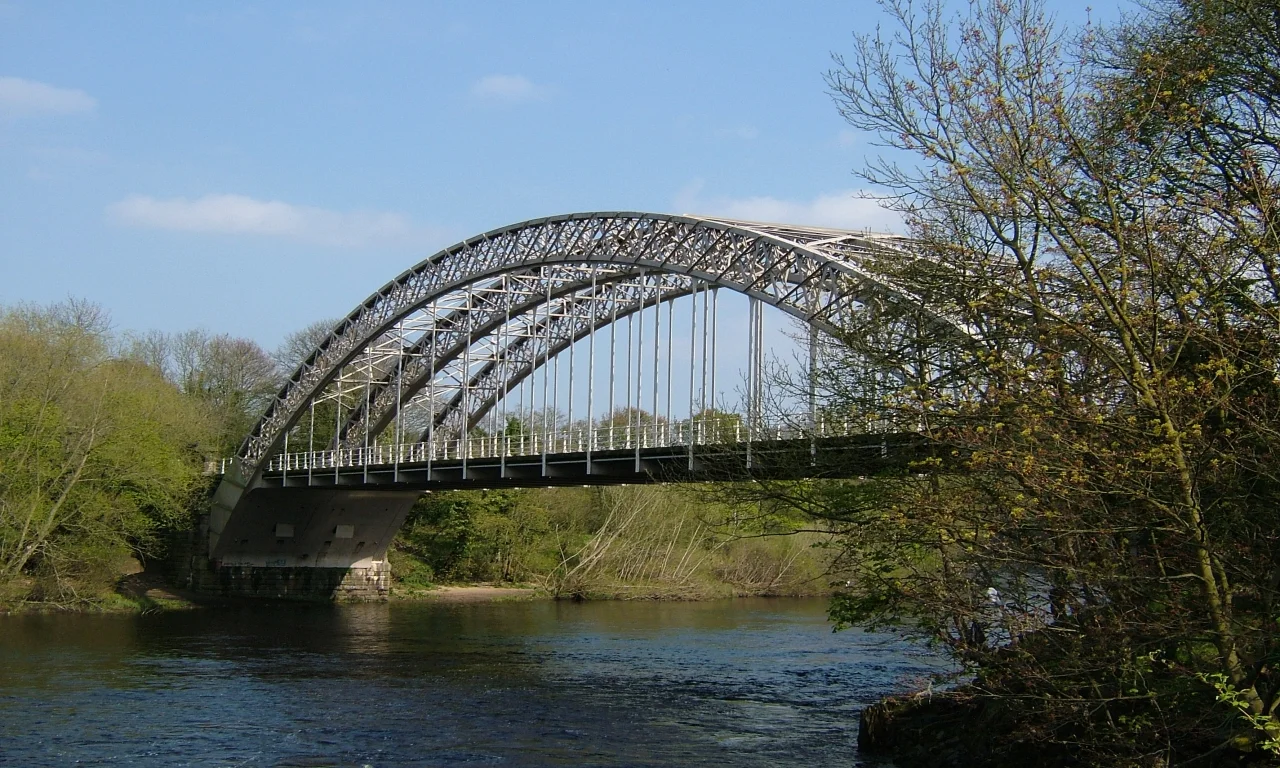
About a mile west of the village, at Hagg Bank, stands one of the most unexpectedly important bridges in the world: Wylam Railway Bridge, also called the Half Moon Bridge or Points Bridge. Built by the Scotswood, Newburn and Wylam Railway Company in 1876, it was originally meant to have four spans on three piers. The local coal companies refused, fearing piers in the riverbed would disturb the shallow mine workings underneath. The engineers responded with a single-span design: three parallel wrought-iron arches resting on abutments on either bank, the rail decks suspended below by 15 wrought-iron drop bars. It cost £16,000. Its descendants include Newcastle's Tyne Bridge (1928) and the Sydney Harbour Bridge (1932). The line closed in 1968, the bridge was bought by Northumberland County Council, restored in 1997 with Heritage Lottery funding, and the cyclepath that runs across it today is part of National Cycle Network Route 72.
Bunting, Byatt and Parsons
Wylam never returned to industry, but it kept attracting talent. The poet Basil Bunting lived here. So did the novelists A.S. Byatt and Margaret Drabble (sisters, neither of them speaking to the other for many years). The Victorian architect Archibald Matthias Dunn (who designed the Cottier-glazed church at Prudhoe) was a resident. The broadcaster Greg Dyke too. So was Charles Algernon Parsons, the engineer who invented the steam turbine, who built the Turbinia, who gave us the modern power station and the modern warship engine room. The village church of St. Oswin's, built in 1886, is dedicated to a Northumbrian saint and was funded mostly by William Hedley's sons George and William. The Wylam Winter Tales festival each January and February fills the village with storytelling, music and crafts. Population in 2025: around 2,100, in roughly 800 households.
Flying Over Wylam
Coordinates 54.974 N, 1.821 W, geohash gcy8w. Cruise 1,500 to 2,500 ft AGL for the best read of the river and village together. Wylam sits in a bend of the Tyne about 10 miles west of Newcastle, with the village on both banks but the main settlement on the south. The unmistakable landmark is the Wylam Railway Bridge (Half Moon Bridge), a single wrought-iron arch a mile west at Hagg Bank. The Tyne Valley railway line runs along the south bank through Wylam station. The cyclepath of the former North Wylam Loop runs along the north bank, passing the isolated stone cottage of George Stephenson's Birthplace about a mile east of the village. Newcastle International Airport (EGNT) lies 6 miles north and is the closest IFR field. Newcastle city is 9 miles east.
From the Air
Coordinates 54.974 N, 1.821 W. Cruise 1,500-2,500 ft AGL. Look for Wylam Railway Bridge (single iron arch) a mile west at Hagg Bank, ancestor of the Sydney Harbour Bridge. Tyne Valley railway on south bank, cyclepath on north bank. Newcastle International (EGNT) 6 miles north.
Nearby Stories
- Seaburn Dene 1.2 km away
- SM UB-115 3.5 km away
- Kielder Forest 4.5 km away
- Appleby Horse Fair 9 km away
- Simonside Hills 9.7 km away
- Streatlam Castle 12 km away
- Stockton-on-Tees 12 km away
- RAF Spadeadam 14 km away