
Yirrkala
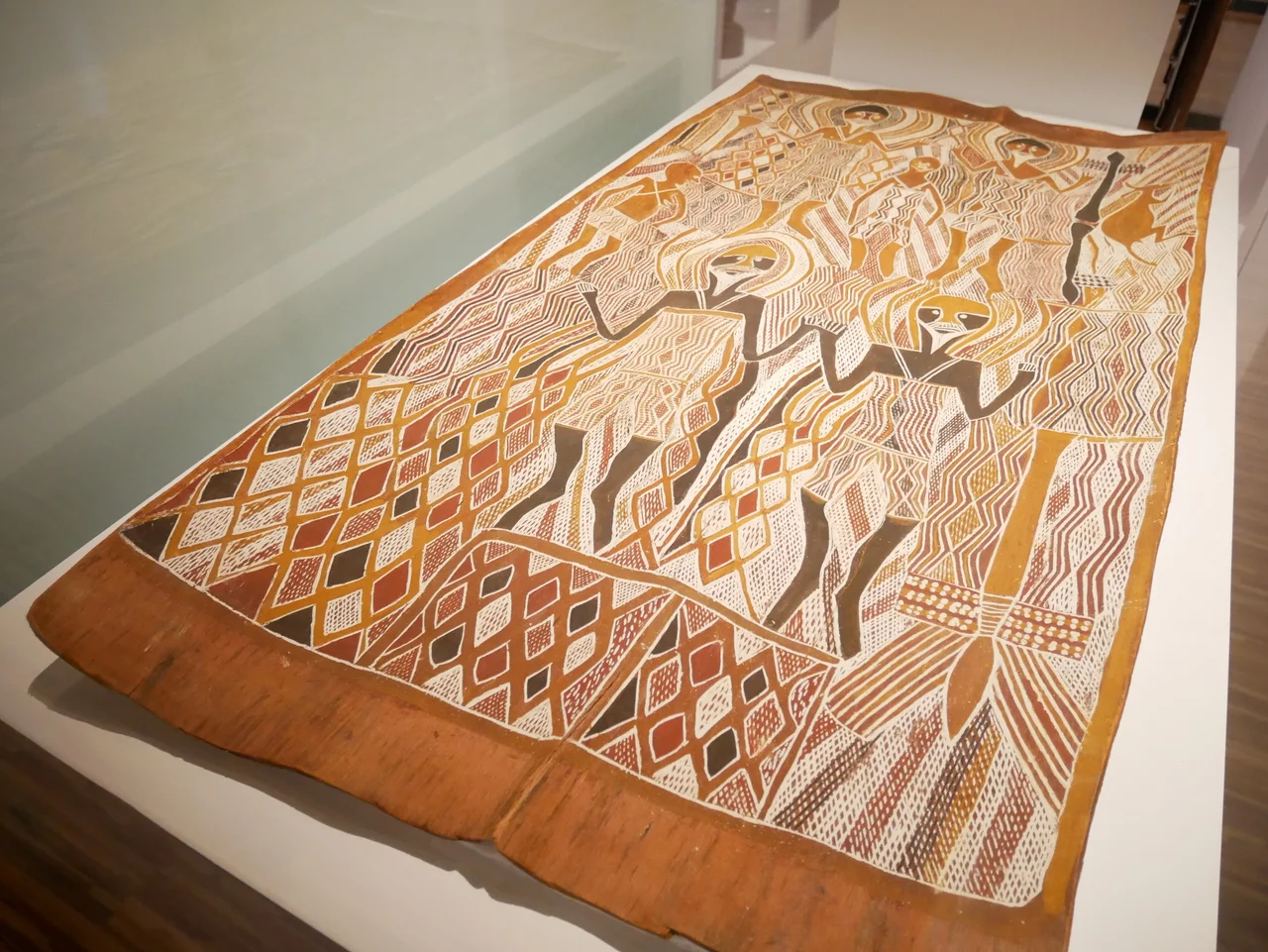
In 1963 the people of a small mission on the Gove Peninsula did something the Australian Parliament had never formally accepted before: they sent it a legal document written in their own law. When the government excised more than 300 square kilometres of their reserve for a bauxite mine without asking them, the Yolngu of Yirrkala answered with bark. Clan elders painted the sacred designs that record their ownership of the land, framed a typed petition inside them, and dispatched it to Canberra. The bauxite mine went ahead anyway. But the Yirrkala bark petitions changed the country, and the place that produced them, a community of about 650 people set against red cliffs above the Arafura Sea, has been a wellspring of Yolngu achievement ever since.
Thirteen Clans, One Place
Yolngu have lived on this country for tens of thousands of years, but the village now called Yirrkala took its present shape in 1935, when Methodist missionaries opened a station here and people from thirteen different Yolngu clans gathered around it. Unusually for the era, the early relationship was not one of pure coercion. Residents came and went as they chose, and the Yolngu folded Christianity into their own ancestral beliefs rather than abandoning them. That confidence in their own law would matter enormously a generation later. Yirrkala sits eighteen kilometres southeast of the mining town of Nhulunbuy, but the two places belong to different worlds: one a company town built for a refinery, the other a Yolngu homeland where the oldest knowledge in Australia is still taught, painted and sung.
The Petitions That Moved a Nation
Early in 1963 the elders painted the Yirrkala Church Panels, two great sheets of board: one carrying the ancestral narratives of the Dhuwa moiety, the other those of the Yirritja. It was a deliberate statement that this land already had owners, and law. When word came that their country had been handed to a mining company, the community created a series of four petitions, typed on a Remington typewriter and bordered with traditional bark painting, and sent them to the House of Representatives. Two were tabled in August 1963. They were the first traditional documents prepared by Indigenous Australians that Parliament formally received, a quiet acknowledgment that Yolngu law existed. The mining proceeded, but the petitions forced a parliamentary inquiry and lit a fuse. The thread runs straight from Yirrkala to the 1967 referendum, the Aboriginal Land Rights (Northern Territory) Act 1976, and the High Court's Mabo decision of 1992.
Old Masters and Bark Ladies
Few small towns anywhere have produced so many artists of international standing. The National Museum of Australia counts Mawalan Marika, Mithinarri Gurruwiwi and Birrikitji Gumana among the old masters of bark painting, and their descendants have kept winning the country's top honours. Yirrkala is also a traditional home of the yidaki, the instrument the world calls the didgeridoo, and some of the finest are still made here. The work is not decoration. Each cross-hatched design, each ancestral figure, encodes clan law and ownership of specific country, which is exactly why painting could serve as legal evidence in 1963. A wave of celebrated women painters, the so-called Bark Ladies, has carried that tradition into major galleries from Sydney to overseas, proving the law on bark is as alive as ever.
Teaching Both Ways
At Yirrkala School, children learn in two knowledge systems at once. The 'both ways' method teaches the Yolngu Matha language and a cultural curriculum called Galtha Rom alongside English, and when the Northern Territory ordered four hours of English-first instruction in 2009, the community held its ground. The approach works: in 2020, eight students became the first from the community to finish Year 12 with university-entrance scores. Yalmay Yunupingu, who taught here for forty years and was widely honoured for it, embodied that mission, as did her late husband, Yothu Yindi frontman and educator Mandawuy Yunupingu. The school is now studied as a model for remote Aboriginal learning.
Treaty, Sung Out Loud
Yirrkala's voice has reached far beyond Arnhem Land. The band Yothu Yindi formed here in 1986, and in 1991 its single 'Treaty' carried Yolngu language and clapsticks onto dance floors around the world, turning a political demand into an anthem. Each August, on nearby Gumatj country at Gulkula, the Garma Festival draws thousands to learn from Yolngu music, dance and ceremony and to debate the nation's future. The community has lost towering leaders, among them land-rights champion Galarrwuy Yunupingu, but it keeps producing them, from artists and footballers to a model on international runways. Yirrkala is small. Its influence on Australia is not.
From the Air
Yirrkala lies at approximately 12.25°S, 136.89°E on the east coast of the Gove Peninsula, in the far northeast of Arnhem Land, facing the Gulf of Carpentaria and the Arafura Sea. From the air it appears as a compact coastal community below low red escarpment country, with beaches and clear tropical water to the east. The nearest airport is Gove (Nhulunbuy) Airport (GOV / YPGV), about 18 km north by road and the gateway for all visitors to the region; long-distance hops connect via Darwin (DRW / YPDN) to the west. Access to the area is by permit through Yolngu-controlled corporations. The wet season (roughly November to April) brings monsoon cloud, heavy rain and cyclone risk; the dry season offers settled, clear flying weather and excellent visibility over the coastline.
Nearby Stories
- Laynhapuy Indigenous Protected Area 26 km away
- Gawa, Elcho Island 59 km away
- Gapuwiyak 65 km away
- Wessel Islands 76 km away
- Bäniyala 111 km away
- Gulf of Carpentaria 218 km away
- Australia–Indonesia Border 227 km away
- Indonesia–Papua New Guinea Border 244 km away