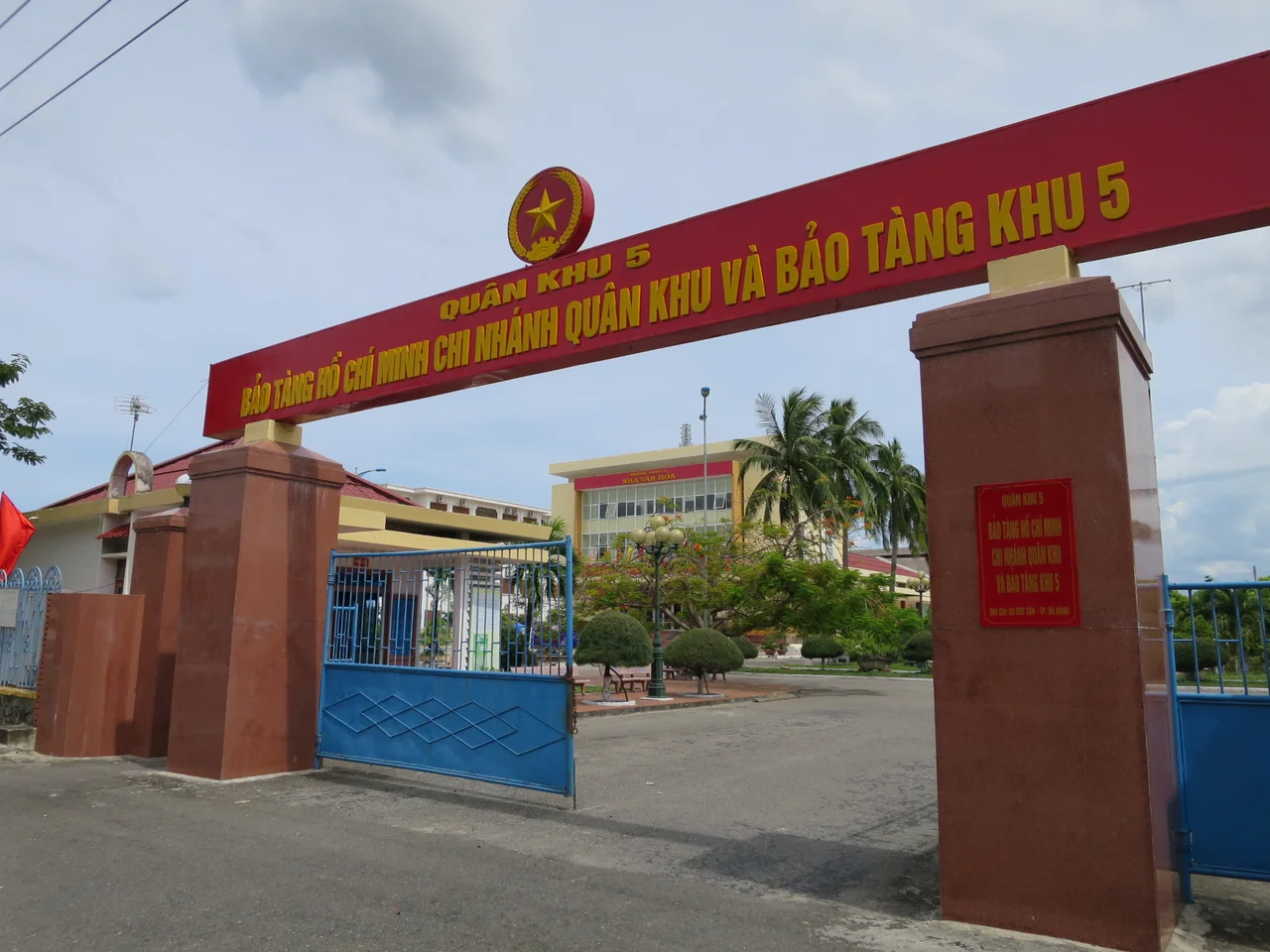

Zone 5 Military Museum, Danang
A captured American M48A3 Patton tank sits in the courtyard under the Vietnamese sun, its olive drab paint bleached and peeling, the turret aimed at nothing in particular. Beside it stands a MiG-21 fighter — tail number 5114 — the actual aircraft that pilot Nguyen Van Nghia used to shoot down a US F-4 Phantom over Bac Thai province in 1972. These are not replicas. Every piece of hardware on the grounds of the Zone 5 Military Museum (Bảo Tàng Khu 5) at 3 Duy Tân Street in Da Nang is the real thing, still bearing the serial numbers and unit markings of the men who operated them, captured them, or died near them.
A Century of Resistance
The museum frames Vietnam's military history not as a series of discrete conflicts but as a single, continuous story of resistance to foreign occupation. The indoor galleries move from Chinese occupation through the First Indochina War against France — represented by a QF 3.7-inch mountain howitzer seized from French forces in Bình Thuận Province in 1953 — through the American war and into the present-day standoff with China over the Spratly and Paracel Islands. The display is unambiguous about its perspective. These galleries belong to the victors, and they tell the story accordingly. But the photographic records of specific battles — Ba Gia, Ia Drang, Operation Starlite, the Hue–Da Nang Campaign — give even a skeptical visitor plenty of documented history to engage with.
Steel in the Courtyard
The outdoor collection is extraordinary in its specificity. Each vehicle comes with a provenance: the M41 Walker Bulldog tank used by the ARVN 14th Armored Cavalry Regiment and captured at Tân Cảnh during the Battle of Kontum in May 1972; the M113 armored personnel carrier seized in 1975 and subsequently deployed in the Cambodian–Vietnamese War; an M8 Greyhound armoured car taken from the ill-fated Groupe Mobile 100 at the Battle of Mang Yang Pass. A BLU-82 "Daisy Cutter" bomb — one of the largest conventional bombs in the American arsenal — was recovered from An Lão District as recently as 2006, a reminder that the ground keeps yielding what the war buried. The Cessna A-37 Dragonfly (serial 10793), captured at Da Nang Air Base on March 29, 1975, has a particularly striking postscript: after capture, it was flown by PAVN pilots in the bombing of Tan Son Nhut Air Base just days later.
The Mothers' Memorial
Inside the main museum building, amid the tactical maps and battle-flag displays, one section stops visitors cold. It memorializes Vietnamese mothers who lost their only child — or multiple children — during the decades of war. There are no weapons here, only photographs and names. These women, called Bà Mẹ Việt Nam Anh Hùng (Heroic Mothers of Vietnam), number in the tens of thousands across the country; the museum honors those specifically from the Zone 5 military region. The display makes no attempt to separate grief from politics, but it doesn't need to. A mother's loss does not require ideological framing. Standing in that room, the tanks in the courtyard feel heavier.
Ho Chi Minh's Shadow
Two of the museum's four sections are dedicated to Ho Chi Minh: a replica of his stilt house in Hanoi, built to the same dimensions as the original in the Presidential Palace complex, and a Ho Chi Minh Museum chronicling his life and the independence movement he led. Together with memorials to General Võ Nguyên Giáp and the commanders of the Zone 5 Military, these sections establish the museum as much a place of political veneration as historical record. Admission is free for Vietnamese nationals; foreign visitors pay VND 60,000, with an additional VND 10,000 to photograph the collection. The museum is open daily except Monday, from 07:30 to 10:30 and again from 13:30 to 16:30.
Living History in a Coastal City
Da Nang is one of Vietnam's fastest-growing cities, its beachfront now lined with resort hotels and its old American air base long converted to a busy international airport (IATA: DAD; ICAO: VVDN). The Zone 5 Museum sits in the older part of the city, a short distance from the Han River. Visitors who arrive expecting a sanitized or abstract account of the war will find instead an inventory of actual machines, actual aircraft, and actual names — bound together by a national story that Vietnam tells with complete conviction. Whatever one's own position on that story, the hardware in the courtyard is not interested in debate.
From the Air
The museum sits in central Da Nang at approximately 16.0487°N, 108.218°E, adjacent to the Han River. Da Nang International Airport (VVDN) is roughly 3 km to the southwest. Flying into Da Nang from the north, the museum is visible near the western bank of the Han River at pattern altitude. The city sits on a broad coastal plain with the Marble Mountains visible 8 km to the south and the Hai Van Pass mountain range rising steeply to the north. Recommended approach viewing altitude: 1,500 ft AGL on the coast-parallel heading.
Nearby Stories
- Mỹ Sơn 6.7 km away
- Tomb of Tự Đức 9.5 km away
- Chàm Islands 16 km away
- Thiên Mụ Temple 41 km away
- Chu Lai Air Base 47 km away
- Tomb of Gia Long 54 km away
- Dong Ampham National Biodiversity Conservation Area 81 km away
- Battle of the Paracel Islands 321 km away