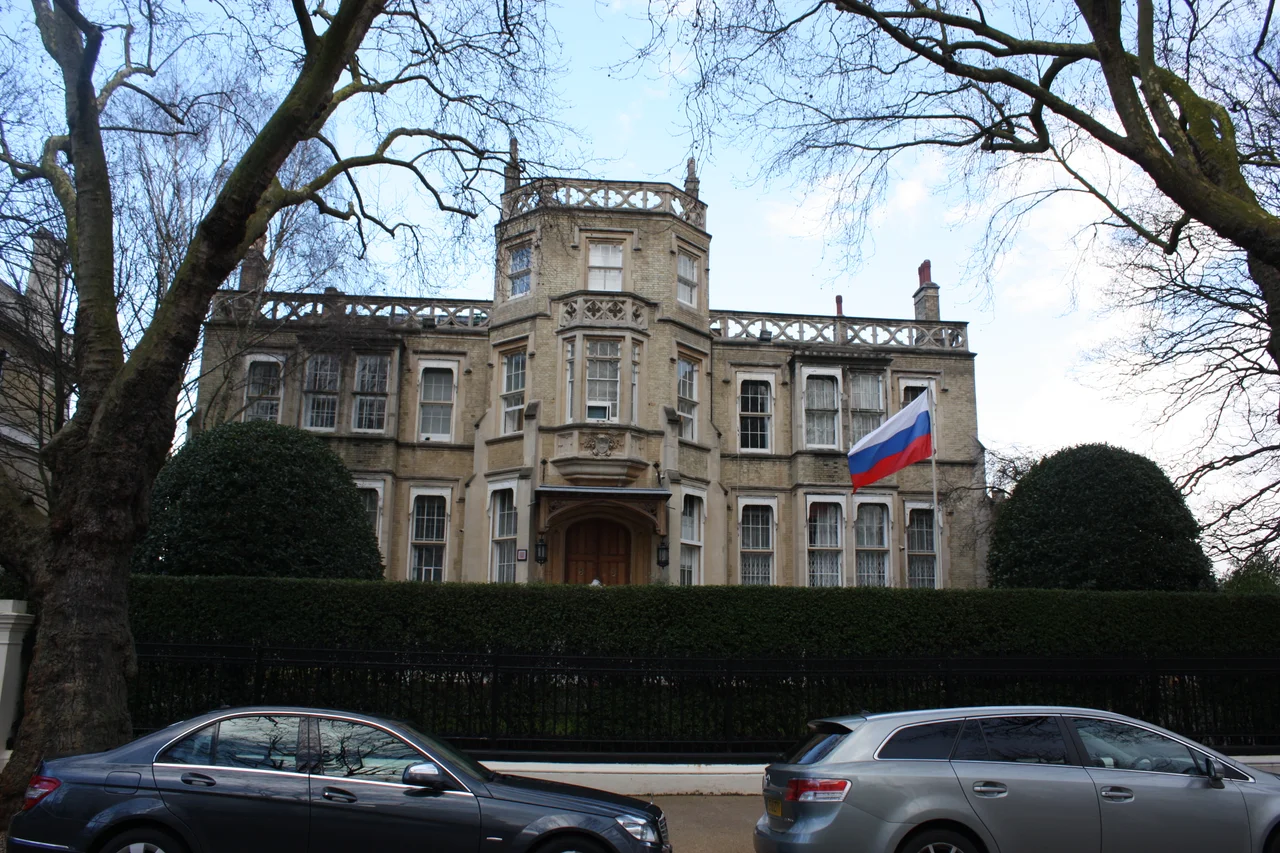

13 Kensington Palace Gardens
Britain rents this house to Russia for one pound a year. In return, Russia rents the British embassy in Moscow for one rouble. The Earl of Harrington commissioned the place in 1851, in his own peculiar version of Gothic style, on land that had once been the kitchen garden of Kensington Palace. A contemporary critic called it the very thumbscrew of design. Today, with the inscription Harrington House painted over and replaced by the number 13, it is the official residence of the Russian Ambassador to the Court of St James's.
Carved Out of Kensington Palace
In 1841 an Act of Parliament hived off twenty-eight acres of Kensington Palace's kitchen gardens and turned them into a street of grand private houses. Kensington Palace Gardens quickly became one of the most coveted addresses in London, lined with what the era's prospectuses called rich private residences. Lord Harrington applied to build in March 1851 and was granted a ninety-one year lease at £147 a year, on condition that his house cost no less than £6,000 and was finished by January 1853. He blew through the budget. Construction started in October 1851 and ran to about £15,000. By July 1853 the Earl was already living in the result.
The Thumbscrew of Design
Harrington wanted Gothic. He sketched plans himself, handed them to the celebrated architect Decimus Burton for the exterior, and let Charles James Richardson supervise the build. Richardson, the surveyor to the Earl's South Kensington estate, was diplomatic in writing but visibly exasperated. He noted that the flat outline and low roofs were not really Gothic, that the windows were more eccentric than beautiful, that the sash frames were common, and that despite spending double the required minimum, the Earl had skimped catastrophically on interior decoration. Contemporary critics piled on. One reviewer reached for the rack: instead of repose we have actual torture, the very thumbscrew of design. The Earl, undeterred, thanked Richardson for building him a house without a fault.
Inside the Plain Rooms
Buff brick with Bath stone dressings, a symmetrical front, a three-storey entrance tower originally crowned with a bell-turret. An oriel window jutted above the front door beneath a quatrefoil parapet. To the south, a conservatory. Inside, from the entrance hall, library and dining room to either side, you reached the saloon at the heart of the house - two storeys high, lit by a skylight of embossed and coloured glass featuring shields, coats of arms, mottoes and monograms. A stone staircase swept up through it until 1924, when it was replaced by twinned oak stairs and the whole room was relined in oak panelling. The rest of the rooms, by all accounts, lived up to Richardson's word: plain. Gothic cornices and not much else. The basement, fourteen feet high and extending under the courtyard, held the working machinery of the household: kitchen, scullery, pastry-room, stillroom, dairy, wash-house, laundry, butler's pantry, steward's room, servants' hall, men's cellars, dust-pit and closets.
From Stanhopes to Soviets
The Stanhope family - the Earls of Harrington - held the house until the First World War. Then in 1924 it passed to Sir Lewis Richardson, a South African millionaire businessman who spent over £25,000 reshaping it. Out went the bell-turret. The conservatory got new windows. The sloping roof was flattened. Inside, considerable changes. Then in 1930, in one of those gestures that only the very rich can afford, Sir Lewis gave the entire house to the British Crown. He suggested it would serve nicely as the Soviet Embassy. By that point Britain and the USSR had reopened diplomatic relations after the freeze of 1927. A new home was needed. The Crown agreed. The carved Harrington House lettering above the door was painted over, replaced by a simple painted 13, and Soviet diplomats moved in.
Diplomatic Real Estate
In 1991, as the Soviet Union dissolved, the British government extended the Russian government's lease for another ninety-nine years. The terms remained extraordinary: one pound a year from the Russians, one rouble a year from the British for their Moscow embassy. The Russian Embassy itself now occupies numbers 4 to 5 and 6 to 7 further down the street; number 13 has been retained as the official residence of the ambassador. Other former Soviet properties on Kensington Palace Gardens have drifted back into private hands. The street, often called Billionaires' Row, runs north from the palace gardens to Notting Hill Gate, and the residences along it include some of the most expensive privately owned houses in the world. Number 13, paying a token rent for one of the rarest addresses on Earth, may be the strangest deal of the lot - a Gothic Revival house that a Victorian called torture, leased for a coin between two governments that have rarely seen eye to eye on much.
From the Air
Located at 51.5071 N, 0.1906 W in the Royal Borough of Kensington and Chelsea. From the air, look for the long north-south slot of Kensington Palace Gardens, a tree-lined street running through Kensington Gardens just west of Kensington Palace itself. Hyde Park lies immediately to the east. Nearest airports: London Heathrow (EGLL) approximately 13 nautical miles west; London City (EGLC) approximately 11 nautical miles east. Best viewed at 2,000 to 3,500 feet.
Nearby Stories
- Stevenage 5.7 km away
- Malling Abbey 5.7 km away
- 1952 Farnborough Airshow Crash 7.7 km away
- Ingatestone Hall 8.2 km away
- Hellfire Caves 9.1 km away
- The Carrington Event: The Solar Storm That Could Happen Again 9.8 km away
- Bletchley Park 16 km away
- Castle Hedingham 23 km away