
1937 Airlines of Australia Stinson crash
Nine days after the airliner vanished, everyone had given up - everyone but a bushman who could not stop looking at the mountains. On 19 February 1937, a Stinson airliner named Brisbane disappeared somewhere between Brisbane and Sydney with seven people aboard. The search planes hunted far to the south, near Newcastle, on the strength of false sightings. But Bernard O'Reilly, who ran a rainforest guesthouse on the Lamington Plateau, kept turning over a simpler idea: that the plane had never crossed the ranges at all, that it lay broken in the green wall of the McPherson Range he could see from his own front door. On 27 February, alone and on foot, he set out to prove it.
Into Cyclonic Weather
The Stinson Model A was, in 1936, about as modern as flying got - a three-engined airliner advertised as among the most luxurious operating in America, capable of 165 miles per hour, with retractable undercarriage and variable-pitch propellers. None of it mattered against the weather it met. The report out of Sydney had looked merely "a little sticky," but almost at once the aircraft, call sign HH, ran into the edge of a cyclone. South-easterly winds slammed into the southern face of the McPherson Range and rose in violent gusts, building extreme turbulence high into the air - a rare and savage local event. The radios of the era were little help; the pilots had only basic Morse, slow enough that a weather report might crawl out at five words a minute. By 7.30 that Friday evening, the Brisbane was reported missing.
A Hunch and a Long Walk
While the official search looked the wrong way, O'Reilly reasoned it out. His own brother had seen the plane heading toward the cloud-shrouded range. If the reported sightings further south were false - and O'Reilly believed they were - then the aircraft must have lacked the height to clear the mountains and gone down somewhere in that tangle of ridges and rainforest. So he walked into it. He hiked into country with no tracks, camping a night on the range, pushing through some of the densest subtropical forest in Australia, navigating by little more than conviction and bushcraft. On the afternoon of 28 February, at about 4:30, he found it: the wreckage, and beside it two men still alive.
The Men by the Wreck
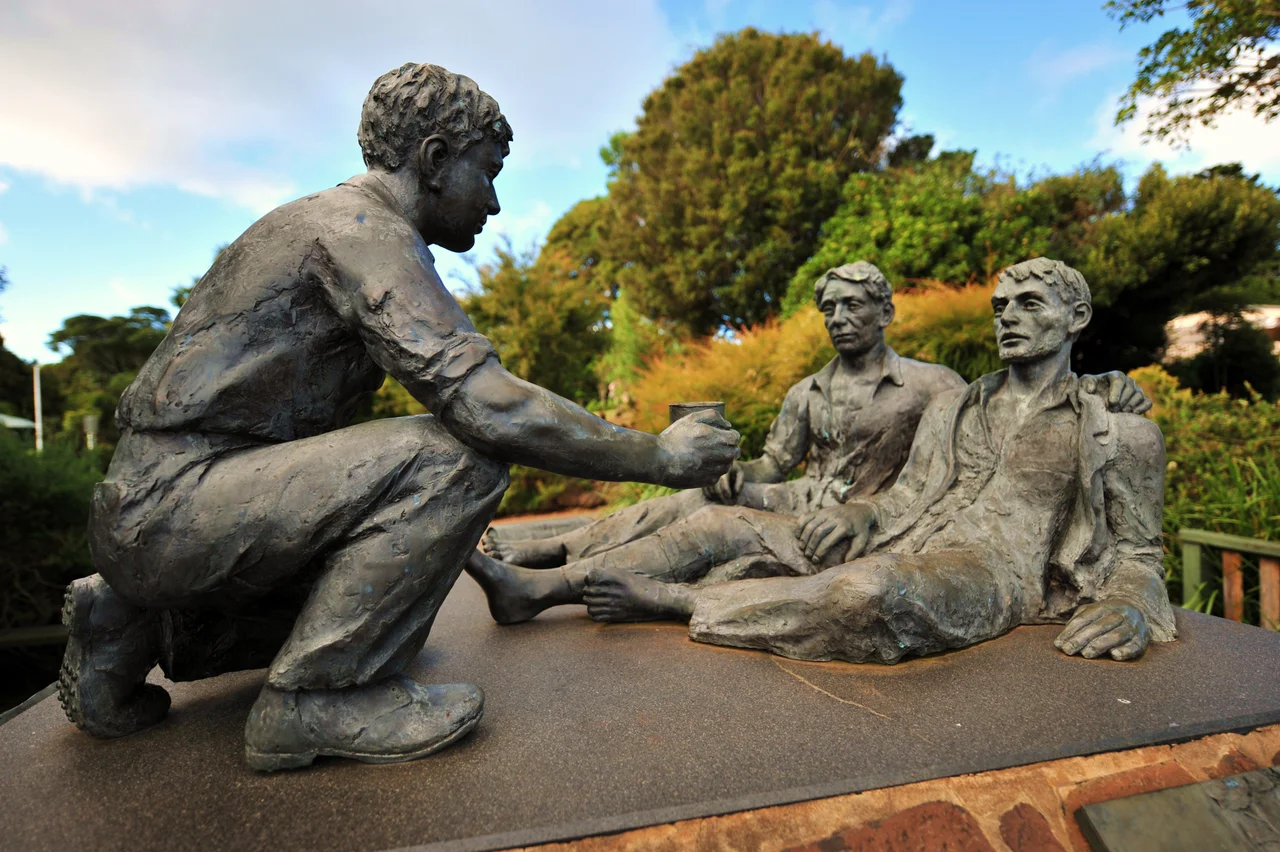
Two survivors had waited nine days by the broken aircraft. Joseph Binstead was unhurt; John Proud had a broken leg. They had kept themselves alive on water carried from a creek a mile off, and they had had nothing to eat. When O'Reilly appeared out of the forest, they asked first to shake his hand - and then, with the dazed humour of men who had been to the edge, they wanted to know the cricket scores. But the wreck held grief as well. Both pilots, chief pilot Rex Boyden, forty, and first pilot Beverley Shepherd, twenty-six, had been killed instantly, along with two passengers. And there was a fifth man unaccounted for. James Westray, twenty-five and newly arrived from London, had survived the crash with burns and set off alone the morning after to find help. O'Reilly found his body on the way back down: Westray had fallen on slippery rocks and died of his injuries, within reach of the help he was seeking.
Green Mountains
O'Reilly's walk back to raise the alarm, and the rescue party that carried the survivors out, turned a guesthouse on the Lamington Plateau into a place of national legend. He became a household name almost overnight, and in 1940 he set the whole story down in his book Green Mountains, which Australians have read ever since. The crash also forced uncomfortable questions: a coroner pressed for better ground organisation, proper weather reporting along air routes, and full use of radio aids - the unglamorous infrastructure that would, in time, make flying safe. Today a plaque marks the crash site deep in the ranges, a monument to Westray stands at Collins Gap on the border, and a replica Stinson sits outside O'Reilly's Rainforest Retreat - reminders of five who died, two who lived, and one man who would not stop looking at the mountains.
From the Air
The crash site lies in the rugged McPherson Range at roughly 28.31°S, 153.12°E, on the Queensland-New South Wales border about 82 km south-south-east of Archerfield Aerodrome (YBAF) near Brisbane. The terrain is steep, densely rainforested ridgeline - part of the Lamington/Border Ranges country and notoriously hard to traverse on foot, which is exactly why the wreck went unfound for nine days. O'Reilly's Rainforest Retreat, with its replica Stinson, sits nearby on the Lamington Plateau. From the air the range presents as a dark, folded wall of rainforest rising sharply from the lowlands; cloud and turbulence build fast against its southern face, as the 1937 crew learned. Nearest major airports are Brisbane (YBBN) and Gold Coast (YBCG) to the north-east, with Archerfield (YBAF) the historic reference point. This is a memorial site in protected wilderness - of interest from the air, but the ground belongs to the rainforest.
Nearby Stories
- Cape Byron Marine Park 5.5 km away
- Spicers Gap Road 17 km away
- The Channon 18 km away
- Glow-Worm Caves Tamborine Mountain 23 km away
- Cape Byron 27 km away
- Allan Cunningham Monument 42 km away
- Bald Rock National Park 56 km away
- HMS Porpoise (1799) 682 km away