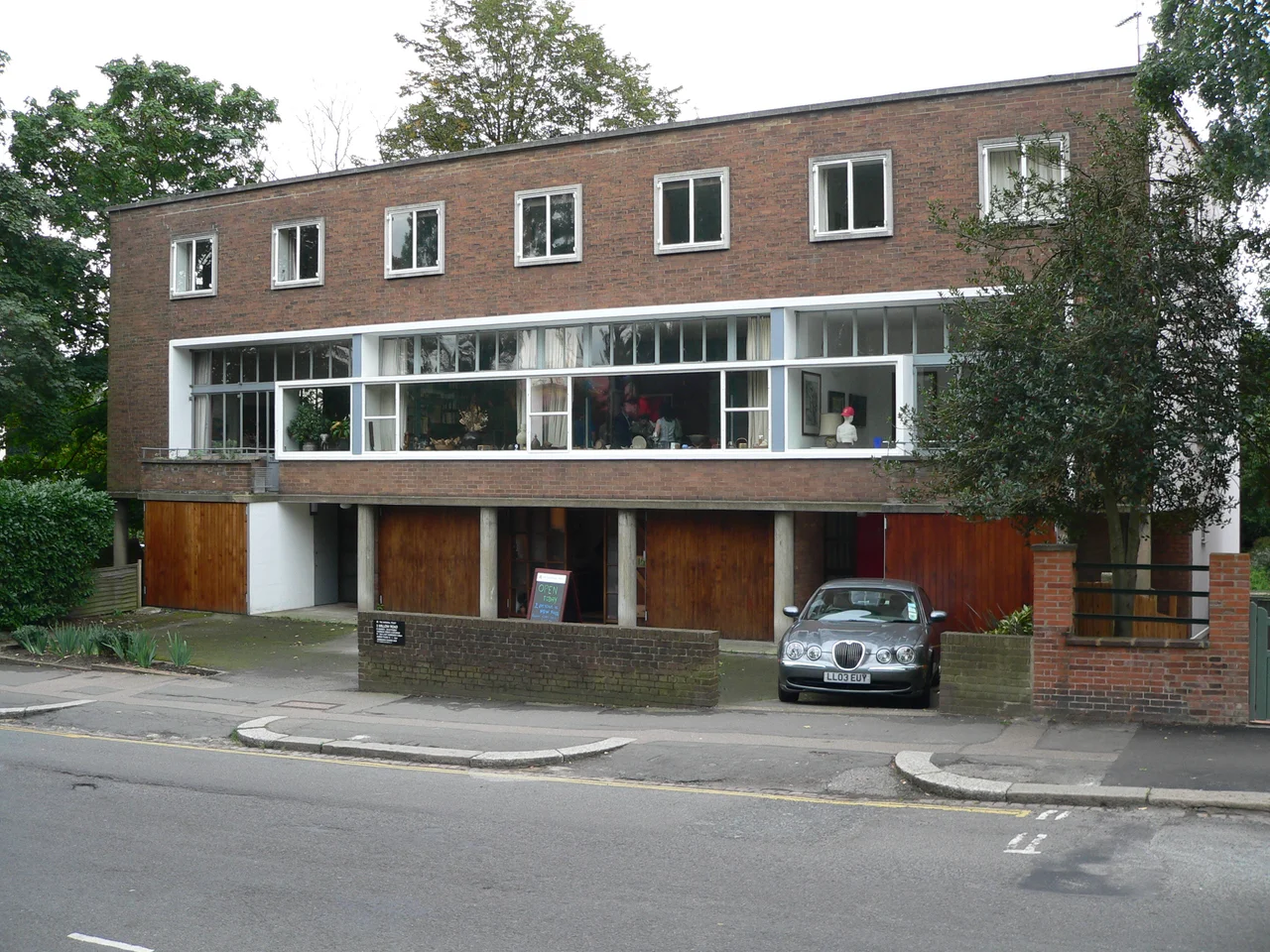

2 Willow Road
Ian Fleming lived in Hampstead. So did Erno Goldfinger. When Goldfinger proposed demolishing a row of Victorian cottages in 1937 to build a modernist concrete-framed terrace, Fleming was among the loudest opponents. He lost. The cottages came down. The new building - severe, flat-roofed, supported by an exposed concrete frame - went up in 1939. Then, in 1959, Fleming published his seventh Bond novel. The villain's name was Auric Goldfinger. The architect heard about it, consulted his lawyers about suing for libel, and was eventually persuaded not to. The book - and the 1964 film of the same name - made his surname synonymous with a megalomaniac who tries to nuke Fort Knox. The house, meanwhile, is now one of the most carefully preserved examples of British modernism, owned by the National Trust and open to the public since 1996.
Three Houses, One Family Home
2 Willow Road is the middle of three connected houses - Nos. 1, 2, and 3 - that Goldfinger designed and built together as a terrace overlooking Hampstead Heath. The plan had originally been more radical: Goldfinger wanted a block of studio flats, believing that flat living was the more socially conscious choice for modern architects. He compromised on the terrace plan, retaining the larger central house as his own family home. He lived there with his wife Ursula and their three children. The two flanking houses, Nos. 1 and 3, remain private homes today. Only No. 2 belongs to the National Trust. Goldfinger lived there until his death in 1987.
The Concrete Frame and the Spiral Staircase
The house is supported by an exposed reinforced concrete frame, parts of which are deliberately visible from outside. This structural choice allowed Goldfinger to keep the interior open and uncluttered, with brick infill between the concrete columns rather than load-bearing walls. The Raumplan ideas of the Austrian modernist Adolf Loos - the notion of organizing rooms around volume rather than floor plan - clearly influenced the layout. At the centre of the house, a spiral staircase designed by the engineer Ove Arup rises through all three floors. Arup would go on to found the global engineering firm that bears his name and design structures for the Sydney Opera House. The staircase, slim and precise, is a piece of engineering as carefully considered as the rest of the house.
An Art Collector's House
Goldfinger filled the house with art and with furniture he had designed himself. The collection is significant: works by Bridget Riley, Prunella Clough, Marcel Duchamp, Eduardo Paolozzi, Henry Moore, and Max Ernst. The house functioned both as family home and as a private gallery, with the carefully framed views and the geometric clarity of the architecture providing settings for the art. When the National Trust acquired the property in 1995, it inherited not just a building but a complete domestic environment - the furniture in its original positions, the art on the original walls, the kitchen as Ursula Goldfinger had used it. A restoration of one of the artworks was featured in Series 3 of the BBC's Hidden Treasures of the National Trust in 2025.
The Trust's Modernist Turn
When the National Trust took the house in 1995, the acquisition was controversial. The Trust had built its reputation on country houses, medieval barns, ancient gardens - properties at least three centuries old. A 1939 modernist terrace was a different proposition. Some members openly questioned whether 2 Willow Road qualified as heritage at all. Time has changed that view. The house is now recognized as one of the most important British examples of pre-war international-style modernism, and the Trust's acquisition of it became a precedent. Goldfinger's Trellick Tower in west London - a Brutalist concrete apartment block once regarded as a symbol of urban dystopia - is now Grade II* listed. The argument that ended in 1995 with Goldfinger's family home being preserved has continued in the recognition that twentieth-century architecture deserves the same care as anything older.
Fleming's Revenge
Ian Fleming and Henry Brooke, the future Conservative Home Secretary, were among the local residents who fought the demolition. Fleming's revenge - naming his villain Auric Goldfinger - was personal and creative. Erno Goldfinger considered suing, then dropped the matter on advice that the publicity would only spread the joke. The Fleming-Goldfinger feud has become part of the house's folklore, a story that the National Trust now mentions on the tour. There is a certain mischief in the fact that one of the most carefully preserved modernist homes in Britain is also the source of a Bond villain's name - that the man who built this stark, beautiful, deliberately uncompromising house also lent his surname to a gold-obsessed criminal mastermind. Visitors walking through the rooms can see Goldfinger's actual taste: paintings by Bridget Riley, sculptures by Henry Moore, furniture he designed himself, a desk where he worked on the buildings - including the Trellick Tower - that would polarize British architectural opinion for the rest of the century.
From the Air
2 Willow Road sits at 51.5600°N, 0.1700°W on the southern edge of Hampstead Heath in the London Borough of Camden, north London. The house lies just south of the Heath - 320 hectares of grassland, ponds, and woodland that form the most dramatic green space in inner London. Nearest major airports: London Heathrow (EGLL) 17nm southwest, London City (EGLC) 9nm southeast. From altitude, Hampstead Heath is unmistakable - a large irregular green area in dense north London. Parliament Hill, on the Heath's south end, offers one of the city's classic views; Willow Road runs along the Heath's southwest boundary.
Nearby Stories
- Stevenage 5.7 km away
- Malling Abbey 5.7 km away
- 1952 Farnborough Airshow Crash 7.7 km away
- Ingatestone Hall 8.2 km away
- Hellfire Caves 9.1 km away
- The Carrington Event: The Solar Storm That Could Happen Again 9.8 km away
- Bletchley Park 16 km away
- Castle Hedingham 23 km away