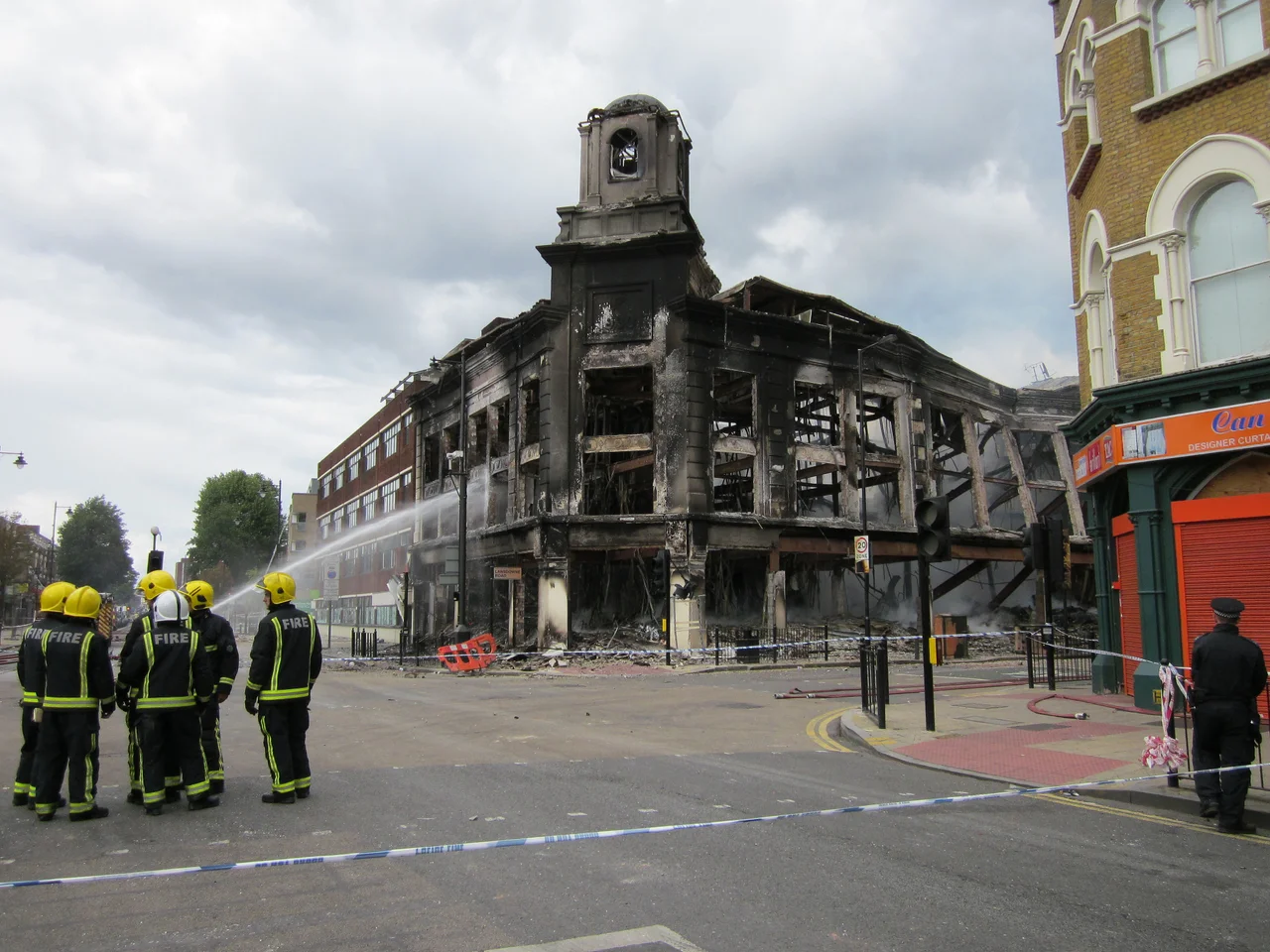

2011 England Riots
Mark Duggan was twenty-nine years old when armed officers stopped the minicab he was riding in on the Ferry Lane bridge by Tottenham Hale station. It was the afternoon of 4 August 2011. A few seconds later he was dead. Two days after that, his family and friends marched to Tottenham police station to demand answers. By nightfall on 6 August, Tottenham was burning. Over the next five days a wave of looting, fire, and confrontation moved out from north London through Hackney, Brixton, Croydon, and Ealing, then jumped to Birmingham, Manchester, Liverpool, Nottingham, Bristol. Five people died. Nearly two thousand were eventually charged. England spent the rest of the summer trying to work out what it had just been part of.
Tottenham, 6 August
The march that started the riots was peaceful. About 300 friends and relatives of Mark Duggan walked from the Broadwater Farm estate to Tottenham police station to demand that a senior officer come out and speak. The senior officer they got was a chief inspector. The crowd waited longer than they had planned. Tensions in Tottenham had a long memory - the Broadwater Farm riot of 1985, the New Cross fire, the murder of Stephen Lawrence, the slow corrosion of trust between police and the local Black community. Rumours circulated. Then something - reports vary about what - tipped the protest into something else. A patrol car burned. Then another. Then a double-decker bus. Then the Carpetright building on the high road went up, and with it the flats above. Looting spread to Tottenham Hale retail park overnight.
What the Bullet Did Not Do
In the first hours, the press widely reported that a bullet had been found embedded in a police radio, implying that Duggan had fired on the officers. A loaded converted blank-firing pistol was indeed recovered from the scene, wrapped in a sock. The Independent Police Complaints Commission later confirmed that there was no evidence Duggan had fired it. The bullet in the radio was an over-penetration - it had passed through Duggan's body. On 13 August the IPCC acknowledged that it may have verbally led journalists to wrongly believe shots had been exchanged. In 2014 a coroner's jury concluded Duggan had been lawfully killed; the Court of Appeal upheld that verdict in 2017. Among many people in Tottenham, the verdict did not settle the question.
Copycat Nights
On 7 August rioting spread to Brixton, Enfield, Islington, Wood Green, and Oxford Circus. On 8 August it left London. Birmingham city centre was looted. So were parts of Manchester, Salford, Liverpool, Nottingham, Wolverhampton, and Bristol. Smaller flares went up in Gillingham, Derby, Leicester. Some of the rioting was organised, often through BlackBerry Messenger, then a free encrypted messaging service popular with younger users; some of it looked more like opportunism, with people simply joining in whatever was happening near them. Many rioters did not cover their faces. Some posed for photographs with stolen trainers and electronics and posted them publicly. CCTV ran constantly, but it was citizen footage, uploaded to Flickr and Facebook, that did most of the identification work for the police afterwards.
The Dead
Trevor Ellis, twenty-six, from Brixton Hill, was shot dead in Croydon on 8 August. Thirteen people were arrested in connection with his murder, all later released without charge. On 10 August in Winson Green, Birmingham, three men - Haroon Jahan, twenty-one, and brothers Shahzad Ali, thirty, and Abdul Musavir Tariq, thirty-one - were killed by a car that drove into the crowd they had joined to protect their neighbourhood. A jury at Birmingham Crown Court later acquitted all the defendants in the case, the judge saying the deaths had resulted from a terrible accident. The next day, in Ealing, sixty-eight-year-old Richard Mannington Bowes died from injuries he received trying to stamp out a litter-bin fire. A sixteen-year-old, Darrell Desuze, was eventually convicted of manslaughter and sentenced to eight years.
Tariq Jahan
Within hours of his son's death, Haroon Jahan's father Tariq stood in front of a crowd in Birmingham, his voice steady, and called for calm. There had been talk of racial reprisal - the driver who killed his son was Black, Haroon and the brothers were British Pakistani. Tariq Jahan had every reason to demand vengeance and instead asked for peace. Step forward, he said, if you want to lose your sons. Otherwise, calm down and go home. His speech is widely credited with averting more deaths in Birmingham that night. The Pride of Britain Awards honoured him later that year. Pauline Pearce, a forty-five-year-old woman from Hackney filmed berating looters with a walking stick in her hand, became another unlikely figure of the week - the Heroine of Hackney - invited to Parliament and given the Team London Award by Boris Johnson.
The Riot Wombles and the Reckoning
Tens of thousands of Londoners turned out the morning after each night of rioting with brooms and bin-bags to clear streets they did not own. The press called them riot wombles. Sikh communities in Southall stood guard at their gurdwaras through the night. Turkish, Kurdish, Bangladeshi, and English residents patrolled in groups from Hackney to Tower Hamlets. Estimated damage ran past £200 million. Some 48,000 small businesses reported losses. The courts moved quickly: by mid-August around 3,100 people had been arrested, and sentencing guidelines were widely understood to have been tightened. Two young men received four years each for trying to use Facebook to start a riot in Cheshire that never happened. The Court of Appeal upheld the sentences. By August 2012, 1,292 rioters had been given custodial sentences totalling 1,800 years.
Tottenham Today
Walk down the High Road in Tottenham today and you would not necessarily know what happened here. The Carpetright building has been replaced. The bus stop where the protest gathered carries a small plaque. The names - Mark Duggan, Trevor Ellis, Haroon Jahan, Shahzad Ali, Abdul Musavir Tariq, Richard Mannington Bowes - are scattered now across Wikipedia pages and family memories rather than the headlines. The debate the riots provoked never really ended: about police and trust, about race and class, about social media and crowd behaviour, about the difference between a protest and a riot and a robbery. From the air, you can still trace the corridor from Tottenham Hale down to Wood Green and on into the heart of the city. From the ground, the question of what happened in August 2011 - and why - is still being asked.
From the Air
Centred near 51.59 N, 0.07 W in north London, though the riots affected sites across Greater London and beyond. From altitude, look for Tottenham High Road running north-south through the rooftops, with Tottenham Hale station and the Lea Valley to the east. Hackney and the Olympic Park lie to the south-east; the spires of central London rise about seven nautical miles further south. Nearest airports: London City (EGLC) approximately 7 nautical miles south-east; London Stansted (EGSS) approximately 22 nautical miles north-east; London Heathrow (EGLL) approximately 17 nautical miles south-west. Best viewed at 3,000 to 5,000 feet.
Nearby Stories
- Stevenage 5.7 km away
- Malling Abbey 5.7 km away
- 1952 Farnborough Airshow Crash 7.7 km away
- Ingatestone Hall 8.2 km away
- Hellfire Caves 9.1 km away
- The Carrington Event: The Solar Storm That Could Happen Again 9.8 km away
- Bletchley Park 16 km away
- Castle Hedingham 23 km away