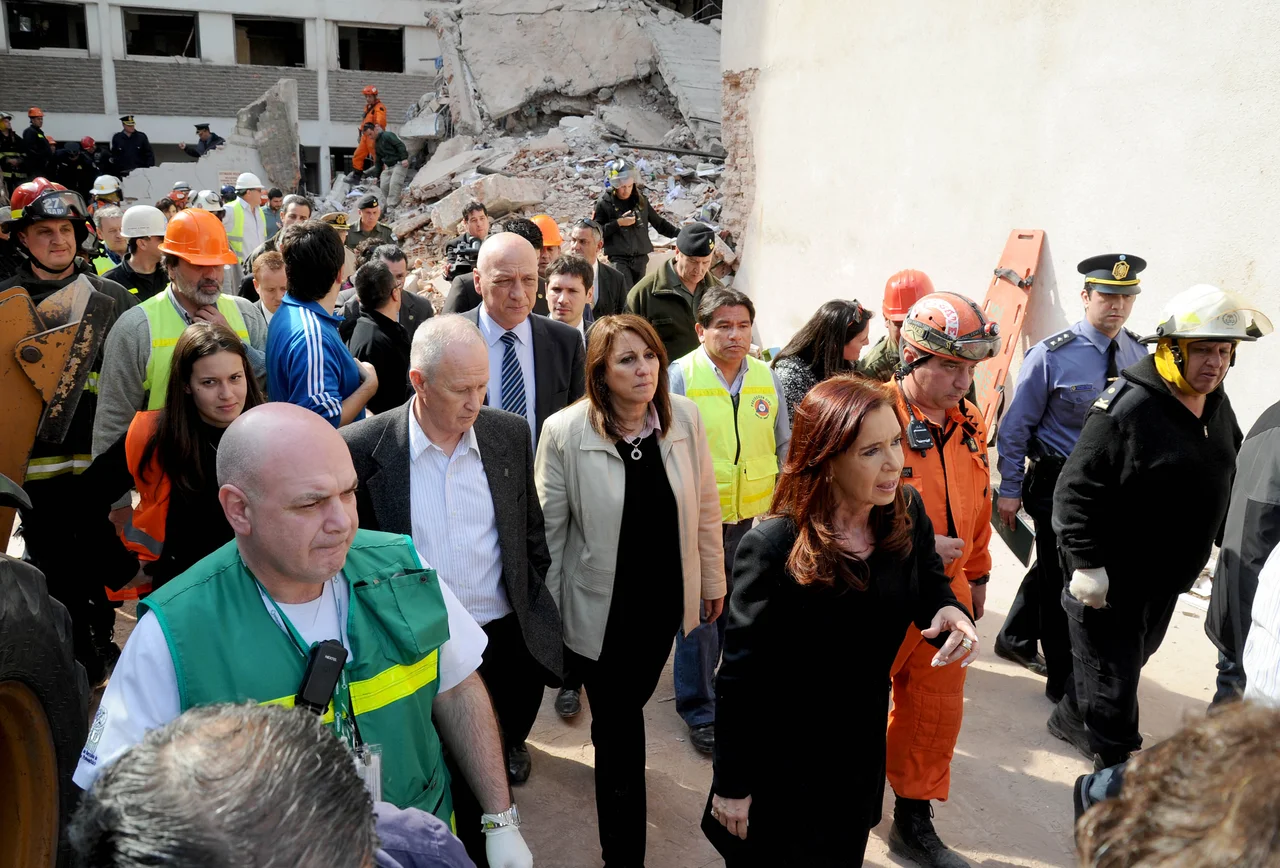

2013 Rosario Gas Explosion
The neighbors smelled it first. For hours that morning, the sharp scent of gas hung over the corner of Salta and Oroño Streets in central Rosario, and people called to report it. Then, at 9:30 on a Tuesday, August 6, 2013, the leak found a spark. The blast tore through a building, and a nine-story apartment block next door folded in on itself, collapsing into rubble with families still inside. Twenty-two people died. Sixty more were injured. The address, Salta 2141, became a word every Rosarino learned to say softly.
An Ordinary Tuesday
There was nothing remarkable about the morning. Children were at school or being readied for it. Workers had left for their jobs; others were still home. The collapsed apartment block was an ordinary place where ordinary lives were underway: people making coffee, getting dressed, planning the week. The dead were not statistics but neighbors. Among them was a 65-year-old woman who survived the initial blast and her injuries for two months before dying on October 8, the last of the twenty-two to be counted. For a week, rescuers, including volunteer firefighters drawn from across the region, dug through concrete and twisted steel, pulling some survivors from the debris and recovering others who had not made it. Families waited at the edge of the rubble for word, holding photographs, naming the missing to anyone who would listen. The search ended on August 13. Beyond the dead, more than two hundred homes were left damaged or destroyed, and hundreds of people who had simply lived nearby found their apartments uninhabitable overnight.
The Calls That Went Unanswered
What made the loss harder to bear was the sense that it could have been stopped. Residents told reporters they had smelled gas hours before the explosion and had phoned Litoral Gas, the city's gas provider. The company insisted it had received no such calls, suggesting people may have dialed the police instead. A prosecutor later testified that the building had suffered repeated gas leaks before that day. A gasfitter, Carlos Osvaldo García, had been doing maintenance work in the building that morning. According to witnesses, one worker fled in a van once he grasped how serious the leak had become, while another stayed behind, trying to get people out of the danger zone before the corner erupted.
A City That Closed Ranks
Rosario's grief turned, almost at once, into action. The national government declared two days of mourning, and political campaigns then underway for an imminent election were suspended out of respect. Pope Francis, himself an Argentine, sent a letter of condolence to the city's archbishop, read aloud during a procession for Saint Cajetan in the Plaza 25 de Mayo. The city's two great rival football clubs, Newell's Old Boys and Rosario Central, set aside the fiercest derby in Argentine football to play a charity match for the victims. Rosario-born Lionel Messi lent his support through his foundation. Musicians gave benefit concerts in cities across the country. A people known for their divisions, footballing and political alike, briefly became one.
Twenty-Two Names
Salta Street was closed. Engineers condemned the two buildings still standing at the site, and out of respect, the demolition was carried out without explosives. For years the corner stood as a wound in the city's fabric. Then Rosario chose to make it a place of memory rather than absence. On the eleventh anniversary, in 2024, a memorial opened on the site, a cultural and educational space where the names of all twenty-two victims are inscribed beneath an opening to the sky. Above a still pool of water, a half-star with eleven points is reflected into twenty-two traces of light, one for each life lost. The city also gathered the stories of the dead into a documentary it called Twenty-Two Open Books. A book closed too soon is still a book that was being written. Rosario decided to keep reading them aloud.
From the Air
The site of the disaster sits at the corner of Salta and Oroño Streets in central Rosario, Santa Fe Province, at roughly 32.94°S, 60.65°W, just inland from the Paraná River waterfront. This is a dense urban grid, not a landmark visible from altitude, and it is best understood on the ground as a place of remembrance rather than spectacle. The nearest airport is Rosario – Islas Malvinas International Airport (ICAO: SAAR, IATA: ROS), about 13 km west-northwest of the city center; Buenos Aires lies roughly 300 km to the southeast. Flag any approach over central Rosario with the respect the site deserves.
Nearby Stories
- Battle of Cepeda (1859) 19 km away
- Battle of the Tonelero Pass 24 km away
- Abadía del Niño Dios 45 km away
- Ramallo Massacre 60 km away
- Sa Pereira Rail Disaster 126 km away
- San José Palace 152 km away
- Battle of Quebracho Herrado 185 km away
- The Pampas 212 km away