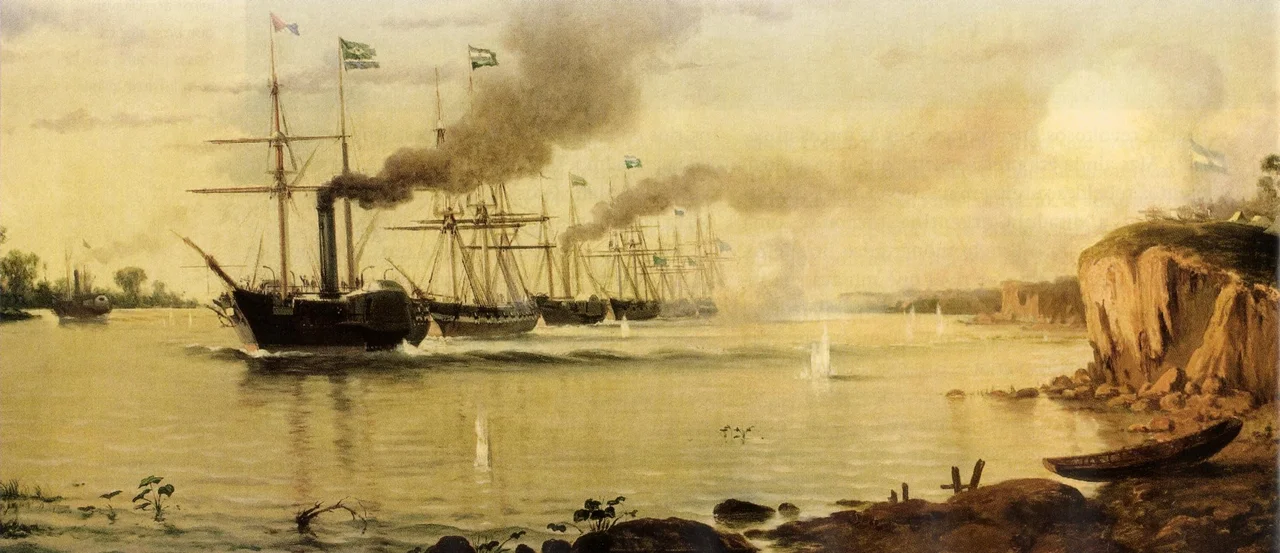

Battle of the Tonelero Pass
On the flagship steaming up the Parana that December morning stood two men who would each, one day, govern Argentina: Bartolome Mitre and Domingo Faustino Sarmiento. They were exiles, riding a Brazilian squadron commanded by a British-born admiral, bound for a war against the strongman who ruled their country. Above them, on the cliff of Acevedo, waited the same general who had chained this river six years earlier. The Battle of the Tonelero Pass, fought on 17 December 1851, was a single hour of thunder over the water - and a hinge in Argentine history.
The River Always Mattered
By 1851 the Parana had become, once again, the road to power. Juan Manuel de Rosas still dominated Buenos Aires and the Argentine Confederation, but his old ally Justo Jose de Urquiza, the powerful governor of Entre Rios, had turned against him, and Brazil had joined the coalition forming to bring him down - the conflict history calls the Platine War. To strike inland, the alliance had to move troops up the river, past whatever defenses Rosas could mount. The same narrows and bluffs that had stopped the British and French six years earlier would now be tested by the Brazilian Imperial Navy. The Parana was not merely a route to the battlefield. It was the battlefield, and control of its passes decided who could carry an army into the heart of the country.
Grenfell's Squadron
Eight Brazilian warships approached the cliff of Acevedo, near the Tonelero pass on the river's west bank. Four were steam corvettes - the Dom Pedro, Dom Pedro II, Dom Afonso, and Recife - and they towed two sailing corvettes and a brig against the current. The fleet was commanded by John Pascoe Grenfell, an English-born officer who had made his career in the Brazilian navy. His flagship, the Dom Afonso, carried a remarkable passenger list: the Brazilian general Marques de Sousa, and three Argentines fighting to free their homeland - Colonel Wenceslao Paunero, and Lieutenant-Colonels Bartolome Mitre and Domingo Faustino Sarmiento, both future presidents of Argentina.
An Hour of Iron
Holding the heights was Lucio Norberto Mansilla, brother-in-law of Rosas and the architect of the famous chain defense at Obligado. He had sixteen guns and some two thousand men. For one hour the Argentine batteries threw more than 450 rounds at the passing ships. The fire killed four sailors and wounded five, but did little to stop the steamers - though some accounts insist the artillery battered the warships far harder than the official tally admits. The ships answered back across the brown water, killing eight of Mansilla's men and wounding twenty. Then the squadron simply pushed past, ran the gauntlet, and continued upstream to land its troops at Diamante in Entre Rios.
The General Who Walked Away
What happened next was almost stranger than the battle. Mansilla, convinced the Brazilian division meant to land directly on his position, withdrew - leaving his artillery and equipment behind on the cliff. The defense that might have bled the invasion dissolved without a final stand. The campaign rolled on, and within weeks it reached its conclusion: at the Battle of Caseros in February 1852, Urquiza's coalition crushed Rosas and ended his long rule. Rosas fled to exile in England, never to return, and died there decades later. The men who had ridden up the Parana past Tonelero went on to shape the modern Argentine state. Mitre would become the first president of a unified republic, and Sarmiento, the schoolteacher-turned-statesman, would follow him into the presidency and become one of the country's most celebrated reformers. The hour of iron over Tonelero had carried them toward the rest of their lives.
From the Air
The Tonelero pass lies near the cliff of Acevedo on the west bank of the Parana, at roughly 33.43 S, 60.06 W, in northern Buenos Aires Province just below San Nicolas. From the air, the western bluffs along the river mark the old battery ground, with the Parana's islands spread to the east. The closest major field is Rosario - Islas Malvinas International (ICAO SAAR), about 70 km up the river to the northwest; the small San Nicolas airfield (SA31) sits a short distance to the south. Buenos Aires - Aeroparque (SABE) and Ezeiza (SAEZ) - lies roughly 215 km to the southeast. Clear autumn or winter mornings, viewed from 2,500 to 4,000 feet, show the bluff line and river channel to best effect.
Nearby Stories
- Battle of Cepeda (1859) 16 km away
- Atucha Nuclear Power Plant 31 km away
- Battle of El Espinillo 33 km away
- San Antonio de Areco 71 km away
- National Flag Memorial 71 km away
- Gualeguaychú 87 km away
- Uruguay River Pulp Mill Dispute 104 km away
- Los Toldos 148 km away